


 30 / 210

[
] 28
A
dvancing
S
ocial
I
ntegration
and
I
ntergenerational
S
olidarity
put stress on a committed relationship and these difficul-
ties need to be addressed. Alongside these issues is the
equally serious problem that stems from a lack of under-
standing of how to handle the very natural occurrence of
conflict in relationships. Not having the skills to manage
one’s negative emotions can lead to abusive behaviour or
distancing, both of which destroy the hope of secure, stable
belonging and attachment. Understanding and accepting
how different another’s perception is from yours can make
negotiating conflicts possible. Where do we learn how to
deal with the conflicts in relationships? It is ideally from
watching our parents’ relationship, later asserting our
perspective in negotiations with our parents and siblings,
and then in our own committed relationships as adults –
hopefully we learn.
Although many families deviate from the ideal, this is
not evidence of the family’s lack of importance. On the
contrary, it is within the family that the solutions may be
found. If we give up on the family, we ignore the basic
human need for stability, belonging and attachment that
every person possesses. If we remain too busy doing our
jobs and building our careers to pay much attention to the
family, society will pay the price.
We become ‘most human’ in our relationships with other
people, and it is in relationships that we reach the highest
human capacity to love and thus learn to refrain from treat-
ing others inhumanely. At the core of the injustices that we
commit against others is a basic lack of love and security.
Could it be that the human heart will always be aching for
the haven of the family? It is only when we take the family
seriously as the unique resource of love, guidance, principles,
compassion and genuine human connection that we may start
to address a root cause of human weakness. Fortunately, we
live in an era where women’s value and unique qualities are
being recognized more than ever before. Thus we are uniquely
positioned to benefit from a society in which men and women
in intimate relationships respect each other as equal human
beings while honouring different capacities, gifts, traits and
needs. The best time to look to the family as the unique
resource it is, is now.
Parents shape the human capital of each community and
nation, negatively or positively. No government programme
or social policy has this ability. Instead the role of govern-
ment is to support parents and afford the family every
protection it needs to raise conscientious citizens. This is
in the best interest of governments, as they will bear the
burden of poor parenting.
Good parenting is subject to a myriad of differing
opinions, but in general, parents who have established
a relationship of mutual respect, compassion, honest
communication and shared virtues with their children
are far more likely to maintain a positive relationship
through all phases of life. Solidly connected grandparents
can contribute their experience, wisdom and support for
their adult children’s parenting of the next generation.
Confronted with economic challenges, many parents rely
on their own parents to provide childcare so that they may
go to work. For the most part, grandparents who share a
healthy bond with their children become a natural source
of love, stability, values and care for the third generation if
living in close proximity. Although there is quality child-
care available, often it is least available to the poor and the
care can lack the same sense of responsibility that a loving
grandparent can provide. Also, when the three generations
are well connected, they may combine resources in living
together, or the grandparents may try to give financial
support for the young or struggling family, decreasing the
stress of raising a family.
In the same way, in a mutually respectful, caring parent-
child relationship, the adult children become willing and
loving caregivers for their ageing parents. With the popu-
lation decline in developed nations, many economies are
faced with fewer young workers providing the tax base for
the large number of ageing adults leaving the workforce.
In addition, many ask whether there will be enough people
to provide care for the elderly as this trend increases.
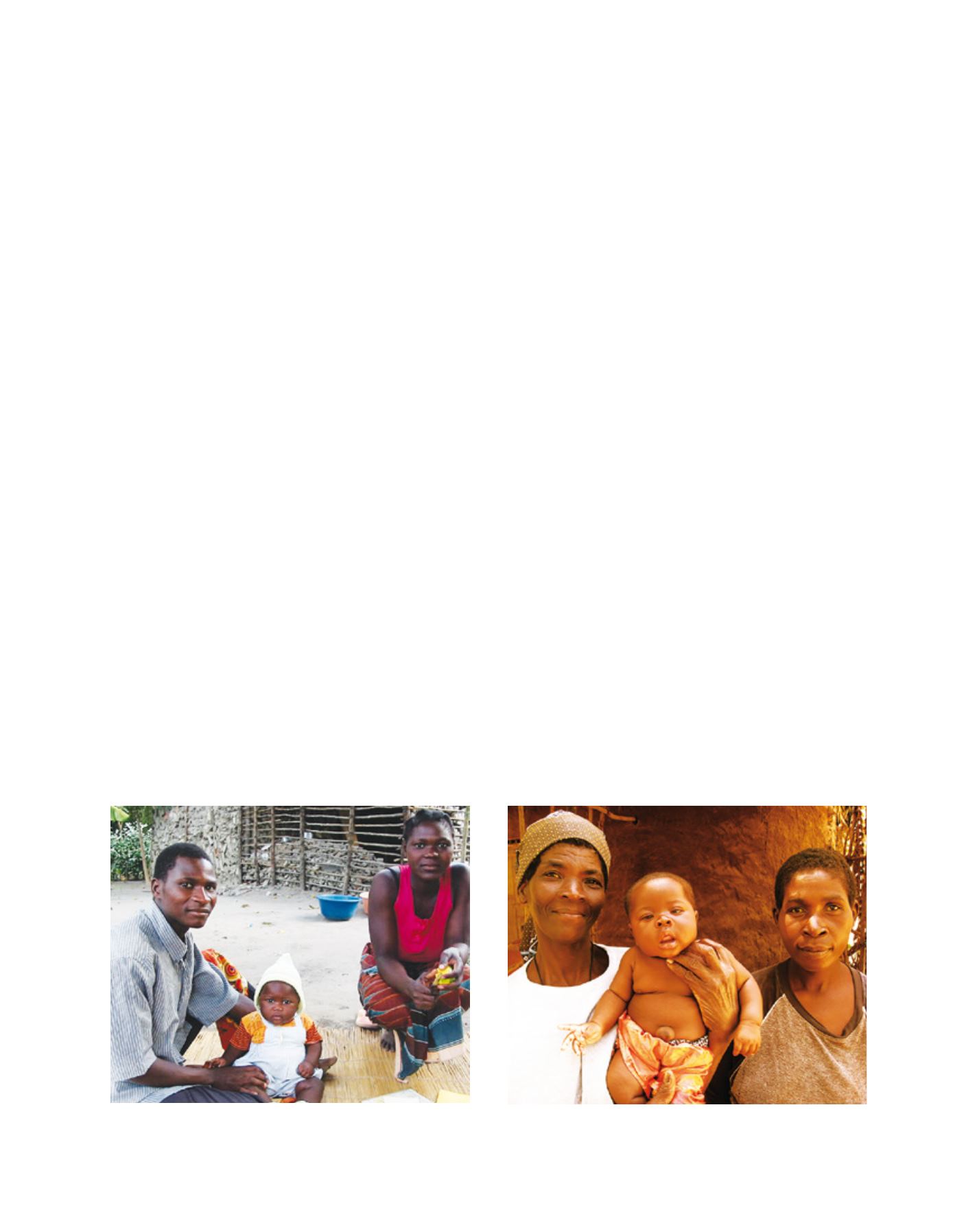
Strong intergenerational relations help each member of the family to develop
into a responsible, caring human being
Grandparents who share a healthy bond with their children can become a
natural source of love, stability, values and care for the third generation
Image: www.careforlife.org
Image: www.careforlife.org