


 32 / 210

[
] 30
Informal support in family life: a hidden gem
for young people, community and society
Professor Pat Dolan, UNESCO Chair, and Director, UNESCO Child
and Family Research Centre, National University of Ireland, Galway
A
dvancing
S
ocial
I
ntegration
and
I
ntergenerational
S
olidarity
P
articipation in family life is a central part of the
normative growing up process for young people
and applies universally, regardless of cultural or
geographical contexts. For centuries, the informal support
provided within family membership across the life course
process has been vital to human sustenance. Even in
contexts of severe adversity, whether man-made crises such
as abject poverty or environmental disasters such as floods
and earthquakes, family support to young people has been
central to their survival, resilience and development.
It is important to highlight and revisit the importance of
informal support and family functioning for young people
in the overlooked context of their everyday living environ-
ment of home, school and community. Additionally, young
people must be recognized as positive civic actors, who benefit
society in the present as well as the future in connection with
their past experiences of giving and receiving social support.
Regardless of the formation of family, kin relationships
including nuclear and extended family are the most typical
and likely source of help. Whether in times of sudden
crisis or in the context of daily living, informal support
from nuclear and extended family is key for many people.
This applies across cultures and continents and over the
life course from womb to tomb. From new parents coping
with their newborn child to adult children caring for their
ageing parents, the vital role of social support from other
family members, friends, community allies and profession-
als is well established.
This is not to say that all families support their members.
As has been well established, particularly in recent years in
relation to children and older people, family members can
be the source of stress and harm. This cannot be denied or
overlooked, but thankfully in the vast majority of commu-
nities across the globe family relationships are key to our
survival. It is also noteworthy that even where children,
youth or vulnerable adults experience maltreatment from
a family member, in many cases other, more loving and
caring family members as well as others, seek to help and
are able to compensate.
1
The social support provided to young people, particularly
from their family, includes instrumental and emotional
help. This is essential, and has been described as the bread
and butter of relationships. Informal support from respon-
sive family members to young people occurs not only in
times of crisis, when it is likely to be noticed, but also in
the processes of daily living through mundane supportive
acts that can perhaps be taken for granted. Young people
also provide support to their family as well as receiving
help. In fact, regular reciprocal support exchanges between
young people and parents is often provided automatically,
to the extent that it may only really be recognized when it
ceases to exist.
For young people, the social support they receive from
within their nuclear and extended family, school and
community has been summarized (for the purpose of
convenience) as ‘tea and cards’.
2
‘Tea’ relates to the types
of help required by young people: tangible (practical help),
emotional (empathy when upset) and advisory (assistance in
making a decision). ‘Cards’ relates to the quality of support
or the ways help is provided, such as closeness (warmth),
admonishment (constructive challenging), reciprocity
(exchange of supportive acts), durability (dependability)
and subtlety (sensitivity).
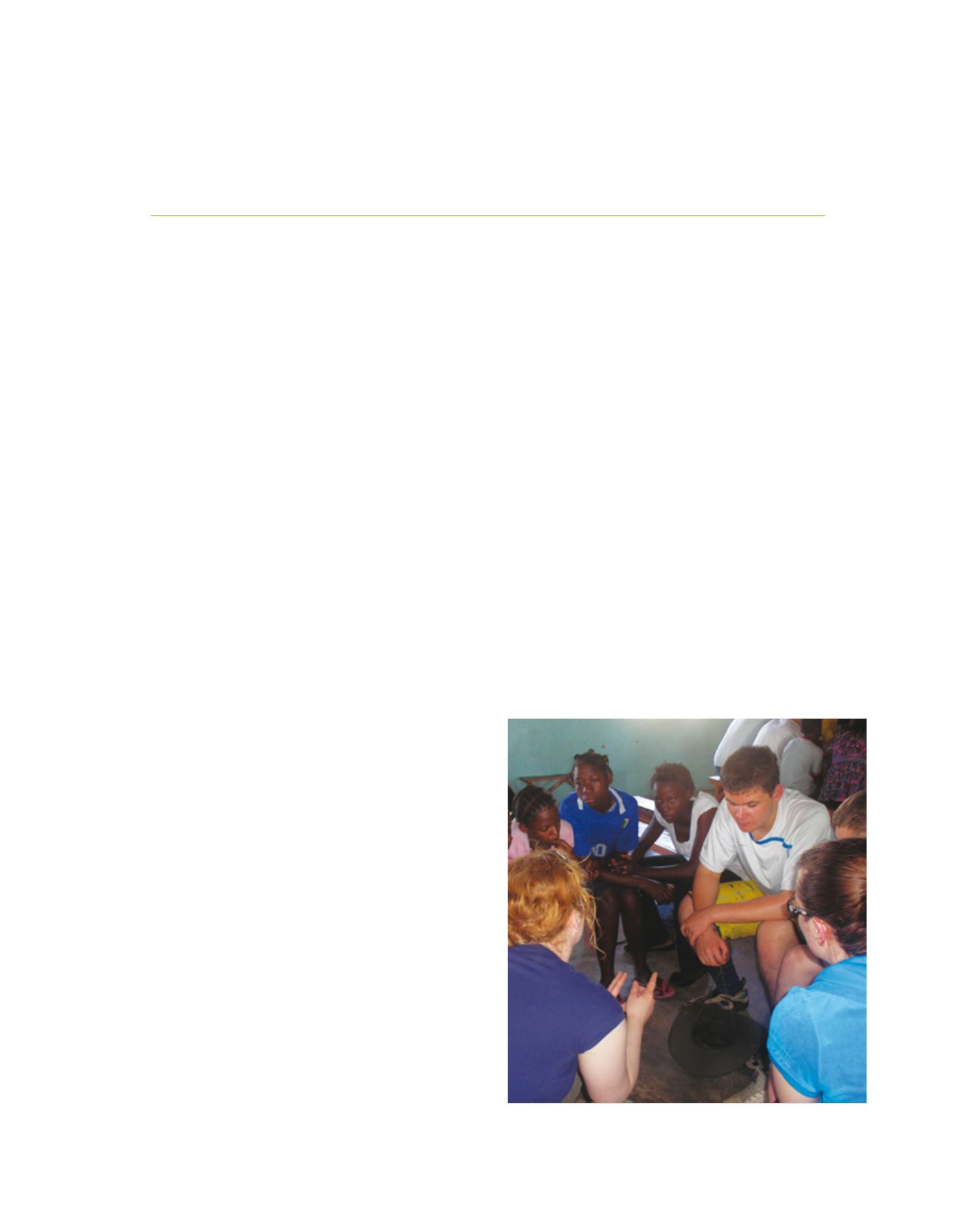
Young people’s participation through civic action is associated with a range of
specific personal benefits, many developed as part of their internal processing
Image: Foróige, Ireland/Alan Kerins Projects