


 42 / 210

[
] 40
A
dvancing
S
ocial
I
ntegration
and
I
ntergenerational
S
olidarity
for Development, the League of Arab States, civil society and
academicians. The aim of the meeting was to discuss the
regional AIDS response in the Arab world within the broader
development agenda, particularly MDGs, and to understand
how family is the key to reaching the goals.
The ‘Impact of Violence Against Women on the Family’
colloquium was organized in collaboration with Qatar’s
Supreme Council for Family Affairs and the United Nations. It
was attended by prestigious personalities including the United
Nations Assistant Secretary-General on Gender Violence,
the Special Adviser on Gender Issues and Advancement
of Women, the Under Secretary-General of the United
Nations, the Executive Secretary of the Economic and Social
Commission for Western Asia, the Special Rapporteur on
Violence Against Women, the Chairperson of the Human
Rights Committee, and the past Chairperson of the Committee
on the Elimination of Discrimination Against Women. The
colloquium also hosted experts in the field from around the
world. It was organized as a contribution to the campaign
of the United Nations Secretary-General to end violence
against women. Recommendations from the colloquium were
included in the Secretary-General’s special report on gender-
based violence, which was presented to the General Assembly
in October 2009.
The ‘Empowerment of Women in Arab Countries’ collo-
quium, organized in collaboration with the Office of the
Special Adviser on Gender Issues and Advancement of
Women at the United Nations, aimed to provide United
Nations member states with expert opinions and recommen-
dations regarding policies to empower women in the political,
economic and social fields. Twenty experts from different
parts of the world explored the empowerment of women in
multiple contexts, addressed challenges and achievements,
and provided recommendations to all stakeholders in order
to make policy responses more effective.
DIFI has also worked with United Nations agencies to learn
more about issues of population, decent work and poverty,
and held several conferences related to the International Year
of the Family. Working with the primary United Nations agen-
cies involved with population and ageing issues (the United
Nations Population Fund, the United Nations Parliamentary
Assembly and UNDESA) and Northwestern University, DIFI
held the ‘Family Support Networks and Population Ageing’
colloquium. The colloquium report was disseminated during
the Commission on Social Development and the Commission
on Population.
DIFI worked with the International Labour Organization
and the International Training Centre to hold the ‘Forum on
Decent Work and Poverty Reduction’. This provided a plat-
form for the exchange of experiences and policy lessons from
different countries, including the Arab region, and helped to
consolidate the Decent Work approach in the region’s national
development strategies and plans. The event’s proceed-
ings were disseminated during the fiftieth session of the
Commission on Social Development at the United Nations.
Several conferences have been held by DIFI for the
International Year of the Family, both as a follow-up to
the tenth anniversary and in preparation for the twentieth
anniversary. DIFI worked with UNDESA and the United
Nations Focal Point on the Family to hold the ‘Family
Policy in a Changing World: Promoting Social Protection
and Intergenerational Solidarity’ EGM. Recommendations of
the meeting were included in the United Nations Secretary-
General’s report on the follow-up to the tenth anniversary of
the International Year of the Family, which was presented to
member states.
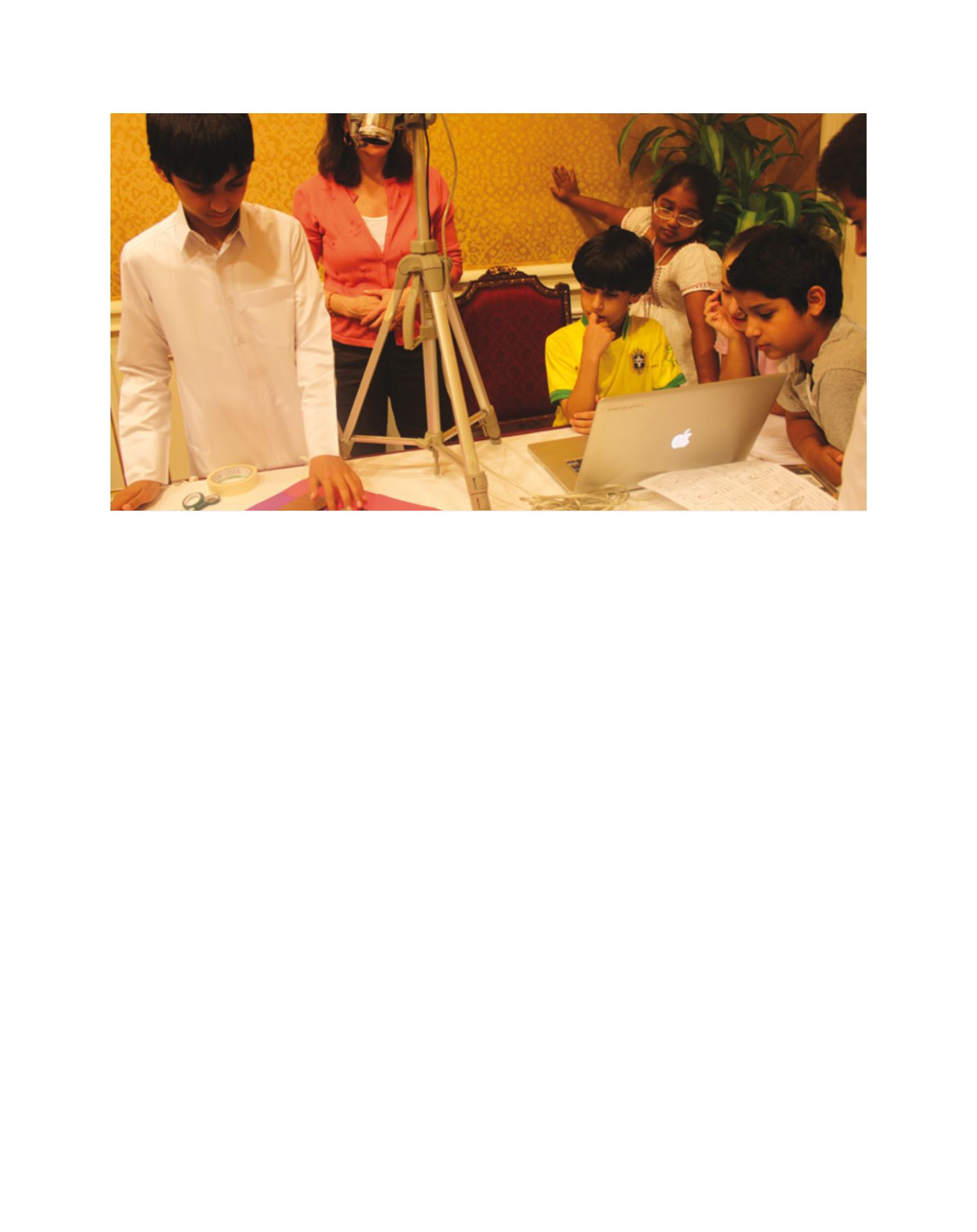
Children participating in an animation workshop, a side event of the Family and the Arab Media conference
Image: DIFI