

 74 / 192

[
] 74
cyclones, which often come without sufficient warning and are the
cause of thousands of fatalities at sea every year. The BOBP-IGO has
prepared jingles and snippets in the Bangla language on safety at sea
to be broadcast through Bangladesh Betar.
Comic books as a medium of education
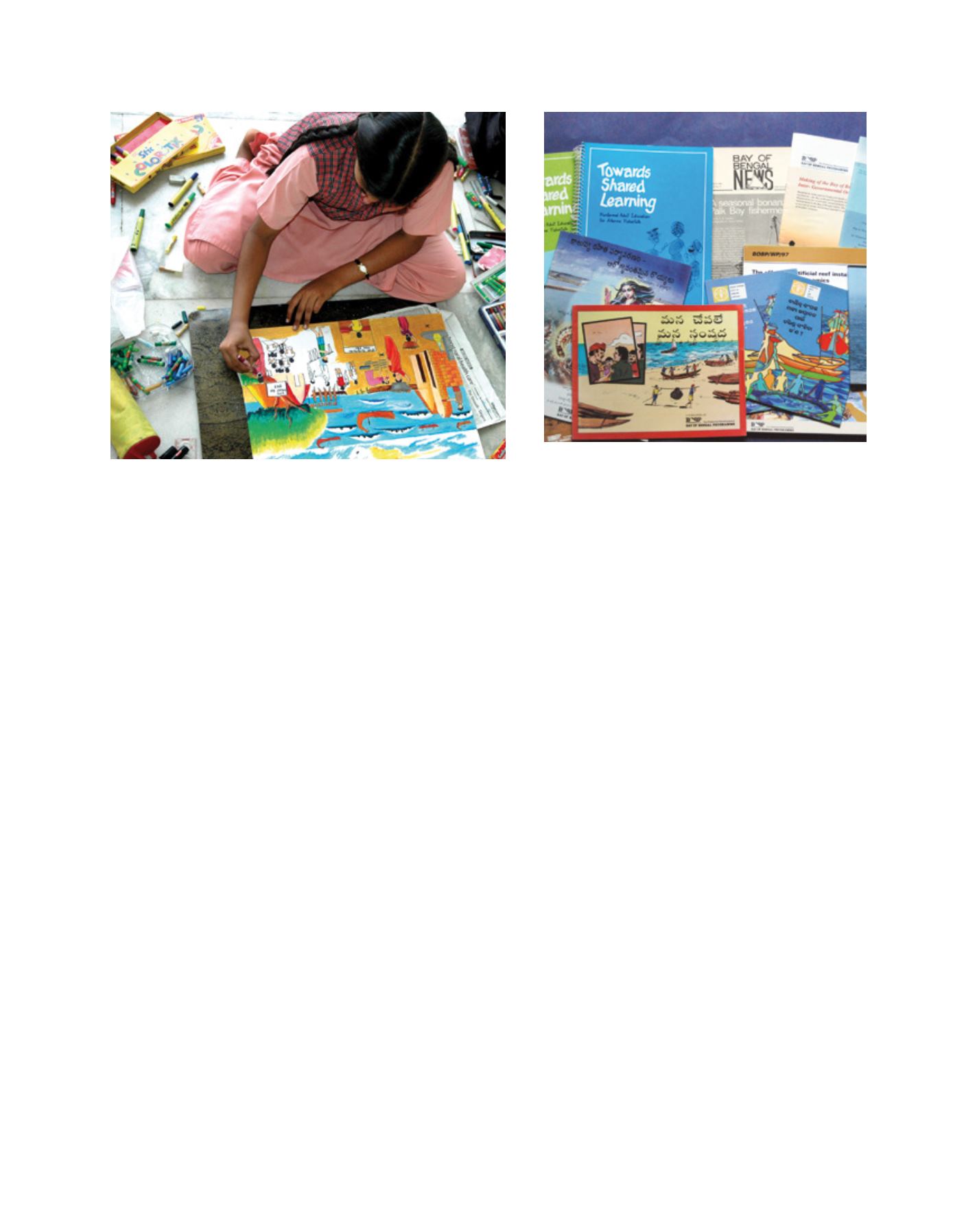
Of the several communication tools that the BOBP tried, the comic
book format was one of the most successful. Its first comic book,
Our
fish, our wealth
, cut across the barriers of sex and age and became
highly popular. Published in 1992, the comic book promoted aware-
ness of the mechanisms of fisheries management among small-scale
fishers. Subsequently, comic books were also produced on the
subjects of cleaner fishing harbours and good practices in shrimp
farming, becoming instant hits.
Other communications tools, such as puppetry, folk theatre, street
plays and video films, have been successfully used by the BOBP
and the BOBP-IGO. The BOBP used video technology for training
and information dissemination as early as 1985. Several video films
prepared by the Programme are popular within and outside the region.
Catch ’em young
As sustainability implies that future resource users must be trained
to take responsibility, the BOBP and later the BOBP-IGO undertook
many programmes and activities aimed at fisher children. It was also
considered important to make children aware, as early as possible,
of the value of protecting the natural environment. In Maldives,
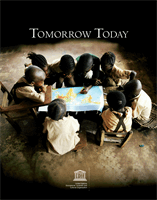
a colouring/work book titled
Life on our reefs
was published for
primary schoolchildren on the islands. The main purpose of this
book was to encourage the children to:
• Critically examine their natural environment
• Learn about the impact of humans on the coral reefs
• Consider what could be done to help safeguard the future of
coral reefs.
After the December 2004 Asian tsunami, which devastated the fisheries
sector in India, Maldives and Sri Lanka, the BOBP-IGO in December
2005 organized a painting competition for school chil-
dren in the affected countries, with the objective of
sensitizing the children to such natural calamities. The
2006 annual calendar of the BOBP-IGO featured some
of the best paintings from the three countries. Several
organizations partnered with the BOBP-IGO in this
initiative. In 2009, a poster on cetaceans of the tropical
Indian Ocean, printed by the BOBP-IGO, was distributed
to all the schools in Maldives to create awareness among
school children of the importance of cetaceans in ocean
life. The poster was prepared in response to a request
made by the Vice-President of Maldives.
Training women as link workers
Fisherwomen play a pivotal role in sustaining and
developing the family. It has been observed that
income earned by women is more likely to be spent
on food and other basic needs than income earned by
men. Consequently, it is recognized that an increase in
women’s income is more likely to improve family status
than increased household income per se.
The BOBP implemented a project on activating fisher-
women for development through trained link workers
in Tamil Nadu, India. The project aimed at providing
fisherwomen with the required basic education and
training to enable them to serve as links between village
women and government officers. Several link workers
were trained and worked for many years in their villages
and surrounding areas. Women’s self-help groups have
been established in many fisher villages in Tamil Nadu
thanks to these link workers.
Taking the Code to the grassroots
The Code of Conduct for Responsible Fisheries, or
simply the Code,
11
is one of the best examples of collec-
tive effort in global fisheries. Signed by the members of
Colouring books help schoolchildren to critically examine their natural environments
Disseminating knowledge – a sample of the publications of the Bay of
Bengal Programme
Image: S Jayaraj, BOBP-IGO
Image: S Jayaraj, BOBP-IGO