

 78 / 192

[
] 78
full-time education in an initiative that seeks quality in the
teaching-learning process and student retention
•
The planetary
: engaging in a high-level debate, so as to be able
to address global environmental change through sustainable
societies. Thus, the Third National Conference received 70
international observers from 43 countries, in preparation for the
International Children and Youth Conference, ‘Let’s Take Care
of the Planet’.
The Third National Conference involved the topic ‘Global environ-
mental changes: think and act in the school and in the community’.
Quality didactic materials were distributed to all secondary teach-
ing networks in the country (58,000 schools) with the objective
of contributing to improving school performance based on the
results of the Basic Education Development Index, encouraging
the inclusion of sustainability and the socio-environmental chal-
lenge in the school Political-Pedagogical Plan, and strengthening
the role of the school in constructing public education and envi-
ronmental policies. The material provided tools for navigating
environmental issues and inter-disciplinarity in the classroom,
while respecting the complexity of the subject by not over-simpli-
fying. Socio-environmental changes beyond climate change are
treated systematically and integrated into the sciences, history,
geography and languages.
The topics involved the four elements – earth, water, fire and
air – in discussion of contemporary problems affecting people
and natural systems throughout the planet. Each topic included
debate on sustainable actions for mitigative, adaptive, preventive
and transformative measures. The material proposed changes to
the world-view to protect values that improve quality of life and
rethink human responsibilities for the present and future of life on
earth. Although the material relates to the Brazilian environmen-
tal contexts and policies, several countries asked for English and
Spanish translations.
1
Following the Education and the Environment
Ministers’ formal invitation to all countries, the prepar-
atory year began with each country defining, adapting
and adjusting the process to its own contexts. 62 coun-
tries from all continents responded positively to the
Brazilian invitation, 52 of which constituted a National
Organizational Committee to coordinate school
processes and a National Conference, and delegations
from 47 countries participated at the international event
in June 2010. The mobilization of the Brazilian initiative
in this preparatory phase can be illustrated by some data
provided by 40 of the participating countries, which
directly involved 87,258 schools and 13,153,229 chil-
dren. In India alone, 80,000 schools and nine million
children participated!
The International Conference, a five-day intensive
event, involved 600 young students aged 12 to 15 years
from 47 countries (38 per cent from the Americas, 24
per cent from Asia/Pacific, 21 per cent from Africa and
17 per cent from Europe), who were elected by other
youth in their countries, maintaining a relatively equal
representation between gender, delegates from rural
and urban areas, capital regions and other cities, public
and private schools, and delegates from ethnically
diverse and varied cultural backgrounds. The youth
gathered to debate a subject that affects all humanity:
global socio-environmental changes with a focus on
climate change. Together they constructed the Charter
of Responsibilities, ‘Let’s Take Care of the Planet’, with
actions aimed at sustainability.
The event was organized as a community where
everyone is a learner, realizing the role of youth
as social actors capable of intervening now. The
International Conference had three dimensions: ‘youth
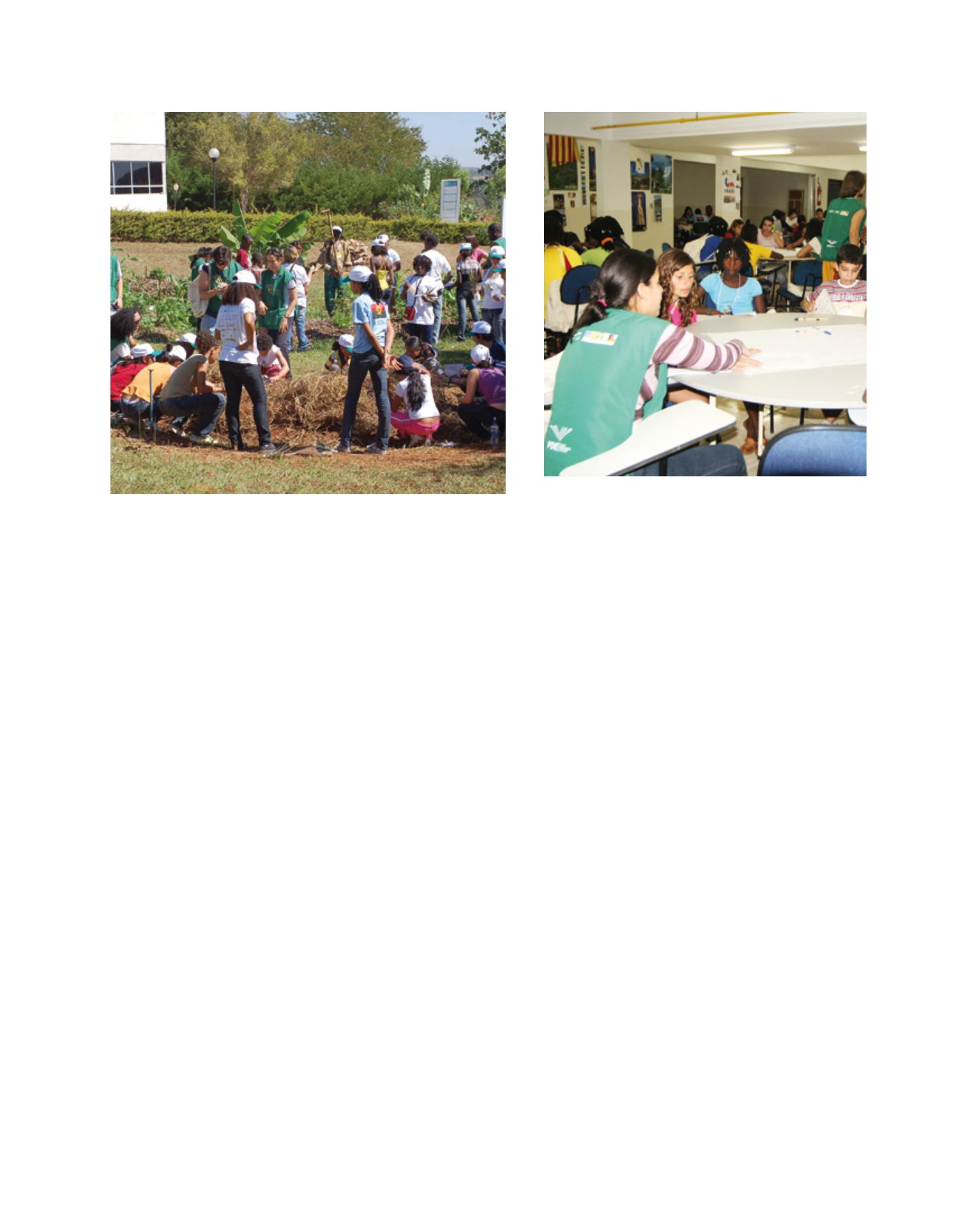
Hands on in agroecology, planting with nature
Continental groups: discuss responsibilities at the ‘Let’s Take Care
of the Planet conference’
Image: Ministry of Education, Brazil
Image: Ministry of Education, Brazil