



 180 / 288

[
] 181
T
ransport
and
I
nfrastructure
Service benefits
During the construction of the Qinghai-Tibet railway
various permafrost-protective measures have been taken
to increase the stability of frozen road bases, accord-
ing to climate models and statistical projection results
and in reference to the experience and lessons of other
countries in the high latitudes. In operation, based on the
relevant climate information, the Qinghai-Tibet Railway
Corporation prepares flood-prevention resources in flood-
prone regions, with timely management of freezing or
melting events in winter. These measures guarantee the
safe running of trains, and play important roles in disaster
prevention and mitigation.
The Three Gorges project
The Three Gorges project spans the Yangtze River by the
town of Sandouping, which is located in Xiling Gorge,
Yichang, Hubei Province. The drainage area controlled
by the Three Gorges project is about one million square
km. Its total reservoir capacity is 39.3 billion cubic metres,
which can reduce the peak flow by around 27,000-33,000
cubic metres per second when handled properly. In order
to ensure its safe operation, local climate monitoring,
assessment and projection services are needed.
Local climate monitoring
TheNational Climate Center (NCC), ChinaMeteorological
Administration (CMA) have initiated special climate
observations in the Three Gorges area since 1996. This
has been fully formed as a climate monitoring net between
easily affected by engineering processes and climate change, and this
can produce thaw settlement. In addition, mountain torrents and debris
flow in summer, snow storms and ice cover in spring and winter, low
temperature, frost and sand storms all have adverse impacts on normal
railway transport.
Intensive climate monitoring
The linear structure of the railway means that a natural disaster
affecting part of the line will affect its overall operations. In order to
provide better climate services for the Qinghai-Tibet railway, on the
basis of the full application of existing meteorological data, 2009 saw
the addition of 21 new observation stations to monitor precipitation
and air temperature along the Xining-Golmud line and 16 obser-
vation stations to monitor the ground temperature for permafrost
between Golmud and Lhasa.
The permafrost environment along the Qinghai-Tibet railway is
extremely sensitive to climate change. In order to provide climate infor-
mation regarding the impacts of long-term climate change (30-50 years
in the future), future climate change on the Qinghai-Tibet plateau and
along the Qinghai-Tibet railway was projected using results from global
and regional climate models. Related climate change information was
also issued, including the annual mean temperature, the highest and
lowest temperature, and the highest summer temperature as well as the
lowest winter temperature over the Qinghai-Tibet plateau and along the
Qinghai-Tibet railway.
Landslides, debris flow and other events resulting from intensive
or continuous rainfall along the Qinghai-Tibet railway during flood
seasons (June-September) may cause transport failure. In response
to this, a tailored rainfall forecast is conducted along the railway.
Special forecast information on important weather processes is issued
one or two days in advance if moderate or above-normal rain occurs
during the flooding season. In response to the frost heave phenom-
enon happening along the north section of the Xining-Golmud line
around Qinghai Lake in winter (late November to January of the
following year), soil freezing and melting indexes were developed
with the use of observational permafrost data around the Qinghai
Lake to monitor and assess permafrost change. Monitoring informa-
tion on changes in permafrost depth is also issued. Relevant climate
information and products are issued by national and provincial
special websites, light-emitting diode electronic displays, mobile
short messages, special information reports and so on.
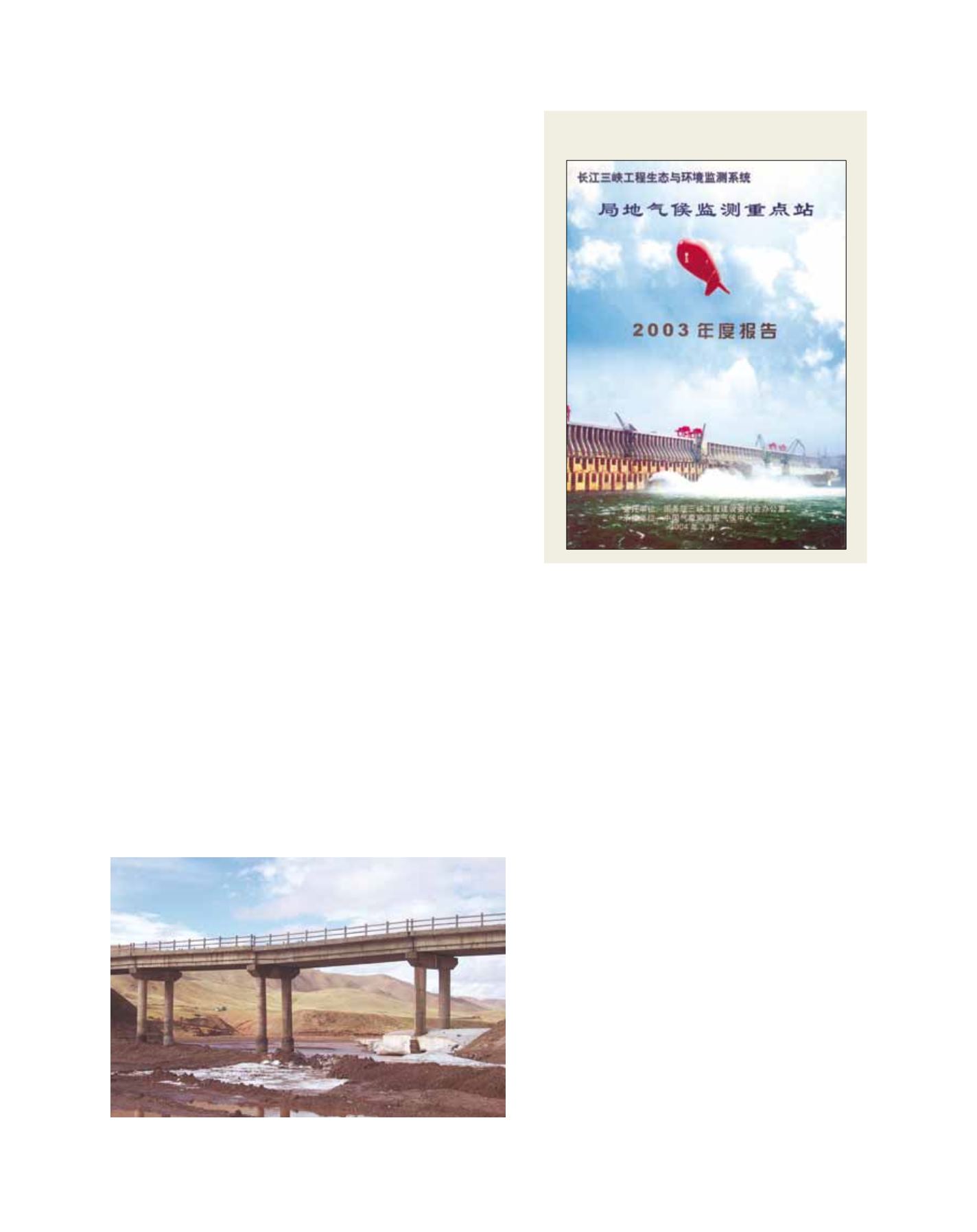
The
Annual Report on Climate Monitoring of
the Three Gorges Reservoir Area
Source: CMA
Image: Qinghai Meteorological Bureau
The Qinghai-Tibet railway crosses the permafrost area