


 143 / 287

[
] 144
O
bserving
, P
redicting
and
P
rOjecting
c
limate
c
OnditiOns
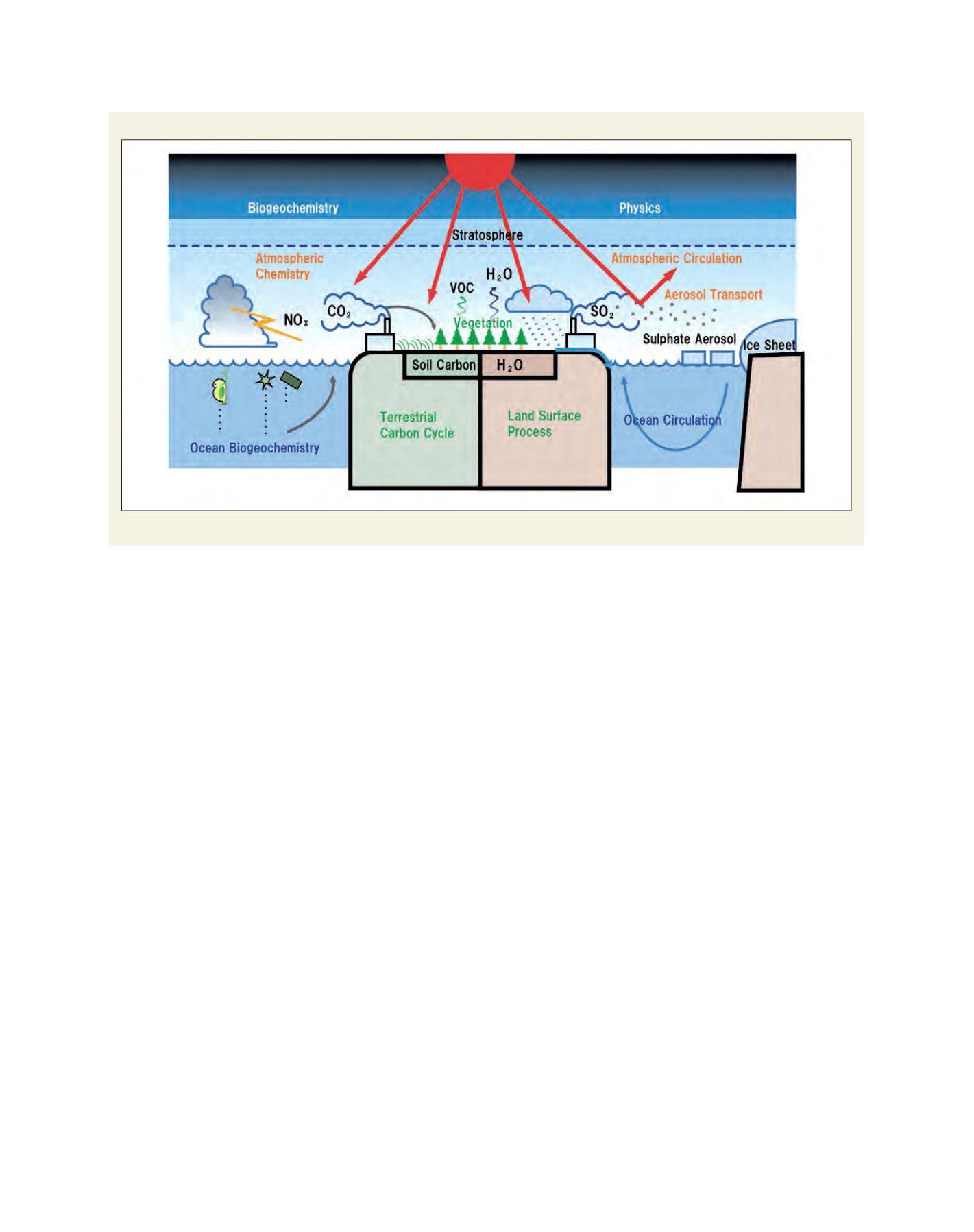
A good example is the structure and results of MIROC-
ESM, the GCM-based ESM developed by Japan Agency
for Marine-earth Science and Technology (JAMSTEC),
under collaboration with Center for Climate System
Research, University of Tokyo, and National Institute
for Environmental Studies.
The target resolution for the model development is
280 kilometres with 80 vertical levels for the atmos-
phere and 50-140 kilometres (spatially variable) with
44 levels for the ocean. The resolution is rather coarse,
particularly considering the fact that JAMSTEC runs
the Earth Simulator, once the world’s fastest computer
and still one of the fastest available for earth scientists.
Coupling many components with a GCM is itself a chal-
lenging task for model developers. Furthermore, some
of the component modules are quite expensive in terms
of computer resources. Plunging into a high-resolution
ESM from the start is not a wise choice. A unique aspect
of MIROC-ESM is its sophisticated treatment of the
stratosphere, leading to reproduction of self-sustained
Quasi-Biennial Oscillation and realistic distributions of
chemical particles such as ozone.
MIROC-ESMwas involved in a coordinated experiment
under C4MIP, in which interactions between climate and
carbon cycle were examined. Results showed that, when
interactions are taken into account, the estimated CO
2
concentration for 2100 has to be elevated by 120ppm
compared to the case where no interactions are consid-
ered. The mainmechanisms are enhancement of microbial
degradation of soil carbon, and lower uptake of excess CO
2
by oceans due to lower solubility of CO
2
, both of which
In order to fill the gap between conceptual models and GCMs,
earth system models with intermediate complexity (EMICs) are
now being vigorously developed. EMICs greatly simplify equations
of motion for the atmosphere and ocean and radiation processes,
retaining the minimal ability to reproduce realistic properties such
as geographical temperature distribution and deep water formation.
EMICs require fewer computer resources, and can be integrated
without supercomputers.
Using the advantage of computational efficiency, EMICs have
often been applied to paleoclimate studies, in which model integra-
tion of tens of thousands of years is common. Embedding vegetation
dynamics and carbon cycle processes in EMICs is an active field.
Indeed, four EMICs with the carbon cycle made a significant contri-
bution to the IPCC Fourth Assessment Report (AR4) by participating
in the Coupled Climate Carbon Cycle Model Intercomparison
Project (C4MIP) together with seven GCMs. EMICs are also suit-
able for tackling problems addressed in the coming Paleo Carbon
Modelling Intercomparison Project.
General circulation models
EMICs constitute, with carefully designed experiments, an impor-
tant element for future projection and interpretation of past events
with timescales longer than a few hundred years. However, they
have the same drawback of a high degree of abstraction as pointed
out for conceptual models, although to a lesser extent. It is desirable
to make a parallel use of GCM-based earth system models (ESMs)
and EMICs in a complementary manner within the allowance
of computer resources. Many of the institutes involved in global
warming projection are developing elaborate ESMs by coupling
biogeochemical modules (vegetation dynamics, carbon cycle and
others) with GCMs.
Components in MIROC-ESM, a GCM-based earth system model
Increasingly elaborate earth systemmodels are being developed for global warming projection by coupling biogeochemical modules with general circulation models
Source: JAMSTEC