


 87 / 287

[
] 88
G
overnance
and
P
olicy
climate change research areas, from variability studies to regional
modelling. This has resulted in a significant increase in the number
of research groups dedicated to climate change, as well as of related
articles and publications in international reviews and magazines.
This commission was replaced in 2001 by the larger National
Council on Climate, which includes representatives from the
autonomous regions, the Spanish Federation of Municipalities and
Provinces, the Federación Española de Municipios y Provincias,
universities, social agents and non-governmental organizations.
Spain has carried forward a focus on climate change to its
national research and development plan for 2008-2011, includ-
ing topics on observation, adaptation and mitigation. Of specific
importance is research exploring the development of energy from
renewable sources that have potential in the Mediterranean region
– especially since water resources will become increasingly scarce
in the area, as will the energy derived from such sources. These
efforts represent an experience that could easily be transferred to
other countries (especially Mediterranean ones) through coopera-
tion programmes.
One Spanish research effort of particular interest at regional and
global levels is the continued survey of the background composition
of the atmosphere. This activity is overseen by Spain’s meteorol-
ogy agency Agencia Estatal de Meteorología (AEMET). To this end,
AEMET has a Global Atmosphere Watch station located at the Izaña
Atmospheric Research Center on the Island of Tenerife. At this loca-
tion it measures parameters including concentration of greenhouse
gases, aerosols and ozone. AEMET also has 13 stations measuring
background air quality distributed all over the nation – as well
as another group of stations located in three national parks – that
monitor ongoing environmental, social and economic changes result-
ing from climate change.
Because of its vulnerability to climate change, identifying
potential adaptation strategies is of significant interest to Spain.
In addition, this insight and experience can be shared
with the entire Mediterranean area, which shares
similar climatological and socioeconomic conditions
and thus has similar vulnerabilities. In line with
keeping climate change a priority, in 2006 Spain estab-
lished The National Plan for Adaptation to climate
change (PNACC) with the goal of incorporating adap-
tation strategies into the planning and management of
natural ecosystems and economical activities depend-
ent on climate variability.
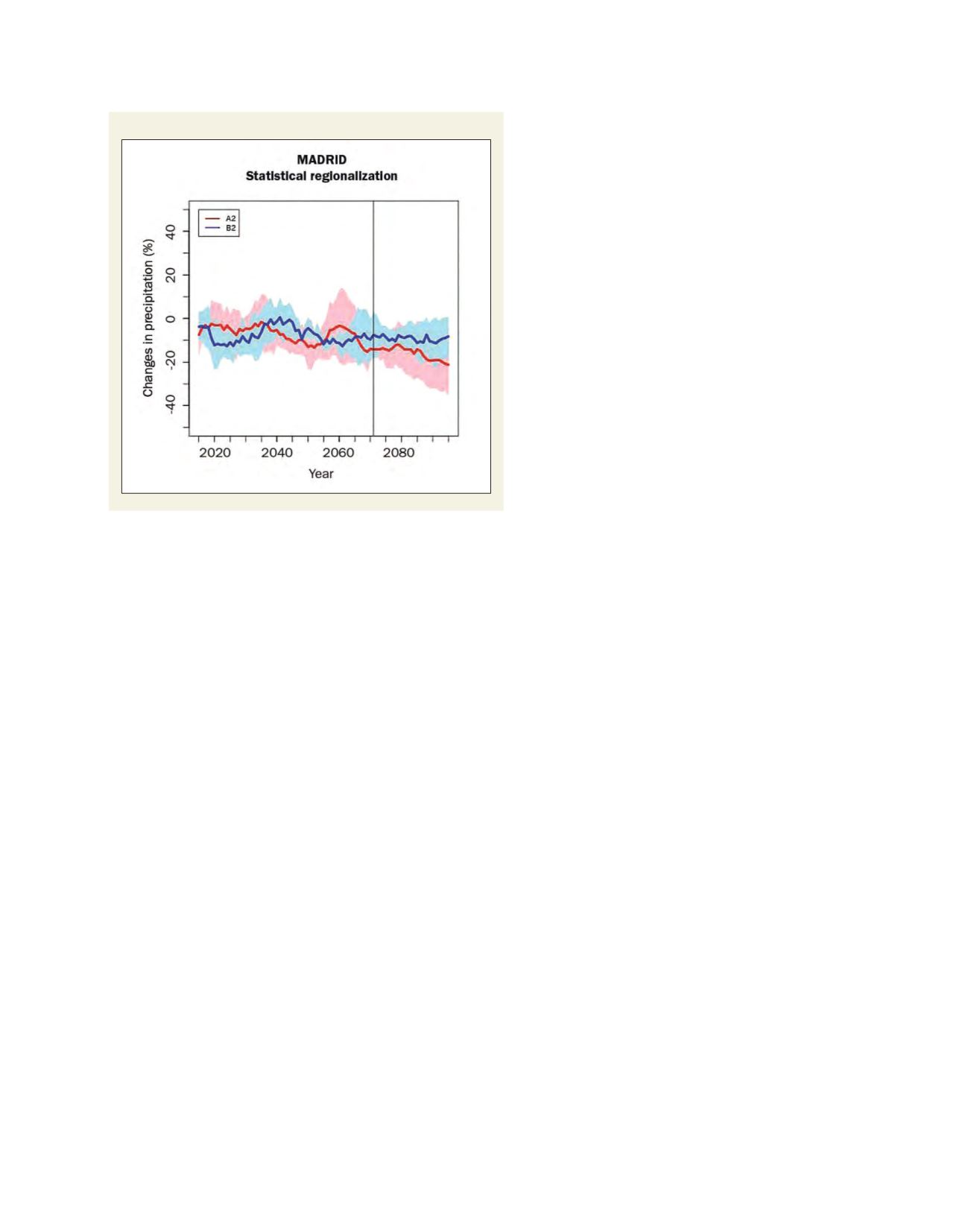
The PNACC set out to generate regionalized scenarios
for climate change in Spain with a further focus on eval-
uating its impact on water resources, coastal zones and
biodiversity. AEMET is responsible for generating region-
alized climate change scenarios at the Spanish level, and
as such, it has established a two-phase project. The first
phase has been finalized and will provide package projec-
tions for Spain and each of the autonomous regions up to
the end of the 21st century. These packages will be based
on information resulting from numerous Spanish research
projects, the third assessment report from the IPCC, and
from AEMET itself.
During the next four years the second phase will be
developed to generate new regionalized scenarios based
on global-level information used in the fourth assess-
ment report and using new regionalization models with
the support of national research groups working in the
field. The results of the three other priority actions
concerning the specific impacts of climate change will
be available in 2010.
Spain is clearly not lacking in the knowledge
required to improve the policies, plans, programmes
and projects relating to sustainable development and
the climate change challenge. Rather, it is lacking the
correct application of its knowledge assets, and in
doing so is failing to optimize its actions towards the
mitigation of and adaptation to climate change. This
is the real challenge for Spain.
2010 will be a key year for Spain, as it will assume
the Presidency of the EU just after the December 2009
Copenhagen Climate Summit – hopefully on time to
halt the increasing loss of biodiversity and put the UN
Commission for Sustainability on the right track.
2010 represents a good opportunity for Spain to
reinforce climate change and its related issues as an
EU priority. But it also gives it the chance to prove
its purpose to apply newly available knowledge on
climate change scenarios to policy making and plan-
ning – particularly with regards to economy and land
planning – as many ongoing national research projects
will have delivered results by then. Therefore, it will
be possible to demonstrate the proper application of
such knowledge by sharing it – particularly within
the Mediterranean area. This should be considered not
just as a responsibility, but also as an opportunity to
turn climate change into a ‘climax for change’. With its
vulnerability to climate change and expertise on energy
from renewable resources Spain should be considered a
leading country in this effort.
Regionalized scenarios for climate change
Source: AEMET