


 15 / 210

[
] 13
A
dvancing
S
ocial
I
ntegration
and
I
ntergenerational
S
olidarity
live in households headed by a grandparent or other relative.
Known as ‘grandfamilies’, these older caregivers provide an
incredible service to their families and their government by
reducing the burden on both. It’s estimated that grandfami-
lies save US taxpayers more than US$6.5 billion a year by
keeping children and youth out of the government-funded
foster care system. Children in grandfamilies can benefit
because relative caregivers are less likely to separate sisters
and brothers and provide a stronger connection to roots,
culture and heritage. Children in relative care report feeling
loved far more often than those in the care of a government
system. And while a young person may age out of a system
when they reach adulthood, they never age out of a family
that continues to care for them even as they transition.
Unfortunately, older relatives are rarely acknowledged in
family policies. It’s becoming impossible, though, to ignore
the pivotal role grandparents, grand aunts and uncles and
extended family members play in supporting healthy children
and protecting social cohesion. Fortunately, in recent years
we’ve witnessed some progress in family policymaking. In the
US, policymakers have begun to recognize that some older
adults are the receivers of care while others are the givers of
care. The National Family Caregiver Support Program, for
example, was originally proposed to fund services such as
respite, support groups and legal services for family members
supporting older relatives. Advocates intervened and success-
fully lobbied for the inclusion of older relatives caring for
children. Still, good family policymaking lags behind and
needs to change so that caregivers can do what they do best:
raise a healthy, productive next generation.
Thriving communities around the world mirror the
family compact of strong exchange and solidarity between
generations. Just like families, communities that support
intergenerational programmes (those that engage two or
more generations) play an important role in promoting inter-
generational cohesion. Dr Leng Leng Thang of Singapore
found that intergenerational programmes provide a platform
for developing positive relationships across generations and
also strengthen the quality of ties between family members.
Similarly, a study in Europe found that younger people
engaged in intergenerational programmes showed more inter-
est in the older members of their own families.
Intergenerational programmes vary around the world,
but they typically fall into four categories – young serving
old, old serving young, young and old serving together,
and intergenerational shared sites. Recording oral histo-
ries, teaching mobile phone use and delivering meals to
home-bound seniors are all examples of the young serving
the old. Older adults serve younger generations when they
tutor, mentor or pass on history and culture. Younger and
older teams can serve together when they assess needs in
their neighbourhoods and recommend solutions, work to
cultivate intergenerational community gardens or produce
music or theatre together. Intergenerational shared sites
can be adult and child day care offered under one roof,
a school and a senior centre built together, or providing
summer meals for low-income children in the dining room
of a nursing home.
Practices and approaches that bridge the gap between
different age groups save dollars while making sense. They
are a tribute to reciprocity. Studies conducted by Johns
Hopkins University and Washington University in St Louis,
US found that that older adults who participated in inter-
generational programmes took better care of themselves,
were healthier and less depressed, scored better on memory
tests and had larger social networks. Young people in the
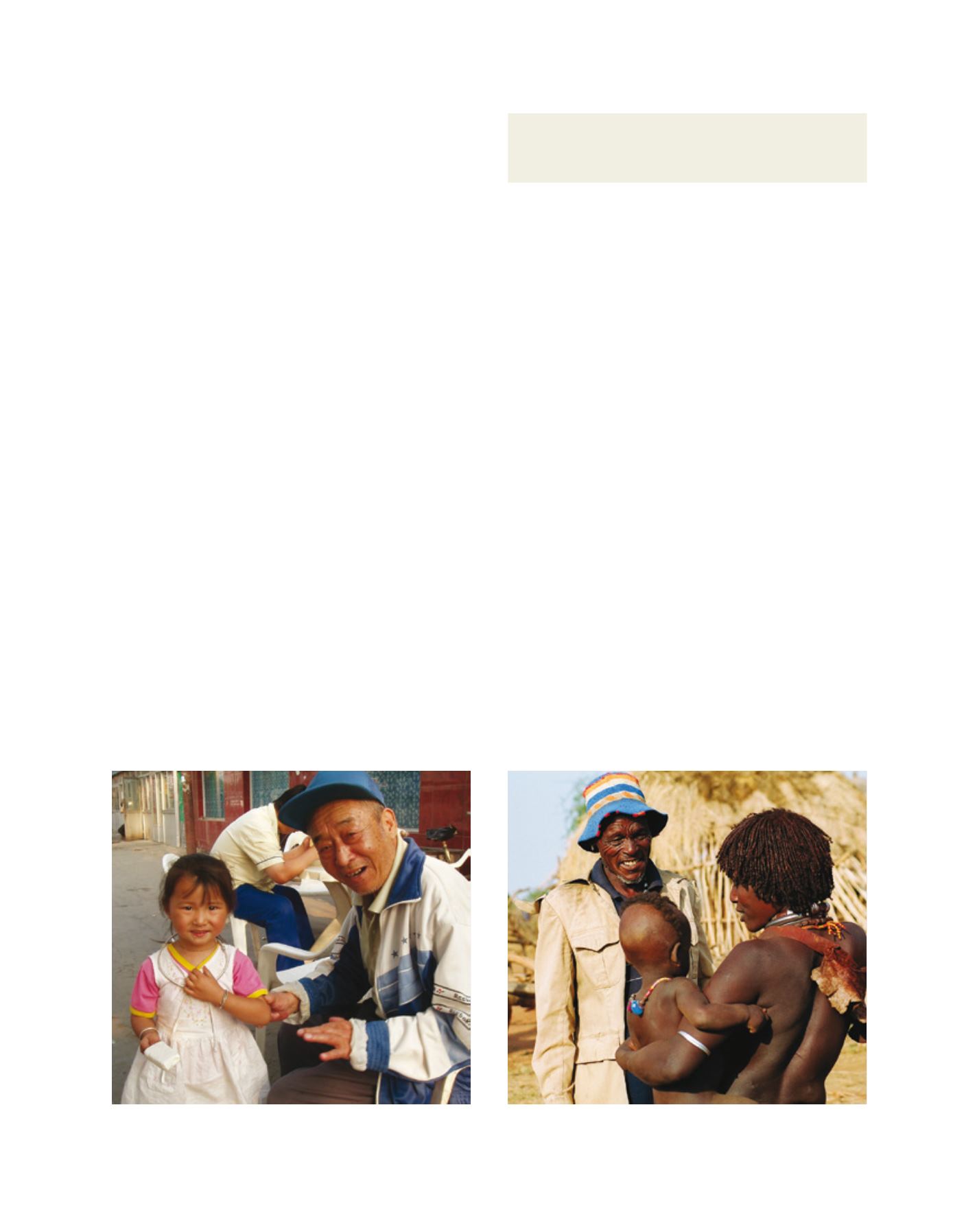
Older relatives play a pivotal role in supporting healthy children and
protecting social cohesion
Image: Generations United/Jeanette DeVore
The family is the natural and fundamental group unit of society and
is entitled to protection by society and the state.
– United Nations, 1948
Reliance on grandparents and other relatives to raise children has increased
dramatically around the world
Image: Generations United/Gabriella Kiss