


 16 / 210

[
] 14
A
dvancing
S
ocial
I
ntegration
and
I
ntergenerational
S
olidarity
against their own family members. This situation is similar
to what Singapore experienced following a law passed there
in 1995. It was modified in 2010 to focus more on a concilia-
tion-first approach which does more to strengthen the bonds
between generations of family members.
Countries can consider an all-generations approach to
developing family policies designed to reinforce social inte-
gration and intergenerational solidarity. Simple questions
such as whether all generations are being viewed as assets
can provide standards to evaluate whether a proposed policy
is family-friendly. Generations United, a US-based advocacy
organization, suggests four principles to judge policies by:
• make lifetime well-being for all the highest priority
• consider the impact of every action on each generation
• unite rather than divide the generations for the greatest
social and financial impact
• recognize and support every generation’s ability
to contribute to the well-being of their families
and communities.
As global populations and economies shift, supporting the
relationships between and among generations in families and
societies becomes even more important. Policymakers and
other leaders can support and strengthen families by using a
lens that values and engages all ages. We are, after all is said
and done, stronger together.
same programmes scored better on reading tests, had more
advanced social skills and were more accepting of people
who were different from themselves.
In economic terms, intergenerational engagement maxi-
mizes the use of the world’s growing human capital asset
– older adults. Every country needs its elders to continue
to contribute and advance the well-being of society. Using an
intergenerational lens or frame strengthens social cohesion
and ensures that this important asset isn’t left dormant.
Hubert Humphrey, a former Senator and Vice President of
the United States, once said that the moral test of government
is how that government treats those who are in the dawn of
life, the children; those who are in the twilight of life, the
elderly; and those who are in the shadows of life, the sick,
the needy and the handicapped. The social compact he was
describing strengthens the commitment between and among
generations. This compact, along with social insurance and
retirement schemes, is coming under pressure as our global
population ages. As countries grapple with changes, some
are turning from a compact to a contract, often supported
by punitive policies. For example, in 2007 India passed the
Maintenance and Welfare of Parents and Senior Citizens Act,
which punishes people found guilty of not providing care for
older family members. The punishment calls for imprison-
ment lasting up to three months or a fine of up to Rs5,000, or
both. Many parents, however, are hesitant to bring charges
Intergenerational approaches in Wales
In 2002 the Welsh Government undertook consultation with older
people across Wales to inform its national strategy for older people.
The most surprising outcome was the concern that older people
expressed for younger people and the belief that it was much harder
for young people now than when they themselves were young.
As a consequence, when the strategy was published in
2003 it contained a funded commitment to develop a national
intergenerational programme to be led by the Beth Johnson
Foundation. Since that time the Welsh Government has continued
to support the development of this work and intergenerational
approaches are embedded across the country.
Highlights have included a national working group on
grandparenting in 2006, the development of a national
intergenerational strategy in 2008 and the training of front-line staff
and volunteers across Wales. The importance of a coherent and
integrated approach now influences the way that policy is approached
and considered. The national action plan to address poverty and
young people takes an intergenerational approach, recognizing
that poverty is transmitted across the generations and needs a
whole community approach. The arts, community schools and the
environment have all become vehicles to develop the exchange of
skills and support to build better connected communities.
Building on its work of the last 10 years, Wales has now
expressed the ambition to become the first truly all-age friendly
nation in Europe. Linking to the work of the World Health
Organization, most authorities have already signed the Dublin
Declaration and a national action plan is being developed to
challenge inequality and disadvantage and ensure everyone
gets the best opportunity to age well as part of strong families
and communities.
“Our experience demonstrates that bringing our youth and older
people together is an essential foundation for a strong, vibrant and
cohesive nation that values all its members and creates a fairer and
more just society.”
– Alan Hatton-Yeo, Generations Together Cymru
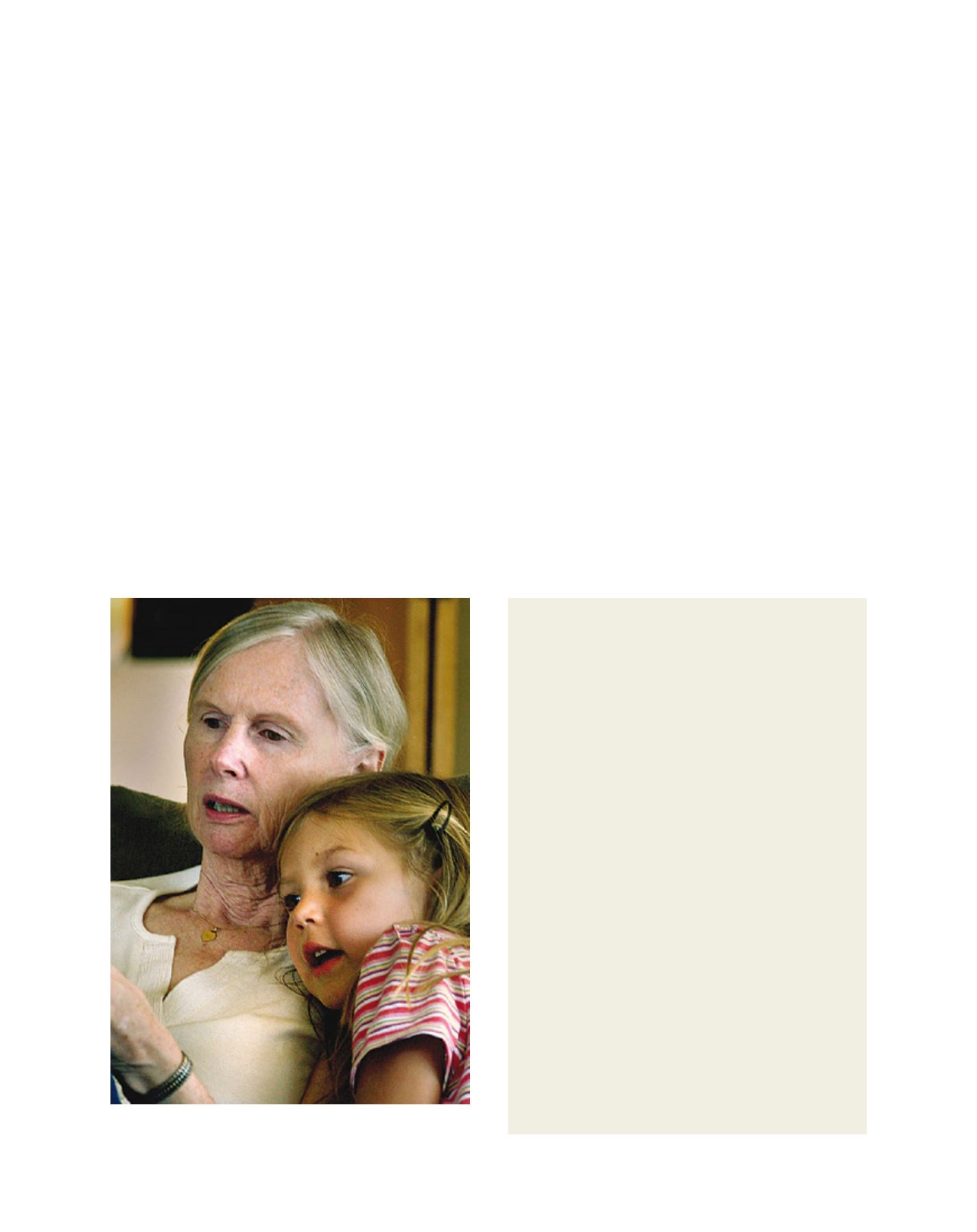
Every country needs its elders to continue to contribute and advance
the well-being of society
Image: Generations United/Richard Adler