


 20 / 210

[
] 18
Strong families building strong communities
Vivian Fernández de Torrijos, former First Lady of Panama and Special Adviser on Family Issues,
Inclusion International; and Diane Richler, Past President, Inclusion International
A
dvancing
S
ocial
I
ntegration
and
I
ntergenerational
S
olidarity
T
here are at least 1 billion people in the world who
have a disability. Of those, about one-third, or more
than 3 million people have an intellectual disabil-
ity. And all of those people are members of families – they
have mothers, fathers, sisters, brothers, aunts, uncles and
cousins. If we assume that each person who has an intel-
lectual disability has at least eight relatives, that means
that 2.5 billion people in the world are touched by intel-
lectual disability.
The nature of intellectual disabilities – difficulty learning,
remembering, problem-solving and often communicating –
means that people who have intellectual disabilities usually
require some degree of lifelong support. And most of that
support comes from their families.
Unfortunately, in most parts of the world, people with intel-
lectual disabilities are invisible. There is a lot of stigma and
misunderstanding about intellectual disability. People may
think that the person with a disability is a punishment for the
parents’ sins, or controlled by the devil. Families may worry
that having a brother or sister with an intellectual disability
will make it difficult for other children in the family to marry. A
father may blame the mother for having a child with a disability
and abandon the family.
A mother tells her story: “In Nepali society, disabled and
(intellectually disabled) individuals are often shunned. Few
people are aware of what (intellectual disability) is and see
the disorder as a handicap and something to stare at and be
ashamed of. I myself have a five-year-old son with (an intel-
lectual disability). The biggest lesson I have learned is that
the more you hide, the bigger the situation grows. I believe
that the parents should not isolate such children from the
fear of stigmatization; rather they should be treated as normal
members of society.”
Children with intellectual disabilities rarely go to school
in most of the world. Those that do are often in schools or
classes separate from the other children of their communities,
so that they remain strangers. People with intellectual disabili-
ties in all parts of the world are more subject to violence and
abuse, less likely to be employed, and generally poor.
People with intellectual disabilities usually require lifelong support,
most of which comes from their families
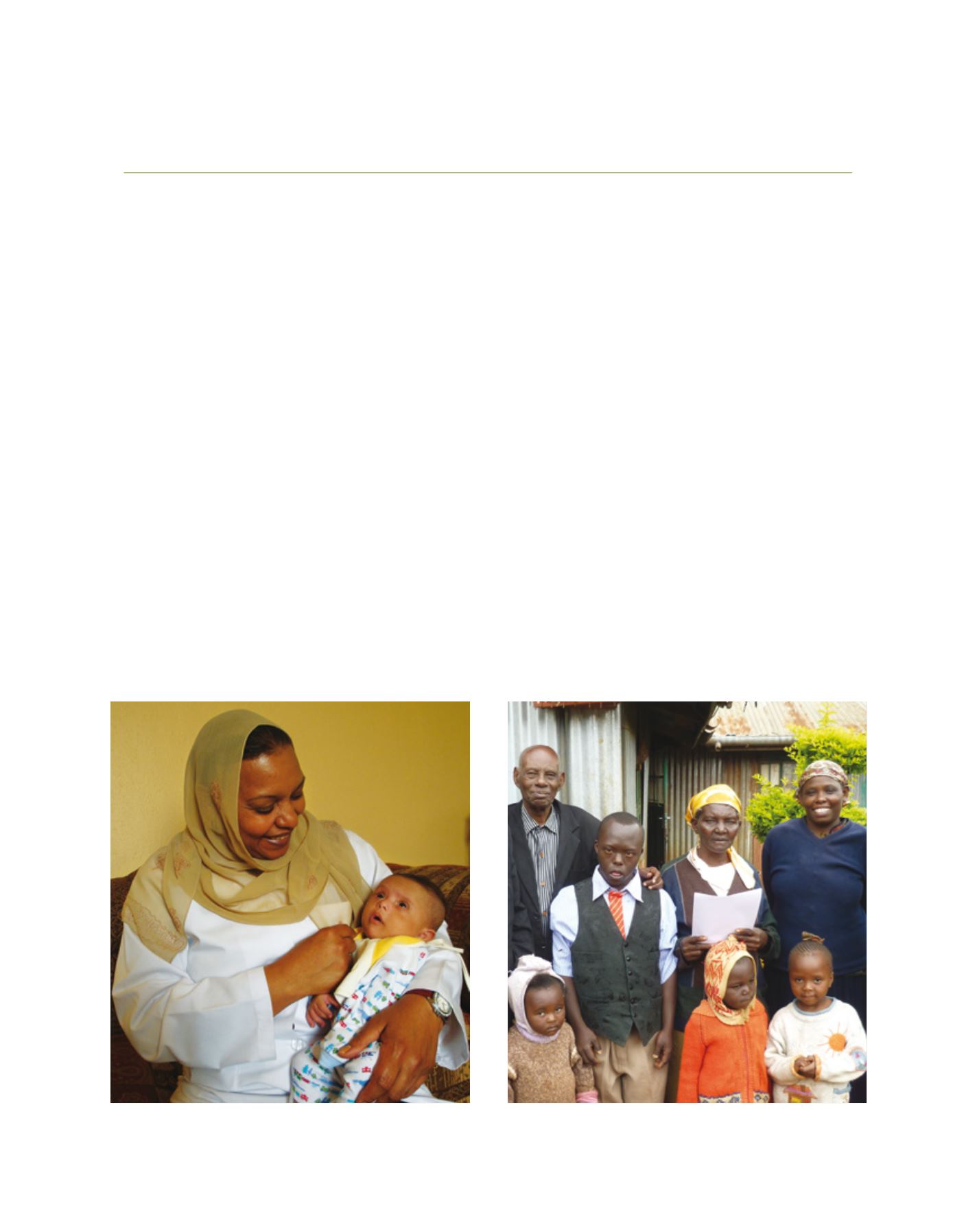
When communities are inclusive, everyone benefits: a weekly parents’ support
group meeting of the Kenyan Association of the Intellectually Handicapped
Image: Help Center
Image: Kenyan Association of the Intellectually Handicapped