


 23 / 210

[
] 21
Parenting around the world:
same task, same effort, different solutions
Marina Robben, President, International Federation for Family Development
A
dvancing
S
ocial
I
ntegration
and
I
ntergenerational
S
olidarity
T
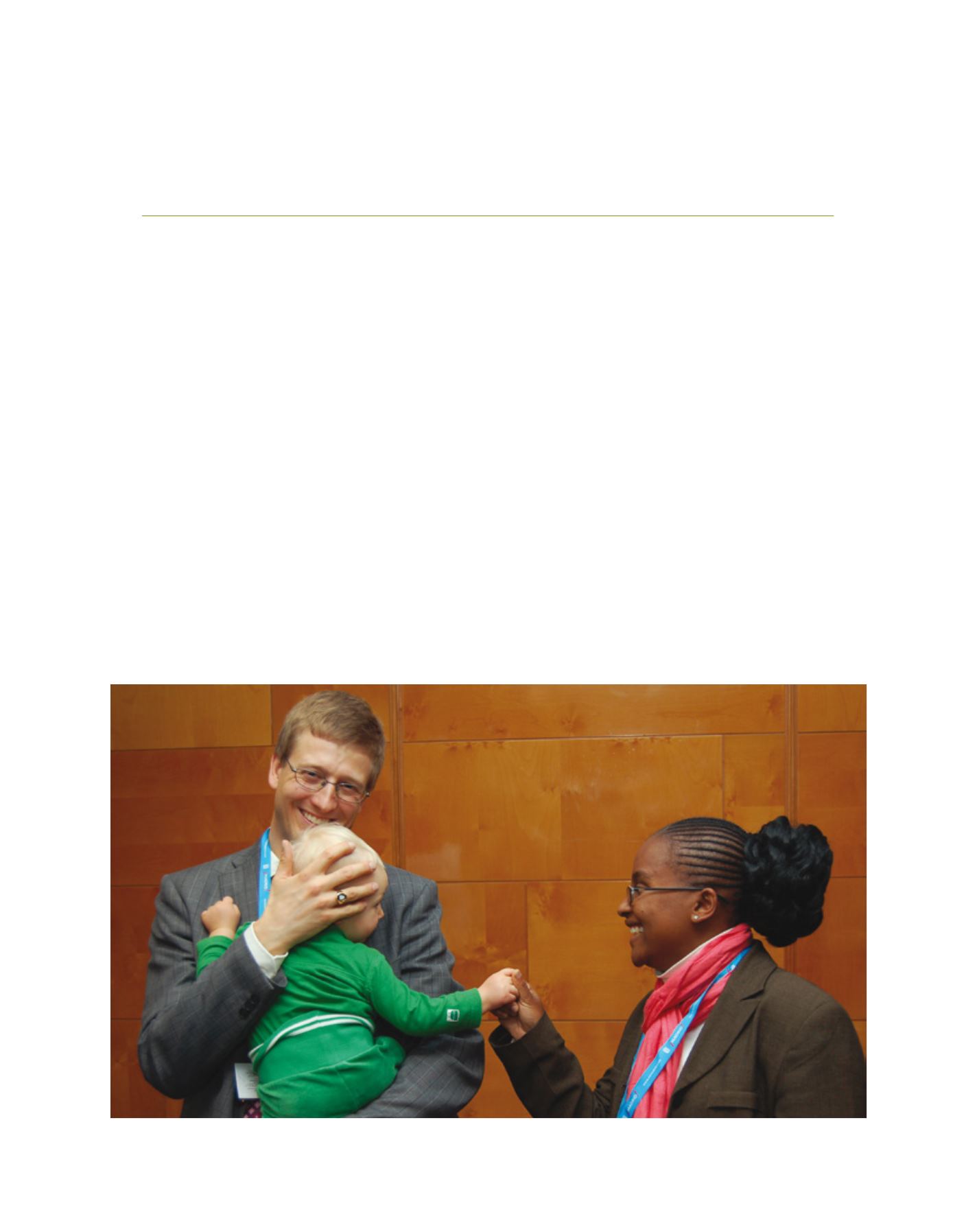
he picture on this page was taken during a meeting
of Family Enrichment leaders some years ago.
Michele had just arrived from Sweden with his
wife Joanna and his young son. Evelyn, from Kenya,
was surprised to see how blond the little boy was. She
approached the family and started smiling as the child
smiled too. It is a great image of how families from such
different backgrounds come together through Family
Enrichment courses, and demonstrates how much parents
have to share and learn from each other.
Back in the 1960s, a group of parents from Spain foresaw
that parents in coming decades would benefit from sharing
experiences. They felt that the best way to do this would not
be by organizing the usual sort of talks and speeches full of
preconceived ideas and ideal solutions. Instead, based on
the experience that some of them had working as profes-
sors in business schools, they designed the first Family
Enrichment programmes using the ‘case method’: a way
to promote open discussion about real situations without
imposing our own ideas or dismissing other people’s.
The famous Harvard Business School professor Chris
Christensen has described the case method as “the art of
managing uncertainty” – a process in which an expert
serves as “planner, host, moderator, devil’s advocate, fellow-
student and judge,” all in search of solutions to real-world
problems and challenges. These experts are not teachers,
but leaders, and in this way, their role perfectly matches the
meaning of the Latin verb ‘educare’: to lead forth. A good
discussion leader does not seek just to cover material in the
classroom, but instead to guide students towards the discov-
ery of critical insights and the uncovering of broader lessons
through thoughtful questioning, listening and responding.
That is why the leader must be well-prepared, both to cover
the content associated with each class session, and to guide
the participant-centred learning experience. The role of this
Michele from Sweden and Evelyn from Kenya show how families from different backgrounds can share experiences through Family Enrichment courses
Image: IFFD