



 21 / 210

[
] 19
Whether in rich countries or in poor ones, families bear
almost all the responsibility for supporting their disabled
members. The vast majority of people with intellectual
disabilities live at home with their families, with little or no
services or support from their communities or governments.
A mother from Bahrain said: “Of course, being a mom is not
just being a mom. You have to be the CEO, the treasurer, the
lawmaker, the good cop and bad cop, a friend, an adviser, a
sympathetic listener and much more. All this has to be done
on a 24/7, on-call service.”
But there are hopeful signs that the situation is changing. In
2006 the United Nations adopted the Convention on the Rights
of Persons with Disabilities (CRPD) which, as of February 2014,
had been ratified by 141 countries. The CRPD promotes the
rights and full inclusion of people with disabilities by rejecting
outmoded and negative stereotypes and recognizing them as
contributing citizens. The CRPD recognizes the rights of persons
with intellectual disabilities to receive the support they need to
exercise their rights. It also requires communities to remove
barriers to their participation and to promote their full inclu-
sion. The CRPD also recognizes that families have a role to play
in ensuring that persons with disabilities can exercise their rights,
and that they require assistance to support their family members.
Some countries have introduced policies to support families.
Panama has given grants to families of persons with intellec-
tual disabilities to help them start small businesses to reduce
family poverty. The United Kingdom has given support to
families to take short-term breaks. The Canadian tax system
compensates families for some of the additional costs of caring
for a child with a disability. Costa Rica includes a disability
targeted transfer as part of its family allowances. South Africa
has a means-tested programme that provides support to fami-
lies who have a child under the age of 18 with a disability.
Research has shown that families of children with intellectual
disabilities often experience a lot of stress. However, further
research has found that this stress is not caused by the disabil-
ity, but by a lack of support to the family, and by the persistent
exclusion of the person with a disability from ordinary commu-
nity activities. Families from the Middle East to Europe, from
Asia to Africa and throughout the Americas describe this
hurtful exclusion from school, from recreation, from religious
institutions and from extended family gatherings.
Unfortunately a large proportion of the resources currently
devoted to assisting people with intellectual disabilities actually
reinforces their exclusion, rather than inclusion. Governments,
donors and international agencies too often fund residential
institutions, segregated schools, special recreation programmes
and separate vocational programmes instead of investing in the
regular systems to make them inclusive of everyone.
A young woman from the Netherlands talked about being
excluded: “Please go on with your efforts to send all children
to school. Not to special schools where they will be treated as
special monsters, not capable of learning, but to regular schools. I
was treated as a monster –not human–because I cannot speak
or show easily what I think. I want to tell the world everybody
should be treated as human beings even when they can’t speak.”
A mother from South Africa reported: “We heard that a group
was starting a campaign for Education for All, but when we tried
to join the coalition we were told they didn’t mean our children.”
But there are also stories of how communities are strength-
ened when people who have intellectual disabilities are included.
Inclusive education is a prime example. When childrenwith intel-
lectual disabilities can go to the same school as their brothers and
sisters and other children from their neighbourhood, everyone
benefits. Mothers have a better chance of contributing to house-
hold income if their disabled child goes to school and doesn’t
require full-time care. The changes required for an education
system to be able to educate children with intellectual disabilities
–qualified teachers who know how to teach children with differ-
ent learning styles, cooperative learning where students help each
other, adapting the curriculum for the needs of students, having
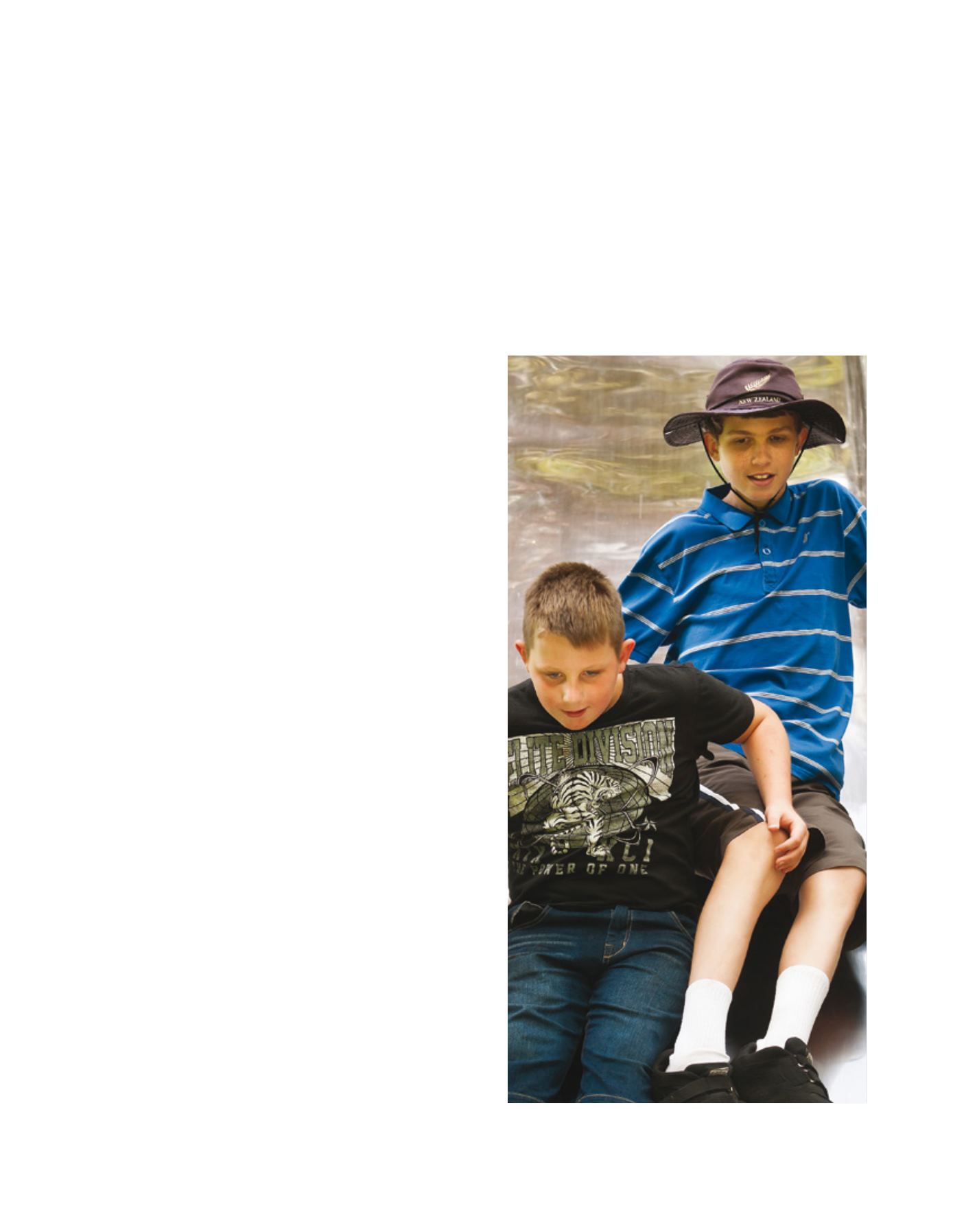
The CRPD requires communities to remove barriers and promote the
full inclusion of persons with intellectual disabilities
Image: IHC and Hyndman Family
A
dvancing
S
ocial
I
ntegration
and
I
ntergenerational
S
olidarity