


 24 / 210

[
] 22
A
dvancing
S
ocial
I
ntegration
and
I
ntergenerational
S
olidarity
individual is to achieve the highest possible level of partici-
pation from the parents attending the session, helping them
to define the problems presented in the case in order to
maximize the learning experience.
The moderators are not only leaders, but also parents who
are experts at facilitating and guiding these debates in small
groups. They are professionals from different sectors, trained
in moderation and communication techniques. Each profes-
sional moderator has a broad knowledge of the contents of
all programmes. The courses are developed with a strong
commitment to cooperation: parents educating parents,
families educating families.
Another key element of the case method is that the other
participants act as co-creators of the learning process. They
are responsible for preparing the case in advance, first individ-
ually, and then often in small study groups. Ideally, learning
should continue after class as students reflect on the discus-
sion and apply insights and lessons in the broader context of
their academic, professional and personal lives.
The case method in the context of family training is
known as the ‘family system’, in recognition of its specific
characteristics. In addition to the traditional three stages
of the case method – individual analysis, discussion of the
case in small groups and general discussion – an inter-
mediary stage is added: the discussion of the case by the
couple. This means that the family system is made up of a
total of four stages: individual analysis, discussion of the
case by the couple, discussion of the case in small groups,
and general discussion led by an expert. The family system
is more focused on the couple than on the subject, and is
based on the following principles.
Parents as primary educators of their children:
The speciali-
zation that so often occurs in contemporary life can lead
parents to relinquish control of their children’s education to
others (teachers, educators, nannies etc). However, it is the
parents themselves who are in the best position to educate
their children, as they are the ones who receive all the infor-
mation about them from different sources. Family Enrichment
courses highlight this reality and provide parents with the
tools they need to develop their own philosophies and goals,
both in terms of education and character. The methodology
– discussion of case studies by the couple, in small groups,
and in larger general sessions led by an expert moderator –
dissuades parents from the temptation to develop a child’s
education system according to a single external perspective.
Professionalization and anticipation:
Through individual
study of the technical notes and discussion of the case studies
in three phases, couples develop their ability to analyse the
reality of a situation, to distinguish facts from prejudices and
judgements, and to get to the root of a problem. The cases
provide an opportunity to anticipate and learn how to deal
with situations that will, sooner or later, arise in family life.
Commitment:
The case method, by virtue of analysing an
external situation, ensures the involvement of both partners
and allows them to rediscover the richness they each bring
to their shared role as spouses and parents. This balance
is critical in the family. On the one hand, for the children,
whose temperaments are generally more aligned with one or
other parent, and for whom it is important to recognize both
parents’ contributions and roles. However, it is also essential
for the couple, who learn to externalize their own ideas, put
them together and manage any differences of opinion effec-
tively. To educate is to teach love, and strengthening the bond
between spouses helps ensure a solid foundation on which
children can grow.
Friendship and definition of common standards:
The
contrasting views of different couples during small group
discussions and general sessions help couples to maintain
objectivity and constantly review their own values. The
cooperative climate surrounding the courses encourages
couples to explore their desires, goals and concerns, thus
providing the basis for long-lasting friendships between
couples. The mainstream climate is not always family-
friendly, and the relationships formed naturally during
Family Enrichment programmes provide a welcome – and
nourishing – change of pace.
Fun and simplicity:
Courses are developed according to the
age of the children and/or the length of the marriage. The
specific problems of a particular period of personality devel-
opment of the children or the evolution of a marriage are
discussed among those experiencing them first-hand, favour-
ing a simple and informal exchange of stories and lessons
learned. The atmosphere, rather than being strictly academic,
is more like a gathering of friends interested in improving and
helping each other with care and affection, while maintaining
a strong level of professionalism.
The courses focused on children cover the main academic
frameworks and the basic habits that children acquire at
each stage of their development. The Marital Love course
concentrates on the most important aspects of a marriage,
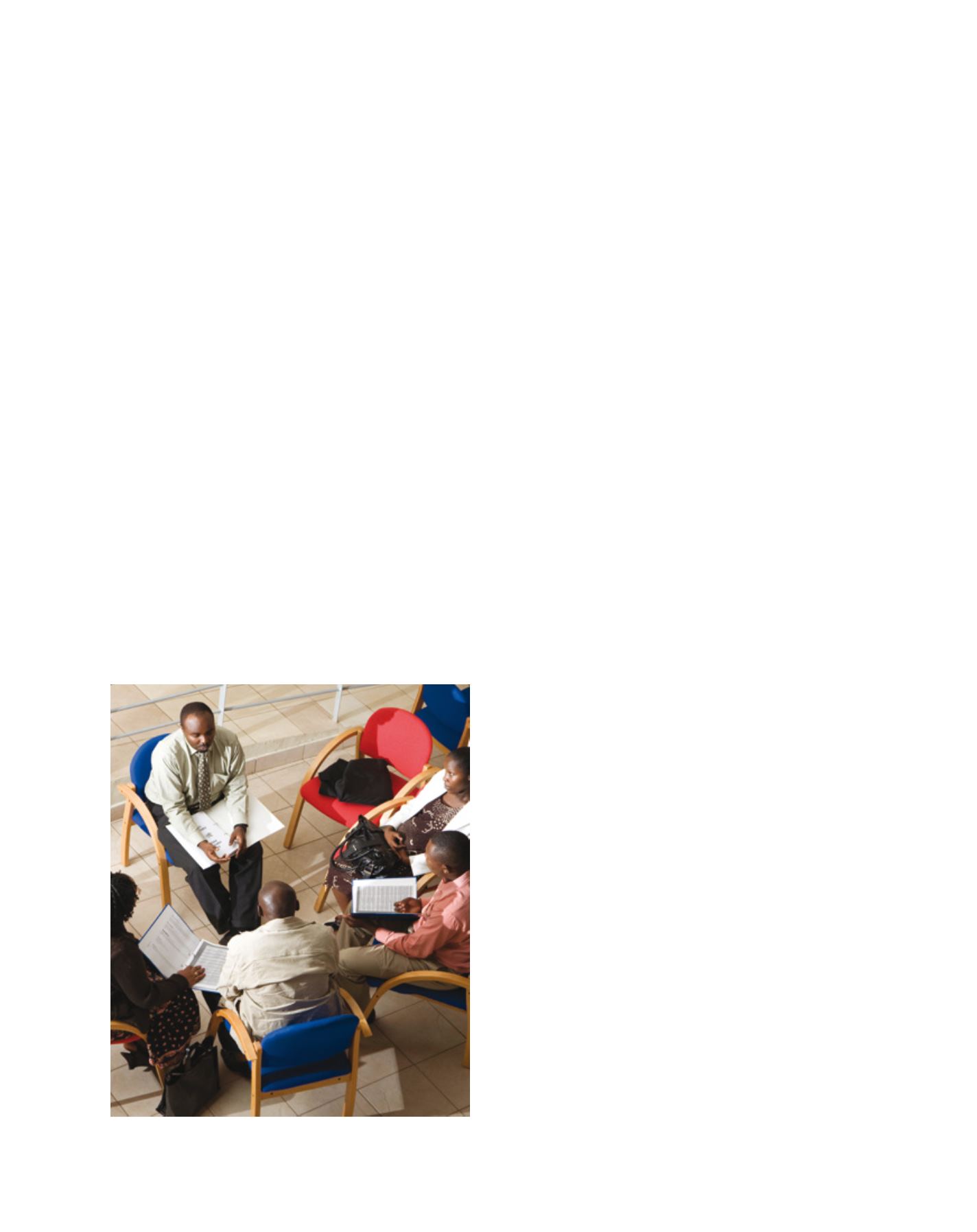
A small group discussion, one of the four stages of the family system
Image: IFFD