


 56 / 210

[
] 54
A
dvancing
S
ocial
I
ntegration
and
I
ntergenerational
S
olidarity
capacity of those in old age) can lead to self-reliance, positive
behaviours and attitudes immune to social deterioration has
been highlighted and set as a priority in social development
policy and strategic initiative programmes.
Thailand’s initiative approaches to mobilize social policy on
family strengthening have been established through national
mechanism. The Ministry of Social Development and Human
Security, as the national focal point in family strengthen-
ing, has designed significant mechanisms at national and
local level. The National Committee on Family Development
Policy and Strategy, chaired by the Deputy Prime Minister,
has functioned as a policy-oriented body responsible for the
formulation of strategic measures for the betterment of family
status. This is characterized by the five standards of family
strengthening:
• good relationships among family members
• proper family roles in all stages of life
• family self-reliance in the economic sphere
• access to social capital
• ability to avoid risks and cope with difficulties.
To achieve its goals, proactive approaches to family protection
and empowerment, such as the 10-menu for family practices,
have been undertaken through initiative activities.
It has been recognized that fruitful outcomes of the above
activities need to be mobilized through cooperation of the
public and private sectors as well as other networks, espe-
cially local communities. In other words, the above strategic
measures can be taken into successful actions only if active
agency networks take part in joint ventures, especially at local
community level.
The Community-based Center for Family Development
(CCFD) is an organization of local public sector bodies
that works to promote the strengthening of families in local
communities. There are two types of CCFD: those under the
supervision of local government administrative organizations,
and those in the public sector that work in coordination with
local government administrative organizations.
The final goal of the CCFD working process is ‘Warm,
strong and sustainable families’. The work process for this
goal is divided into two stages: preparation for selection and
setting up of the CCFD working group, and the implementa-
tion period of the CCFD.
In order to increase the efficiency of the CCFD, several
areas of focus and notification are necessary. Executives of
the local government administrative organization or those
participating in selecting the CCFD working group should
have capacities to scrutinize and make decisions at a certain
level. Selected areas with information on families are neces-
sary to ensure an effective work process. Further, the scope of
work and expectations need to be clearly set, and there must
be capable staff with knowledge and experience in planning
and project management.
There are three levels of change:
• individual level: activeness, awareness, accountability
• working group level: learning and ability to analyse work
approach, monitoring and evaluation of target groups
• network level: operational section, coordination and support
section that feel content with the cooperation process.
The main objective is that the local government administrative
organizations are aware of the value of working with target
groups and demonstrate willingness to continue their support
as their capacities allow. The target groups are protected and
their problems are attended to and solved, both at the level of
the individuals and through the group support process.
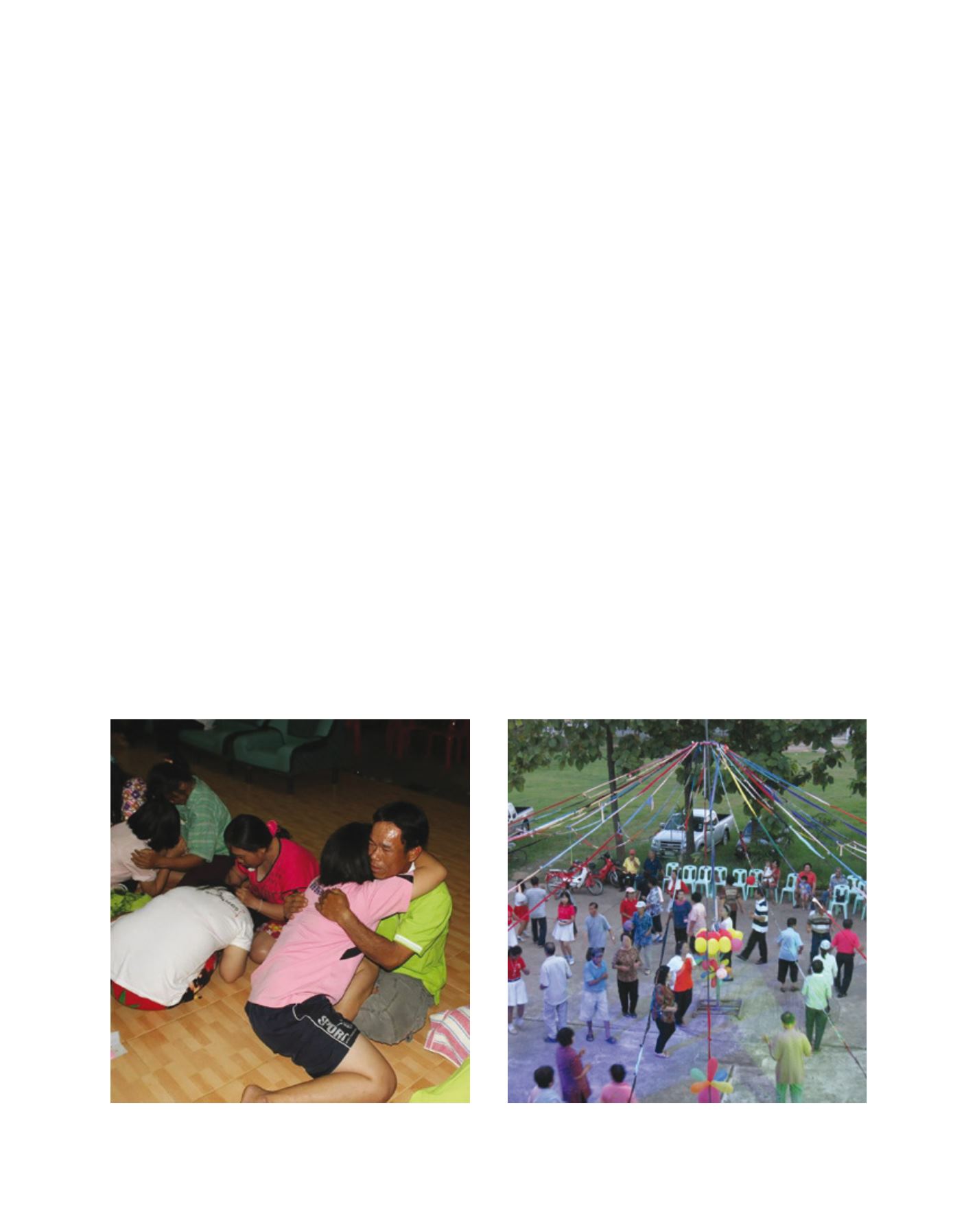
Good relationships among family members are crucial to
strengthening the family
Warm, strong and sustainable families are the final goal of the
CCFD working process
Image: CCFD
Image: CCFD