


 53 / 210

[
] 51
Family-oriented policy
Bathabile Olive Dlamini, Minister of Social Development, Republic of South Africa
A
dvancing
S
ocial
I
ntegration
and
I
ntergenerational
S
olidarity
F
ollowing the end of apartheid and the establish-
ment of a new democratic dispensation in 1994, the
post-apartheid South African Government instituted
various policy and legislative reforms aimed at, among other
things, the realignment of the country’s institutions, in order
to transform South African society. However, the family was
not explicitly addressed in many of these policies. Rather, it
was usually inferred and, in consequence, most socioeco-
nomic benefits indirectly filtered down to the family.
Past and present poverty analyses and strategies of intervention
have also primarily concentrated on households, as opposed to
families, thereby causing policies to overlook intrafamily dynam-
ics in the country. It is against the above background that the
absence of an explicit policy framework on the family in South
Africa has, over the years, been identified by government poli-
cymakers, academics, civil society and concerned citizens as a
critical shortcoming that needed to be urgently addressed.
Reducing poverty, unemployment and inequality remain
South Africa’s greatest challenge. Among the major causes
of poverty in the country is lack of or low earned income.
Essentially, employment creation has not transpired at the
anticipated rate, and many people are still unskilled. This
inability of many people to secure employment has led to many
families facing additional burdens, due to limited or no income
to secure family livelihood. This situation continues to place
a huge dependency burden on families. Poverty still reflects
apartheid settlement patterns, and virtually all poor households
are found in the former Bantustans regions, informal settle-
ments and townships. Great inequality income distribution
persists
1
largely as a result of the reproduction of the disparities
in ownership income, resource skills and other determinants of
people’s capacity to take advantage of opportunities.
As far as poverty is concerned, women endure a dispro-
portionate burden of the outcomes of past policies. Whereas
men worked in various industries during the apartheid era,
many women remained in the rural areas to look after family
members. Historically, women received income primarily in
the form of remittance from their spouses. Cultural practices
such as patriarchy also reinforced the exclusion of women
from economic activities.
The gender division of labour continues to influence the
way families function. Women typically assume more house-
hold responsibilities, spend a larger portion of their time on
unpaid care work than men, and make up a greater proportion
of discouraged work seekers.
Child poverty is another particularly worrisome trend in South
Africa, and is a direct consequence of family disintegration.
A report of which analyses the 2005/2006 income and expendi-
ture survey by Statistics South Africa was able to paint a clearer
picture of this phenomenon.
2
According to the report, child
poverty peaked at 65.5 per cent and remains more extensive
than poverty among adults (45.2 per cent), thereby confirming
that there is greater incidence of children in poorer households.
The country’s response to confront family poverty was to
develop a White Paper on Families which is a family-focused
policy. The intention of the white paper is to make a significant
contribution to the fight against poverty which affects millions of
SouthAfricans, including children, youth, families, women, people
with disabilities and older persons. Furthermore a comprehensive
social security programme such as child support grants, foster care
grants, housing assistance and tax breaks, serves as a protective
measure for families in need. In addition, short-term interventions
such as an extended public works programme, community works
programme, income generation project and women’s cooperative
projects are being implemented by government to address the
socioeconomic state of the families in South Africa.
Ensuring work-family balance
Women are the primary providers of care and have been
entering the labour force in greater numbers, hence the need
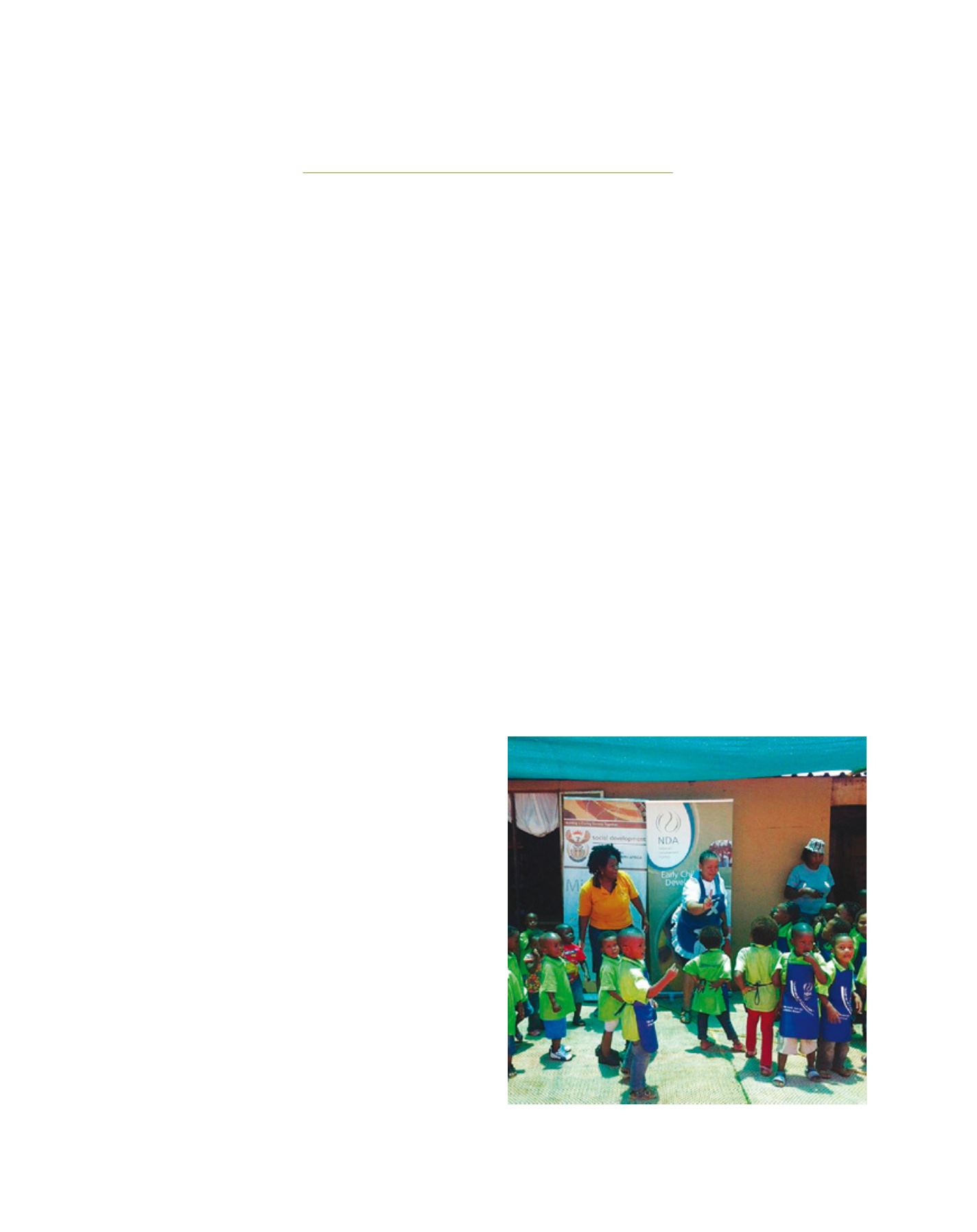
Image: Department of Social Development, South Africa
The South African Government has intensified the Early Childhood
Development programme to support mothers