


 50 / 210

[
] 48
Wh
ā
nau Ora: strengthening M
ā
ori families
in Aotearoa, New Zealand
Emeritus Professor Sir Mason Durie, Massey University; and Ng
ā
Pae o te M
ā
ramatanga,
Indigenous Centre of Research Excellence, New Zealand
A
dvancing
S
ocial
I
ntegration
and
I
ntergenerational
S
olidarity
M
ā
ori are the indigenous people of Aotearoa
New Zealand. Like indigenous populations
who have been colonized in other parts of the
world, the M
ā
ori suffered serious depopulation in the
latter half of the nineteenth century as a consequence
of infectious diseases, musket wars, land losses and
malnutrition. By 1910, however, and largely due to
inspirational indigenous leadership at political, medical
and community levels, a recovery process was evident.
More than a century later, the 2013 New Zealand Census
of Individuals and Dwellings showed that the population
had increased from around 47,000 in 1910 to 598,605, now
accounting for 14 per cent of the total New Zealand popula-
tion. Although slowly ageing, M
ā
ori are relatively youthful,
the median age being 24 years compared to 38 years for the
total population. In that respect the population is larger
than it ever has been in the past, with greater rates of
participation in a range of professions and industries. There
are also positive signs of greater participation in tertiary
education. According to the New Zealand Government
Statistician, over 36,000 M
ā
ori stated a bachelor’s degree
or higher as their highest qualification at the 2013 Census
– a more than 50 per cent increase since 2006.
Meanwhile, in the face of alarming disparities between
M
ā
ori and non-M
ā
ori first detailed in 1960, significant
changes to M
ā
ori policy were introduced in 1984. The
changes partially reflected the New Zealand Government’s
recognition of the1840 Treaty of Waitangi, under which the
British Crown made certain guarantees to M
ā
ori including
recognition of M
ā
ori property rights and expectations of
similar citizenship rights and social well-being. The 1984
approach also recognized the right of M
ā
ori to retain their
language and culture and to enjoy state-supported M
ā
ori
television and radio networks. Importantly, the new mood
saw the emergence of M
ā
ori health and social service provid-
ers, M
ā
ori language-medium schools, and the introduction
of M
ā
ori perspectives into the core business of hospitals,
schools, prisons, universities and government departments.
However, notwithstanding major gains over the previous
three decades, most socioeconomic indicators show that
M
ā
ori still fare worse than non-M
ā
ori. Life expectancy is
some eight years less; acute and chronic illnesses are two
to three times more frequent; educational achievement is
significantly lower as are incomes, home ownership and
stable employment. M
ā
ori rates of imprisonment are higher
than for non-M
ā
ori, truancy rates are similarly greater and
poverty among M
ā
ori families is substantially higher than
among other sections of society. According to the 2013 Child
Poverty Monitor, one in three M
ā
ori children is deemed to
live in poverty compared to one in seven European children.
In some areas the disparities have increased despite the
increasing number of M
ā
ori non-governmental organiza-
tions (NGOs) delivering a wide range of services, mainly in
health and social services. But the services have generally
been small, in competition with each other, and geared
to the resolution of individual crises. Contractual obliga-
tions required by government funders have been narrowly
defined, favouring specific interventions such as truancy,
diabetes management or smoking cessation, and meas-
urements of compliance have focused on accounting for
volumes rather than results. What had been missing was
an approach that could incorporate individually-oriented
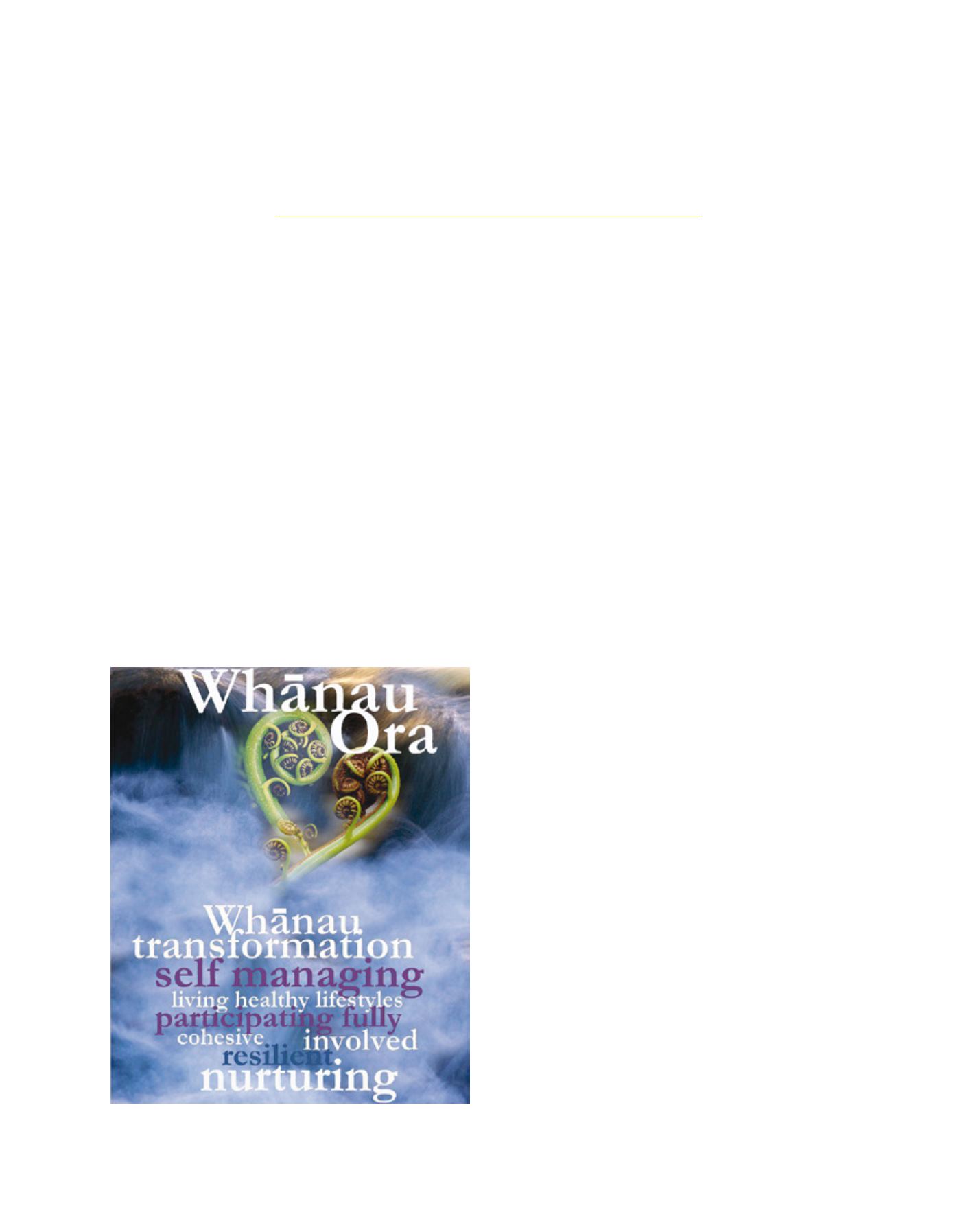
Wh
ā
nau Ora combines social, cultural and economic values to provide
integrated services that contribute to wh
ā
nau empowerment
Image: Rosalie Liddle Crawford