


 229 / 336

[
] 229
Environmental rehabilitation of the
Lake Pátzcuaro watershed, Michoacán, Mexico
Miguel A. Córdova, Appropriate and Industrial Technology Subdivision Head, Mexican Institute of Water Technology
and Ramón Pérez Gil Salcido, Director, Water Program, Gonzalo Río Arronte Foundation
W
ith water as its pivotal element, a comprehensive
programme was developed to establish a basis for
attaining the sustainable development of the Lake
Pátzcuaro watershed.
The programme’s main goals are:
• enhancing and promoting environmental awareness and culture
among the watershed’s inhabitants
• seeking consensus regarding the main problems and their solutions
• increasing the knowledge of natural resources availability and use
• establishing criteria for prioritizing actions
• performing and promoting the execution of projects and
structural works that generate tangible benefits for the watershed
and its communities
• managing and channelling investments to ensure the sustainability
of the environmental rehabilitation process.
In order to achieve this, it was necessary to define and implement a
strategic plan based on the identification, prioritization and execu-
tion of actions agreed on by the different stakeholders.
The Lake Pátzcuaro watershed is located in the state of
Michoacán, Mexico. It is a closed basin, with an area of 929
km
2
. Altitudes range from 2,035 to 3,300 metres above sea
level (masl), with an average altitude of 2,369 masl. Mean
precipitation in the area is 775 mm, while mean evapora-
tion is 1,393mm. The lake covers an area of 126.4 km
2
and
has an average depth of 4.9 m, with a storage volume of
619.4 Hm
3
. The population of the watershed is estimated
at 120,000 inhabitants. Its economy is based mainly on
tourism, forestry, fishing and craftsmanship, and recently
on money remittances from its immigrants working in the
USA. Due to its singular beauty and historical relevance,
going back to pre-Hispanic times, the region is considered
as one of Mexico’s most emblematic and culturally rich.
The indigenous Purépechas people are an important part
of the population.
With the aim of contributing to the solution of the
watershed’s environmental problems, which have
been caused by years of deterioration and ecological
abuse, an agreement was signed in 2003, which gave
W
ater
C
ooperation
, S
ustainability
and
P
overty
E
radication
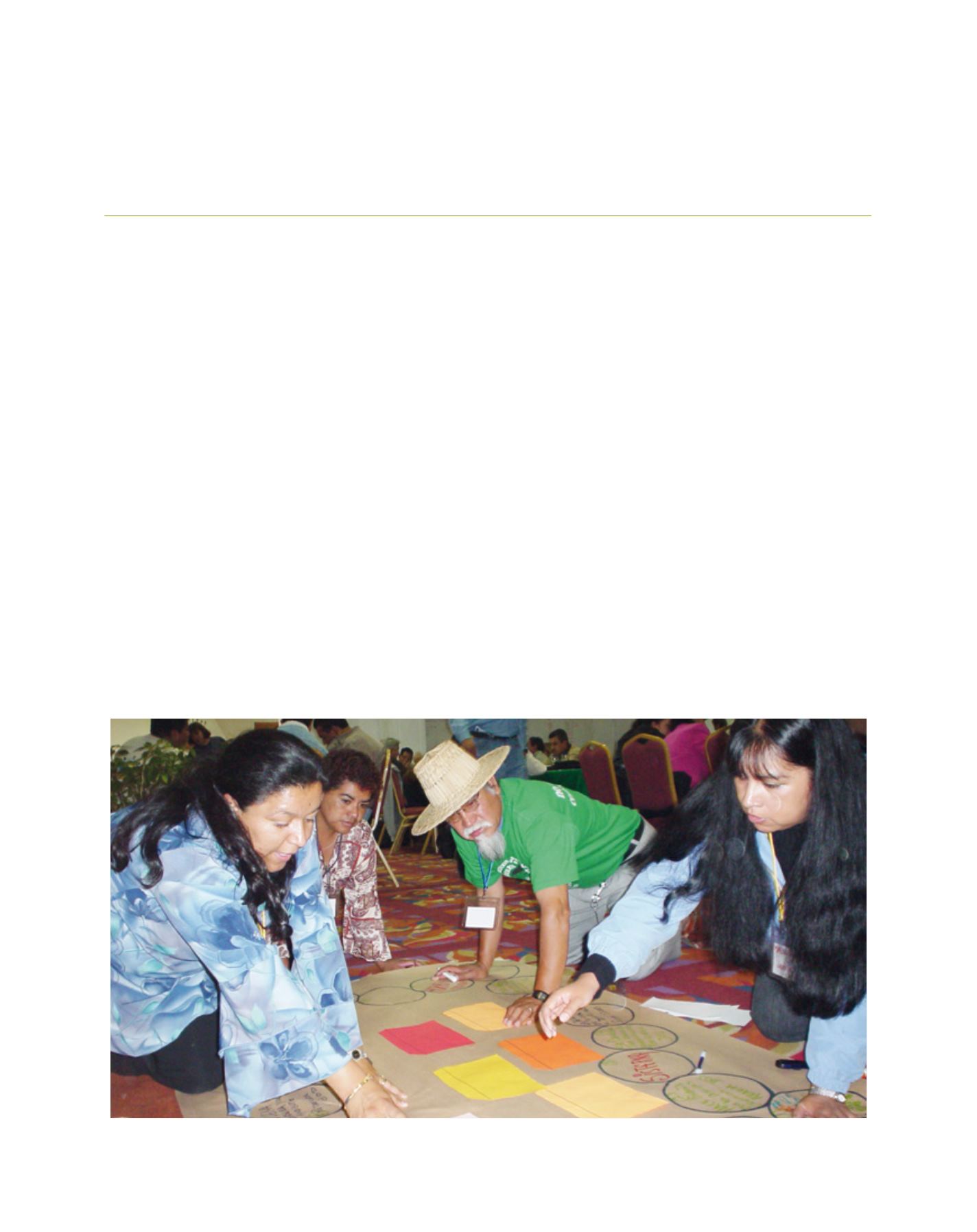
Local educators and community leaders participating in activities to develop the ‘Discover a Watershed: Lake Pátzcuaro’ educator’s guide
Image: Rita Vázquez, IMTA