


 231 / 336

[
] 231
W
ater
C
ooperation
, S
ustainability
and
P
overty
E
radication
accepted for receiving financial aid from the Fund for the Treatment
of Wastewater in Touristic Areas, which will help consolidate their
self-sufficiency. Some of the wetlands (Cucuchucho, Santa Fe de la
Laguna and Erongarícuaro, which produce 8 l/s in total) are also
eligible for this fund.
The water utilities of Pátzcuaro, Quiroga, Erongarícuaro and
Tzintzuntzan have worked on the detection and repairing of leaks,
which has resulted in preventing losses of more than 75 l/s in the
four townships. For example, in Quiroga, losses due to leaks have
been reduced by 25 l/s and water pressure was increased in the
network, thus considerably improving drinking water services to
the population. In Pátzcuaro, three of the 10 hydrometric districts
were divided in sectors, and with the partial rehabilitation of the San
Gregorio Aqueduct, losses were reduced by 15 l/s. In the four town-
ships, wells were equipped with macrometers and user records were
updated. These works and the actions deriving from them benefit
more than 70,000 inhabitants, close to 60 per cent of the total popu-
lation of the watershed. In addition several studies and actions were
made in order to improve and update water and sanitation rates,
which have helped to significantly increase the revenues of water
utilities in Pátzcuaro and Erongarícuaro.
Some 24 water springs have been located, rehabilitated and
protected. Three of them were habilitated to be used as drink-
ing water supply sources. For example, from the Las Palmas and
Tzentzénguaro springs, 12 l/s and 10 l/s are channelled to the
communities of Quiroga and Tzentzénguaro respectively.
In order to reduce the problems associated with extreme poverty,
the transfer and appropriation of water technologies has been
promoted. In this regard, 4,749 houses have been adapted with
several systems for water harvesting, extraction, conduction, storage,
purification and consumption. These include rainwater harvesting
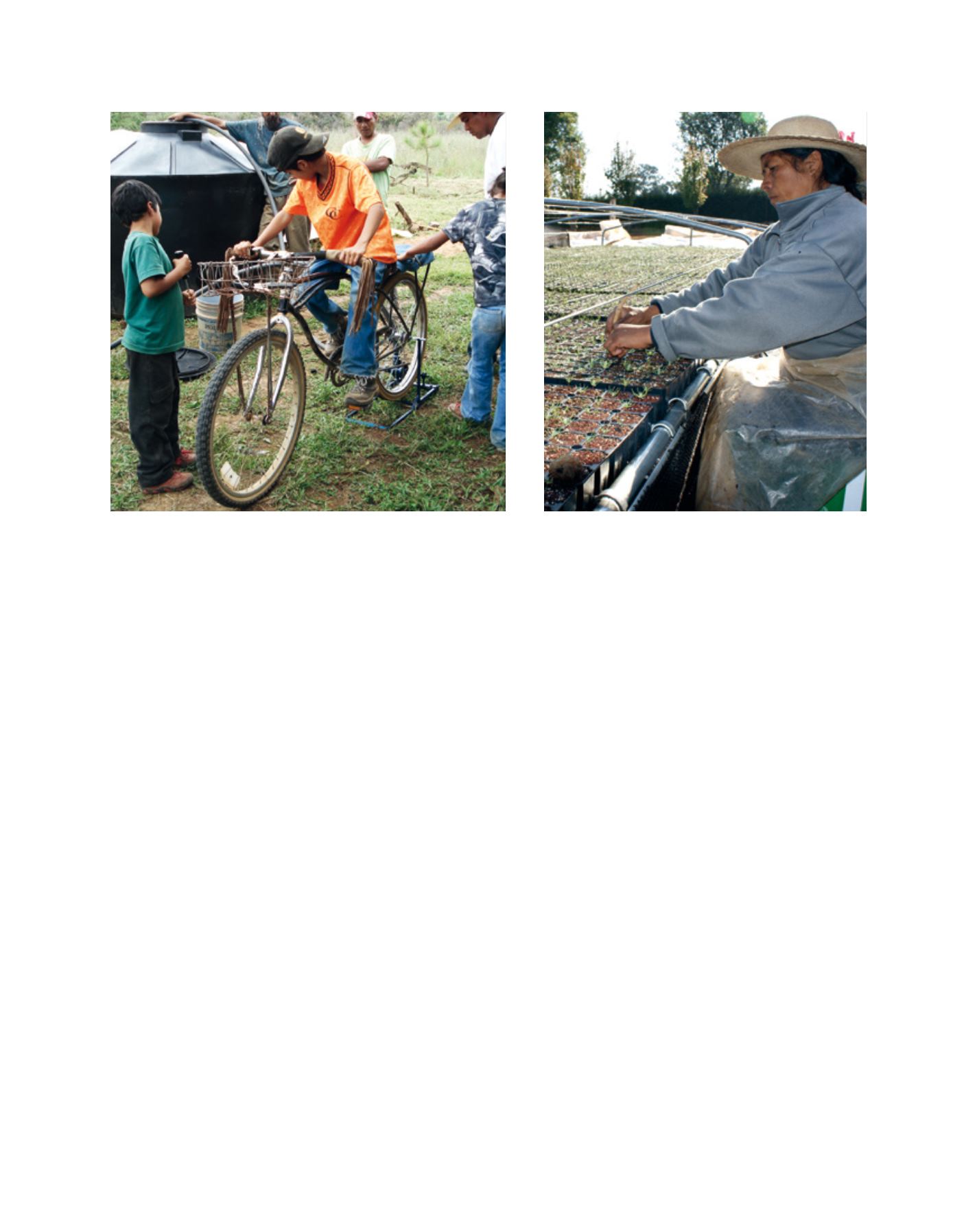
systems, pedal-powered pumps, cisterns, solar disinfection systems,
biofilters and family orchards equipped with self-
operating irrigation systems. During this process, the
participation of indigenous Purépecha women has been
crucial. Thus, the basic water and sanitation require-
ments of more than 1,222 rural and indigenous families
have been covered.
In the upper part of the watershed, several projects
have been implemented to support reforestation and
control soil erosion. A series of practices have been
transferred and adapted for the conservation of 10
priority microwatersheds. Specifically, this includes
forest rehabilitation in more than 1,649 hectares. This
has entailed planting species such as
Pinus pseudos-
trobus
,
Pinus greggii
and
Pinus michoacana
using both
traditional excavation methods and drilling machinery
in Pátzcuaro, Huiramba, Lagunillas, Erongarícuaro,
Tzintzuntzan, Quiroga and Salvador Escalante. The
survival rate after the rainy season was over 80 per cent.
Reforestation actions were taken along the borders of
farms, grasslands and cattle-raising ranches by plant-
ing 46 km of live fences of white cedar (
Cupressus
lusitánica
). Infiltration ditches and diversion ditches
were excavated in the townships of Ichupio, Cerritos
and Crucero de Chapultepec, thus achieving the infil-
tration of 11,352 km
3
of water between 2008 and 2011.
In general terms, there are now 56,786 hectares of
non-eroded land with an adequate forest cover (60.55
per cent of tree vegetation/watershed surface area). It is
worth noting that in the municipality of Pátzcuaro, at
the Francisco J. Mújica tree nursery, there is a highly-
technified module with the capacity to produce up to
600,000 plants per year.
A bicycle adapted as a pedal-powered pump for irrigation purposes in the community
of San Pedro, Pátzcuaro
The technified module at the Francisco J. Mújica tree nursery, which
can produce up to 600,000 plants per year
Image: Miguel A. Córdova
Image: Roberto Menéndez, IMTA