


 259 / 336

[
] 259
E
conomic
D
evelopment
and
W
ater
The second kind has been for ‘Water Friendly Farmers’,
teaching people to farm in the semi-arid conditions of
much of the basin, using water harvesting techniques for
crops and drinking, self-sufficiency of livestock keeping
and waste reuse. This latter training has been undertaken
by a teacher, Josphat Macharia, on his 5-acre plot that
sustains his extended family with much output to spare.
It has been calculated that his land can feed 30 people and,
as such, his methods provide a clear beacon for future land
management in the face of increased pressure from climate
change. Trainees have undertaken to go home and further
train another 10 people each in their workplace, home
location or church community.
The training camps have also supported members of
SHGs that were in receipt of physical improvements.
These have taken the themes of erosion control, water
efficiency and water quality. Erosion control projects
have built dams in dry gullies that experience flash floods
to hold back sediment from entering the lake, and intro-
duced tree-planting schemes on steep land in headwaters.
Water efficiency projects have provided water harvesting
for schools where the teachers and governors have agreed
to create vegetable plots and tree nurseries with the chil-
dren. They have also targeted SHGs growing vegetables
where water is in limited supply, such as a pan dam for a
women’s group that leases and farms 10 acres of arid land
and a youth group that built its own greenhouse but could
only access water from streams far away. Water quality
projects have provided cleaner water for collection from
dams in an innovative way that also provides biodiversity
restoration, funded through the REWE Group.
The REWE Group project, ‘Papyrus Restoration’,
focuses on projects that restore the papyrus fringe around
Lake Naivasha. Artificial islands are being planted onshore
in ponds with papyrus. When established, these will be
anchored offshore in selected locations, to spread and
grow into an established swamp to protect the lake from
sediment and enhance fish growth and reproduction.
Restoration in the catchment is focused on a few of the
many artificial dams left over from colonial farming, now
in disrepair. Projects have assisted SHGs with fencing and
building materials; the groups have erected the fencing,
strengthened the dams and built cattle drinking troughs
with water taps below the dams. The communities that
surround the dams can now access water no longer
contaminated by cattle and cleaned by the natural wetland
plants that had been eliminated by grazing or trampling.
Water cooperation in the future
By the middle of 2013, all the initiatives designed to
unite water users in the Naivasha basin are bearing fruit;
although each action is small, they are like a pebble in a
pond, spreading ripples ever outward. There is an enor-
mous amount still to do, to achieve a sustainable basin
with inhabitants no longer in poverty. Imarisha’s SDAP
vision – “A clean, healthy and productive environment
and sustainable livelihoods in the Lake Naivasha basin
for the benefit of the present and future generations”
– is at the beginning of a long road to achievement.
national conference on climate change and asked if he could help. Staff
of the Prince of Wales’s International Sustainability Unit then made
a field visit and a rapid environmental and economic appraisal of the
catchment, which stimulated the creation of a newmanagement organi-
zation by the Government of Kenya, called Imarisha Naivasha. In 2012
Imarisha produced its Sustainable Development Action Plan (SDAP)
2012-17, requiring the development of a monitoring programme for
lake health and a database of information to support the “enabling
conditions for effective water regulation and governance, sustainable
land and natural resource use and sustainable development in the lake
Naivasha Basin”.
The third series of events came from European retailers – the
direct buyers of cut flowers – who began to fund small projects
that would act as demonstration successes, to be repeated across the
catchment as Imarisha and the initial PES grew to facilitate catch-
ment-wide sustainability. Some of these ‘early wins’ were projects
from UK retailers and Dutch and Swedish governments, funded
through Imarisha. Others were directly funded by two European
retailers that prize their commitment to sustainability – the German
REWE Group and Swiss Coop – through the universities of
Leicester and Nairobi. These universities have the longest-running
research partnership at Lake Naivasha, since 1982, which has been
responsible for most of the ecological understanding of the lake
described above.
The Coop-funded project, entitled ‘Sustainable Roses and Water’,
focused on promoting water efficiency among users and training
them to recognize it as a finite resource. The central part of this has
been two kinds of five-day residential training camps for horticul-
tural workforce officials, WRUA committee members and members
of self-help groups (SHGs) that are also being assisted by the physi-
cal demonstration projects.
The first kind of training camp has been for ‘Water Ambassadors’,
where people are taught about the water cycle fromglobal to local scales,
about cleaning wastewater for environmental acceptability, purifying
raw water for domestic use and about the ecology of Lake Naivasha.
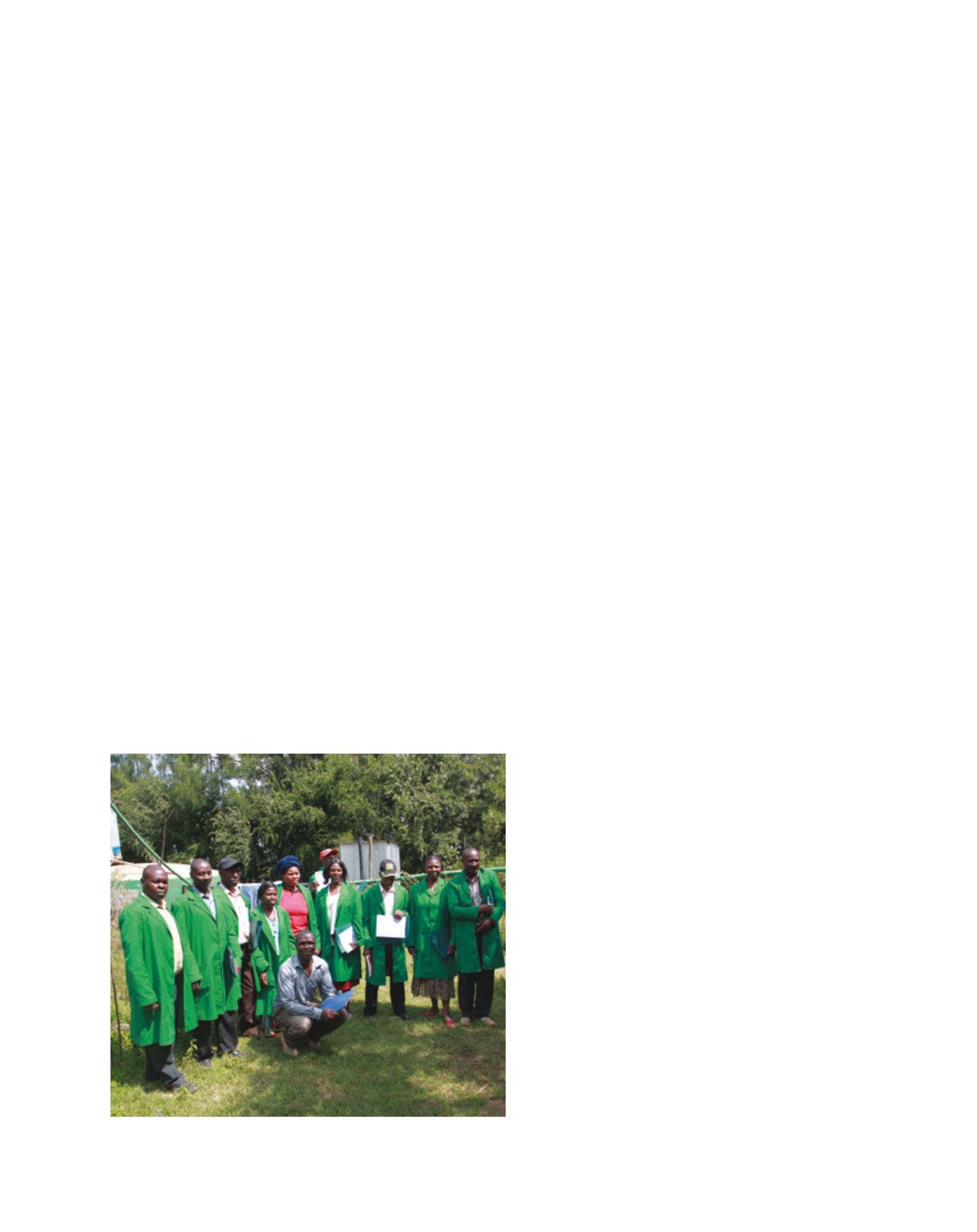
Teacher Josphat Macharia training Water Friendly Farmers
Image: Nic Pacini