



 170 / 208

[
] 170
Governing sustainable
development in Malaysia
Adnan A. Hezri, Institute of Strategic and International Studies, Malaysia,
Wasis Ahmad Kamal, Economic Planning Unit, Prime Minister’s Department, Malaysia, and
Pek Chuan Gan, United Nations Development Programme, Malaysia
M
alaysia is often hailed as an example of a successful
developing country. With a population of 28.7 million,
Malaysia is currently on track to achieve most of the
illennium Development Goals (MDGs) in aggregate terms ahead
of the 2015 deadline. This has been made possible largely because
of strategic and proper planning as well as investments in physi-
cal infrastructure, primary education and primary healthcare
services over the last four decades. Notably, the country has
largely achieved the MDG objective of eradicating poverty, which
fell from 17 per cent in 1990 to 3.8 per cent in 2009, based on
the national poverty line. It has also achieved gender parity at all
levels of education, surpassing parity at the universal level.
The Government has outlined its commitment to the MDG-Plus
agenda (which features targets that go beyond the original MDGs)
through its Tenth Malaysia Plan, 2011-2015, with 30 per cent of
development expenditure allocated to the social sector. In 2011,
Malaysia’s Human Development Index was 0.761, giving the
country a rank of 61 out of 187 countries with comparable data,
and also above the East Asia and the Pacific regional average. In
the Economist Intelligence Unit’s Quality of Life Index, Malaysia is
ranked 36th out of 111 countries.
To conserve and sustainably utilize its rich biological diversity
endowment, Malaysia continues to commit at least 50 per cent of its
land areas as forest cover, which according to the Food
and Agriculture Organization in 2010 now stands at 62.4
per cent. In the Environmental Performance Index 2012,
an international benchmarking survey of national environ-
mental stewardship, Malaysia is ranked at 25th position
among 132 countries surveyed. Rapid development and
environmental transformation in Malaysia has proven to
be a success in economic terms. For instance, a Federal
Land Development Authority (FELDA) rural development
scheme, which was originally meant to release citizens
from the vicious circle of poverty through planned and
coordinated development of land and socioeconomic
activities and to ensure that economic development goes
hand in hand with social development, together with other
poverty eradication programmes have managed to reduce
poverty to 3.8 per cent. The FELDA scheme has received
accolades as a successful policy for bringing about social
and economic benefits and setting a good example to other
developing countries.
Planning system and sustainable development
Traditionally, environmental policies across the world
have been, and often still are, developed in a reactive,
fragmented and uncoordinated way. The shortcom-
ings of this approach have become manifest in rising
environmental pressures and the displacement of prob-
lems rather than the provision of solutions. With the
advent of sustainable development, questions about
how economic, environmental and social interests
can be accommodated simultaneously, and how more
comprehensive and integrated policies can be devel-
oped, become more prominent. However, there are
many technical and political difficulties in integrating
the three objectives for sustainable development. In
view of this, central to Malaysia’s success is its national
vision and strategy for development. The vision is based
on long-term policy design beyond electoral cycles that
seeks to change key societal structures.
In Malaysia, attempts have been made to mainstream
environmental concerns and priorities into economic
and social development plans since the 1960s, backed
by strong institutions, which have proved able to accom-
modate changes yet durable and stable enough to ensure
continuity of actions. For instance, in 1967 the Prime
S
ustainability
P
olicies
, P
rogrammes
and
their
E
conomic
I
mpact
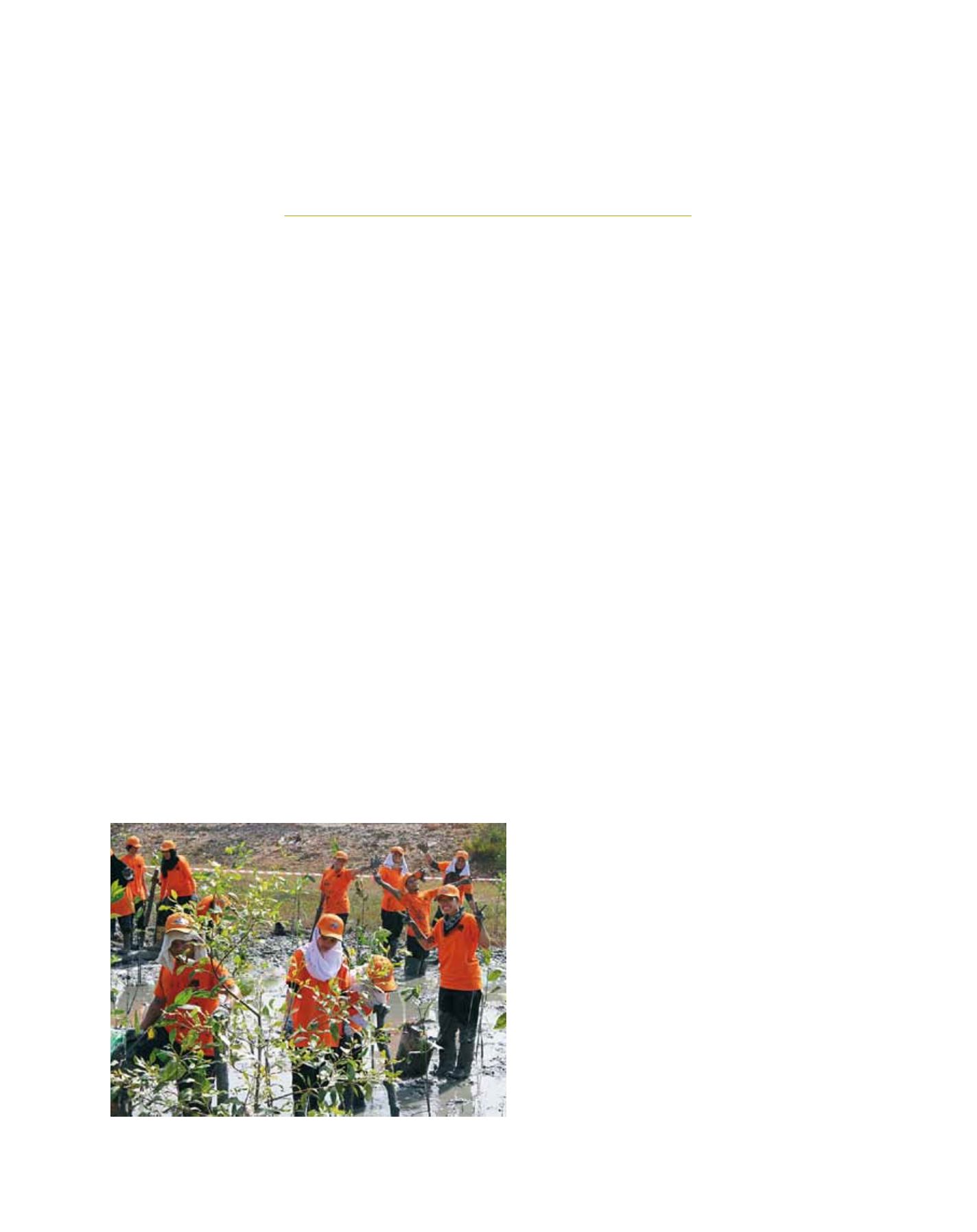
Malaysia is on track to achieve most of the Millennium Development Goals
Image: Ali, Noorhisham, Economic Planning Unit, Malaysia