


 16 / 156

[
] 16
Given the enormous humanitarian concerns, the need to
adapt existing policies to emergency situations proved an
important step. UNEP has been working with the Government
of Sri Lanka to carry out rapid environmental impact assess-
ments of over 400 housing sites. In Indonesia, UNEP has
supported the development of screening mechanisms for the
vast number of reconstruction projects underway. Similarly,
building codes that call for disaster-resilient construction and
policies that promote the use of sustainable building materi-
als hold promise.
Spatial planning procedures and other decision-support tools
also contribute strongly to the recovery process. In Sri Lanka,
UNEP is working with environmental authorities to advance
the use of Strategic Environmental Assessments (SEAs) for
township planning; these assessments are being adapted to
consider disaster risk and vulnerability in the planning process.
With the support of new policies on the use of SEAs, decision
makers have access to important information about the impli-
cations of alternative planning choices. In Indonesia, UNEP is
working with government agencies and recovery partners to
advance an environmental framework to guide local level recov-
ery efforts. Such approaches, once institutionalized, are helpful
to the recovery process while also supporting broader nation-
wide efforts to promote sustainable development.
From where we stand
The past 18 months have seen perhaps the best-documented
disaster response in history. It is clear, however, that even with
the best intentions, not all innovations have been successful.
However, lessons have been learnt from all of them. From the
earliest days, UNEP worked closely with national governments
and other partner organizations to find viable solutions to the
environmental concerns raised by the disaster and the follow-
ing recovery process, and many of these are relevant to disaster
risk reduction.
While more careful analysis of what worked and what did
not is required, it seems that the environment will no longer be
the silent victim of disasters, and that opportunities to protect
the vital ecosystem services that support sustainable and disas-
ter-resilient communities will continue to grow. As a result, it
may be said with confidence that the work of post-disaster
recovery will never be the same.
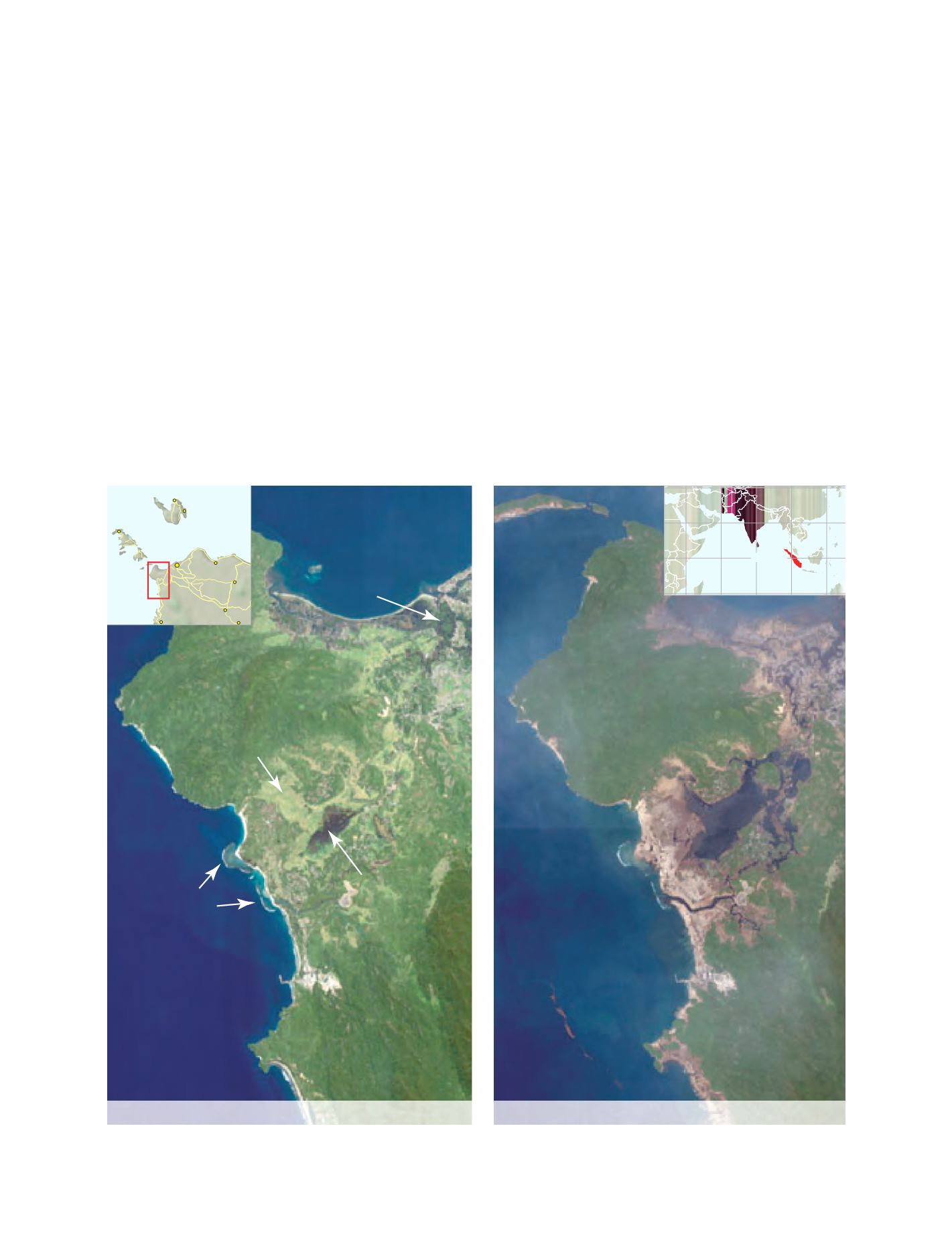
Damage to ecosystems, Aceh, Sumatra, Indonesia
10 Jan 2003
29 Dec 2004
Fish Ponds
Mangroves
Corals
Rice Fields
Small Lake in
Rice Field
Indonesia
Sumatra
I
N
D
I
A
N
O
C
E
A
N
ARABIAN
SEA
Kuede
Jantho
Sabang
Lambada
Gleeburk
Melingge
Seumileum
Anoi Itam
BANDA
ACEH
Image: Akiko Harayama, 2005. Based on IKONOS image
©
CRISP 2004, National University of Singapore. Courtesy of UNEP/GRID-Europe