


 14 / 156

[
] 14
T
HE EARTHQUAKE THAT
struck off the coast of Indonesia
on the 26 December 2004 unleashed a wave of unprece-
dented proportions. The scale of international response
to the disastrous impacts of this tsunami was also unprece-
dented. In the days, weeks and months that followed, the
international community endeavoured to meet the unique chal-
lenges posed by the catastrophe with new and innovative
approaches.
The Indian Ocean tsunami prompted new mechanisms for coor-
dination among UN agencies, international financial institutions
and non-governmental organizations. Development agencies were
involved earlier in the recovery process – perhaps earlier than ever
before. New protocols for facilitating early recovery are rapidly
maturing. In drawing the linkages between disaster risk and devel-
opment, the recovery process included concerted efforts to ‘build
back better’ and created opportunities to advance sustainable
development and even to help achieve the Millennium
Development Goals. In addition, the coincidence of the post-
tsunami phase with the World Conference on Disaster Reduction
and agreement on the Hyogo Framework for Action in January
2005, assured that disaster risk reduction was a part of the recov-
ery agenda. This new approach to recovery and commitment to
build back better was also marked by unprecedented attention to
environmental issues.
Awareness of the environmental dimensions of disasters is by no
means new. The physical environment is the source of all natural
hazards. While some hazards are the unavoidable consequences
of bio-geophysical processes, others are directly or indirectly
affected by human-induced environmental change. The evidence
that climate change is associated with changing patterns of hydro-
meteorological hazards is no longer seriously disputed. Similarly,
it is well established that land use and land cover change play signif-
icant roles in floods, landslides and droughts. Intact coastal
ecosystems provide valuable, if not total protection from many
coastal hazards. These are among the many crucial services
provided by healthy ecosystems. In addition, the correlation
between degraded ecosystems, poverty and vulnerability to natural
disasters is well documented and the prevention dividends of envi-
ronmental management include strengthened community resilience
and reduced vulnerability to disasters.
Environmental factors in building
risk-resilient communities
Glenn Dolcemascolo, PhD, Technical Adviser, United Nations Environment Programme,
Division of Environmental Policy Implementation/Disaster Management Branch
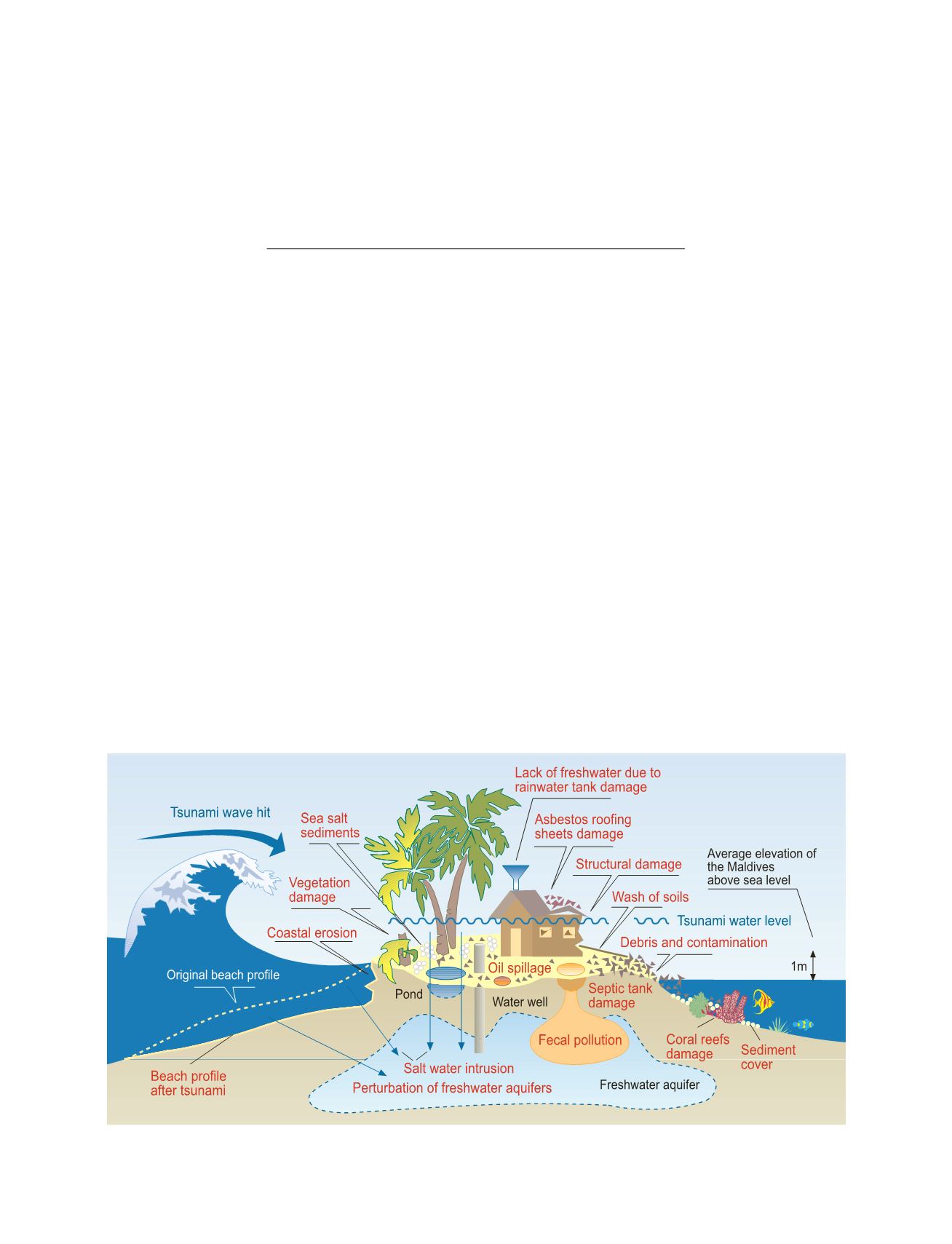
Environmental impacts of the Asian tsunami in the Maldives
Image: UNEP Asian Tsunami Disaster Task Force