


 12 / 156

national drive is to ensure that educational programmes and
public information integrate the notion of natural hazards and
disaster risk attenuation measures. It will aim at advocating that
the education and information about natural hazards and disas-
ter reduction reach as wide an audience as possible. Schools,
industry, the mass media and non governmental organizations
(NGOs) can play an important role. At the same time,
programmes for the general public can serve to stimulate politi-
cal support for long-term mitigation and preparedness measures.
Scientific and technological solutions to the complex problems
of disasters must be rooted in social realities, in the fullest sense
of the term. Science needs to be seen only as part of a continuum
of action extending from the design of interdisciplinary research
to the communication of results to diverse non-specialist user
groups and to formal and informal education. Beyond the
advancement of science and technology, UNESCO advocates their
blending with other disciplines, notably with traditional knowl-
edge, for every society harbours its own distinct way of
determining how to act and react in relation to disasters. In
Thailand, the 196 members of the Mokens of the Surin Islands,
known as ‘people of the sea,’ who were living in a tsunami-
thrashed village, all survived the devastation of the 26 December
2004 disaster. As they noticed that the seawater had quickly
receded, they knew they had to flee from it and go to higher places
immediately.
A number of steps can be taken to integrate disaster reduction
and development planning. Perhaps the most important among
these steps is for governments to build capacities among managers
and disaster-specialists to enable them to pursue strategic plan-
ning for disaster risk reduction and implement it in development
projects. Capacity-building and education for disaster reduction
and human security should not be a one-off affair, but rather a
continuing process, offering individuals lessons in coping with
hazards not just once but several times throughout their lives.
Furthermore education and raising awareness of disaster risks
must respond to society’s changing needs and focus on empow-
ering individuals throughout their lives.
The promotion of global and regional initiatives targeting capac-
ity building on specific hazards and themes is providing useful
platforms for cooperation. Over the past three years, UNESCO
has been associated with the launch of the International
Consortium on Landslides (ICL), the International Flood
Initiative (IFI) and with regional efforts. The objectives of the ICL
are to promote landslide research and capacity building, notably
in developing countries; to integrate geosciences and technology
within the appropriate cultural and social contexts in order to
evaluate landslide risk in urban, rural and developing areas; to
combine and coordinate international expertise in landslide risk
assessment and mitigation; and to promote a global, multidisci-
plinary programme on landslides. The secretariat for ICL is hosted
at Kyoto University. The purposes of the IFI are to promote an
integrated approach to flood management, in order to maximize
the long-term benefits of floods and minimize the loss of life,
goods and other assets that result from floods. The operational
arm of this initiative is the International Centre for Water Hazard
and Risk Management (ICHARM) in Tsukuba, Japan, which has
been established under the auspices of UNESCO. At the regional
level, projects are carried out in the Mediterranean and in South
Asia.
Jointly with the US Geological Survey, UNESCO is imple-
menting projects on capacity building regarding earthquake risk
in the extended Mediterranean region and in South Asia. The
purpose is to assess, evaluate and help reduce expected earth-
quake losses in those regions. The projects facilitate the exchange
of data, software and expertise through the provision of work-
shops, and enable the development of joint activities. Several
regional organizations have been involved in programme work-
shops. Similarly, in the framework of the Tehran-based
International Institute of Earthquake Engineering and Seismology,
an alliance for cooperation on earthquake risk reduction in central
Asian cities is being promoted.
The need for capacity building in effective information and
appropriate action was demonstrated with dramatic clarity by the
Indian Ocean tsunami. Scientists were aware that one of the
mightiest earthquakes known had occurred deep beneath the sea
on 26 December 2004, but had no way of alerting people in the
path of the ensuing tsunami. A timely warning could have saved
tens of thousands of lives. The tsunami early warning system
established by UNESCO in the Pacific in the 1960s has been a
quiet success for nearly four decades. Sadly, it took a loud disas-
ter to wake up the world to the need for similar systems for other
oceans and seas. It is to be recalled that the tsunami programme
of UNESCO’s Intergovernmental Oceanographic Commission
(IOC) had recommended the creation of early warning systems
in the Indian Ocean and in the Caribbean long before December
2004, but this advice had not been heeded. No single country
can adequately protect itself from tsunamis without an interna-
tional network composed of hundreds of observation stations.
Following, and immediately after the Indian Ocean calamity,
the IOC has been coordinating the efforts of two-dozen countries
in the Ocean region in order to build a regional early warning
system. This truly cooperative tsunami warning system is now in
place and is operating as of July 2006. The architecture of the
system consists of the simultaneous operation of two distinct
components:
• Internationally coordinated detection networks of
instruments
• A network of 28 national tsunami warning centres.
The third essential component is an effective education and
preparedness programme. The IOC is also assisting the countries
to carry out needs assessments in respect of material and capac-
ity building requirements, and in relation to public awareness
and risk reduction needs. Recommendations have been delivered
[
] 12
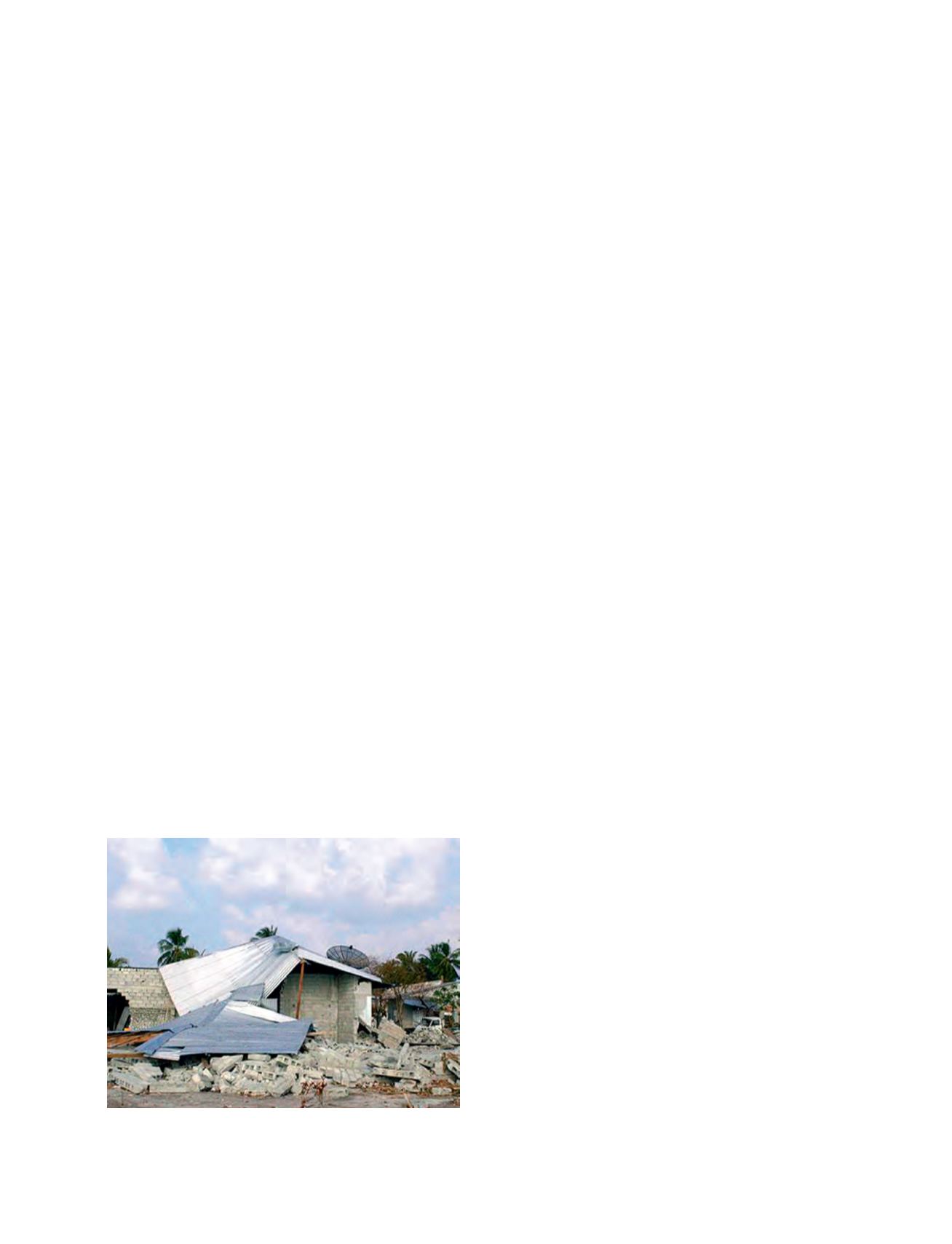
School buildings in the Maldives destroyed by the tsunami
of 26 December 2004
Photo: UNESCO/H. Hakeem