


 21 / 156

feature restricted to regions of low rainfall. It originates from defi-
cient precipitation over an extended period, which results in water
shortage for some activity, group or environmental sector.
6
Drought drives farm families off their land and livestock produc-
ers out of business, and brings hardship to water-dependent
enterprises. It may cause loss of income, in turn creating revenue
shortfalls for local governments. It can have devastating impacts
on the lives of migrant agricultural workers, and can lead to
conflicts over the use of water for humans or ecosystems.
7
The conceptual definition of drought, as a protracted period
of deficient precipitation resulting in extensive damage to crops
and loss of yield, is important in establishing drought policy. For
example, the Australian Government provides financial assistance
to farmers only under “exceptional drought circumstances,” when
drought conditions are beyond those considered part of normal
risk management.
8
The operational definition of drought helps identify its begin-
ning, end, and severity. For agriculture, this might compare daily
precipitation values to evapotranspiration rates to determine the
rate of soil moisture depletion, and express these relationships
in terms of drought effects on plant behaviour (i.e. growth and
yield) at various stages of crop development. It could be used in
an operational assessment of drought severity and impacts by
tracking meteorological variables, soil moisture, and crop condi-
tions during the growing season.
9
Drought in Africa
African farmers often lack the information and resources to
develop and implement a water conservation/drought plan.
Planting crops becomes a gamble, based on the assumption that
there will be enough rain to produce a successful harvest. The
risk is spread across the continent, where much of the total area
is vulnerable to drought with low and medium rainfall, largely
explaining the critical food situation across Africa.
Water availability constitutes the primary natural constraint to
agricultural development in Africa, but only 4 per cent of its
renewable water resources go into irrigation, compared to 40 per
cent in Asia. Only 7 per cent of African arable land is irrigated.
In addition, there is low use of yield-enhancing inputs such as
improved seeds, breeds or fertilizers.
10
Consequently, over one-fifth of the population of Africa’s 30
countries (26 per cent of 832 million people) is undernourished.
In 2003, 23 out of 53 countries experienced food crisis. Nearly
38 million people are facing food emergencies, while around 207
million are chronically hungry, a number that is growing in
absolute terms.
Minimizing risk and the impacts of drought demands an
emphasis on community-based drought preparedness. This
entails the integration of drought management plans, especially
mitigation strategies and preparedness, with sustainable devel-
opment plans and the inclusion of drought in comprehensive
water management, land use, and long-term planning strate-
gies.
According to the AU/NEPAD secretariat, integrating DRR with
development can only be sustained if disaster management insti-
tutions are themselves sustainable. Their governance must
improve to develop the requisite capacity; access to adequate and
secure resources; focusing interventions on the needs of people
at risk; participatory processes; and coordinating activities with
other stakeholders.
11
Long-term drought impact reduction strategy
UNECA’s advocated strategy aims to increase resilience to
drought-related disaster based on a greater measure of self-help,
self-reliance, and self-determination. Preparedness measures,
particularly for comprehensive drought planning and proactive
mitigation, are essential to lessening the impact of drought and
reliance on emergency measures.
Interventions should focus on disaster planning and proactive
mitigation programmes within the framework of the AU and
based on NEPAD’s guiding principles for owning and leading
Africa’s development process. Planning should help coordinate
[
] 21
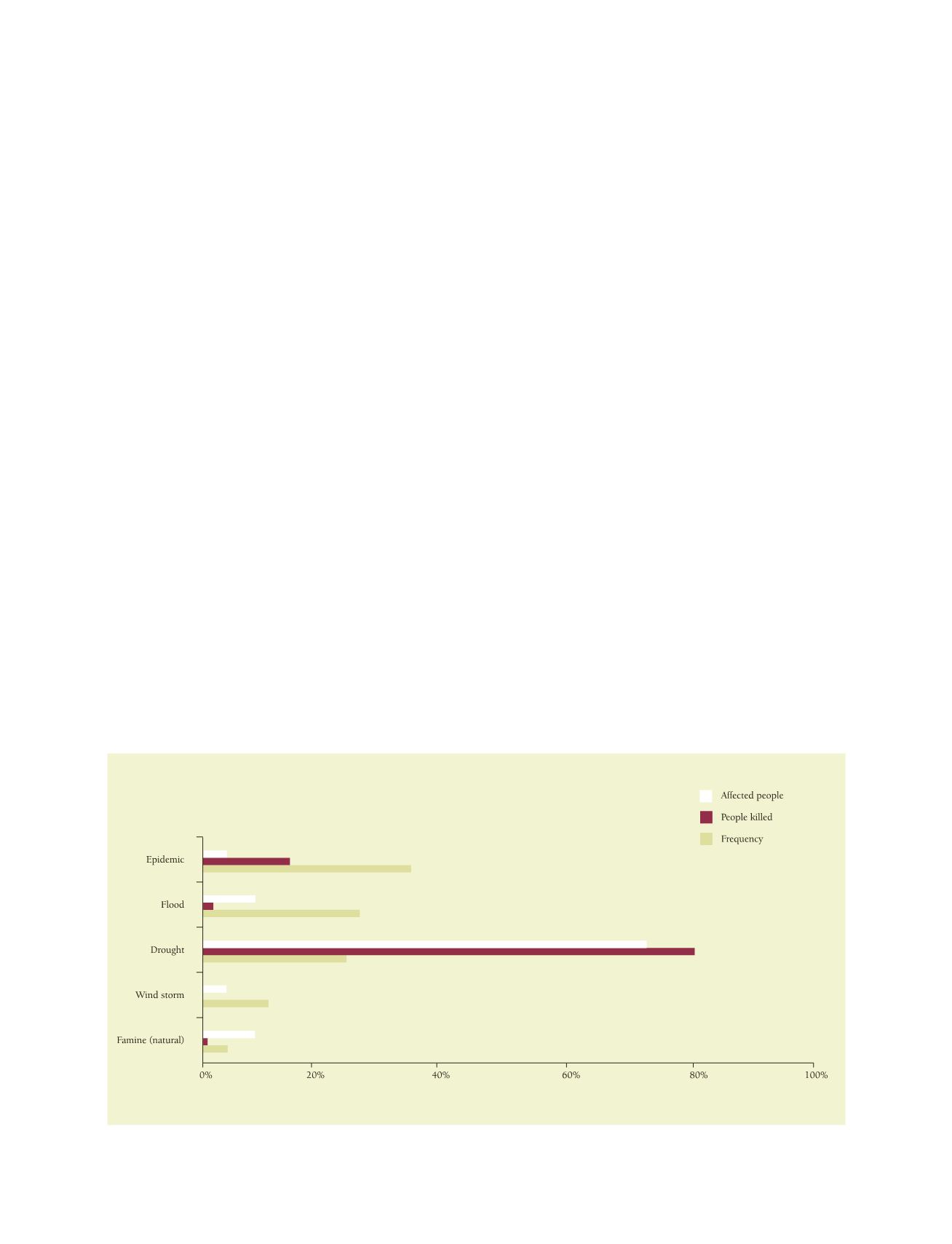
Source: ADRC, 2002
Disasters: frequency and damages in Africa, 1975-2000