


 25 / 156

efforts, the sector contracted by 52 per cent in 2005 (72 per cent
in the case of crops).
In the case of tourism most of the measures have centred on the
training of locals to improve their level of skills and on the diversi-
fication of the tourism product. Hurricane Ivan created a mismatch
between the demand and supply of labour, which had important
gender effects. Reconstruction activities required labour skills
(demand for skilled labour) that were not found among those who
lost jobs (supply of unskilled labour) due to the effects of the hurri-
cane.
Notwithstanding the devastating effects of the disaster, the
OECS/ECLAC report identified safety valves such as cruise ship
tourism, which if appropriately identified and managed could act as
buffer stocks to the general economic downturn. For 2005, tourism
contracted by 35 per cent with regard to the previous year. The
number of stopover passengers dropped by 4 per cent in 2004 and
by 27 per cent in 2005. Contrarily, the number of cruise ship passen-
gers rose 56 per cent and 20 per cent for the same years.
In terms of the social sectors, reconstruction efforts have been
fairly successful in the case of education and health. The World
Bank reports that at the beginning of the school year in September
2005, all secondary schools reopened on time and only 12 per cent
of all schools did not reopen. Most schools have by now been
restored. In the health sector, a greater part of the affected infra-
structure has been restored to its normal levels of operation, and
reconstruction activities involve the use of disaster resistant stan-
dards.
However, in the housing sector many homeowners have rebuilt
residential homes using the same materials that they used before
Hurricane Ivan. This left them as vulnerable as before to natural
disasters. In cases where different materials were used for construc-
tion, these include asphalt-based material, which can represent a
fire hazard. Thus government and agencies’ efforts to show people
the procedures they should follow in order to rebuild ‘better,’ have
not been very successful.
In the same vein, there are no discernible welfare effects of the
measures taken and policies implemented. Grenada is still charac-
terized by a social context that is not conducive to natural hazard
risk reduction. Grenada exhibits a high rate of unemployment
(currently estimated by unofficial sources at 30 per cent), high levels
of poverty (29 per cent of households are poor) and of poor house-
holds headed by females (42 per cent of the total), significant elderly
dependency ratios (32 per cent), with teenage fertility rates of 17
per cent. Moreover the country has a significant informal sector
where official rules and regulations do not apply.
7
The systemic devastation caused by Hurricane Ivan, the massive
donor response, the number of measures and policies put in place
to mitigate the damage and the lack of complete preparedness on
the part of the population to face such an event, make Grenada in
the hurricane’s aftermath a source case for the study of natural disas-
ters. From the available data and information we can draw several
lessons that can inform the type of policies needed for risk rehabil-
itation and reconstruction approaches to increase a country’s
resilience to natural disasters.
First, it is necessary to view natural disasters as a recurrent rather
than an isolated event. Although awareness of natural disasters and
risk is raised in the immediate aftermath of the disaster, these
concerns tend to subside with the passage of time. Ultimately,
natural disasters are conceived as a one-time, unlikely event. A major
question is how to incorporate the recurrent nature of natural disas-
ters into real risk analysis when the time frame for natural disasters
to recur far surpasses that of people’s decision-making horizon.
Second, once natural disasters are understood as recurrent events,
it follows that their effect can be cumulative. Rehabilitation, miti-
gation and risk reduction policies have yet to address and
incorporate the ‘natural disaster cumulative factor.’
Third, natural disasters create impending gaps between the need
for the skills required for reconstruction and mitigation purposes
and those available in the population stock. In the case of Grenada
the reparation of hotels, yachts and housing needed specialized
skills that were not found among those who were left without work
due to the impact of the hurricane (mainly unspecialized and
unskilled female labour). Training programmes and, more to the
point, improved skills must become part of any education policy.
Fourth, natural disasters have an inescapable gender dimension.
In the case of Grenada, at the time of the hurricane, more than half
of the labour population working in the tourism sector and more
than half of heads of households were females. However, females
cannot easily move as males do from the tourism sector to the
construction sector, which is generally the sector that experiences
high rates of growth in the aftermath of any disaster due to recon-
struction activities. Thus, policies must address the differentiated
effect of a natural disasters on men and on women.
Fifth, there are sectors (or sub-sectors) that are resilient to natural
disasters – that is, whose performance was not affected by the
occurrence of a natural disaster. In the case of Grenada, the activity
in the cruise ship sub-sector was unhampered by Hurricane Ivan
and in fact, the number of passengers actually increased during the
aftermath of the event. The Government must identify these hurri-
cane buffer-stock or safety-valve sectors. They can play a crucial role
in reconstruction activities – and in risk mitigation in general –
because these are the sectors that prevent the effects of a natural
disaster from being totally widespread.
Finally, policymakers, stakeholders and the general population of
a country must be cognizant of the fact that there are delays in the
implementation of reconstruction and risk mitigation measures and
policies. And more importantly, they must be aware that in general,
in developing economies there is a divide between policy design
and implementation, with the former far surpassing the latter. Thus,
the focus should be placed on the degree to which any given policy
design can be implemented and on ensuring that there are proper
mechanisms in place for implementation.
8
[
] 25
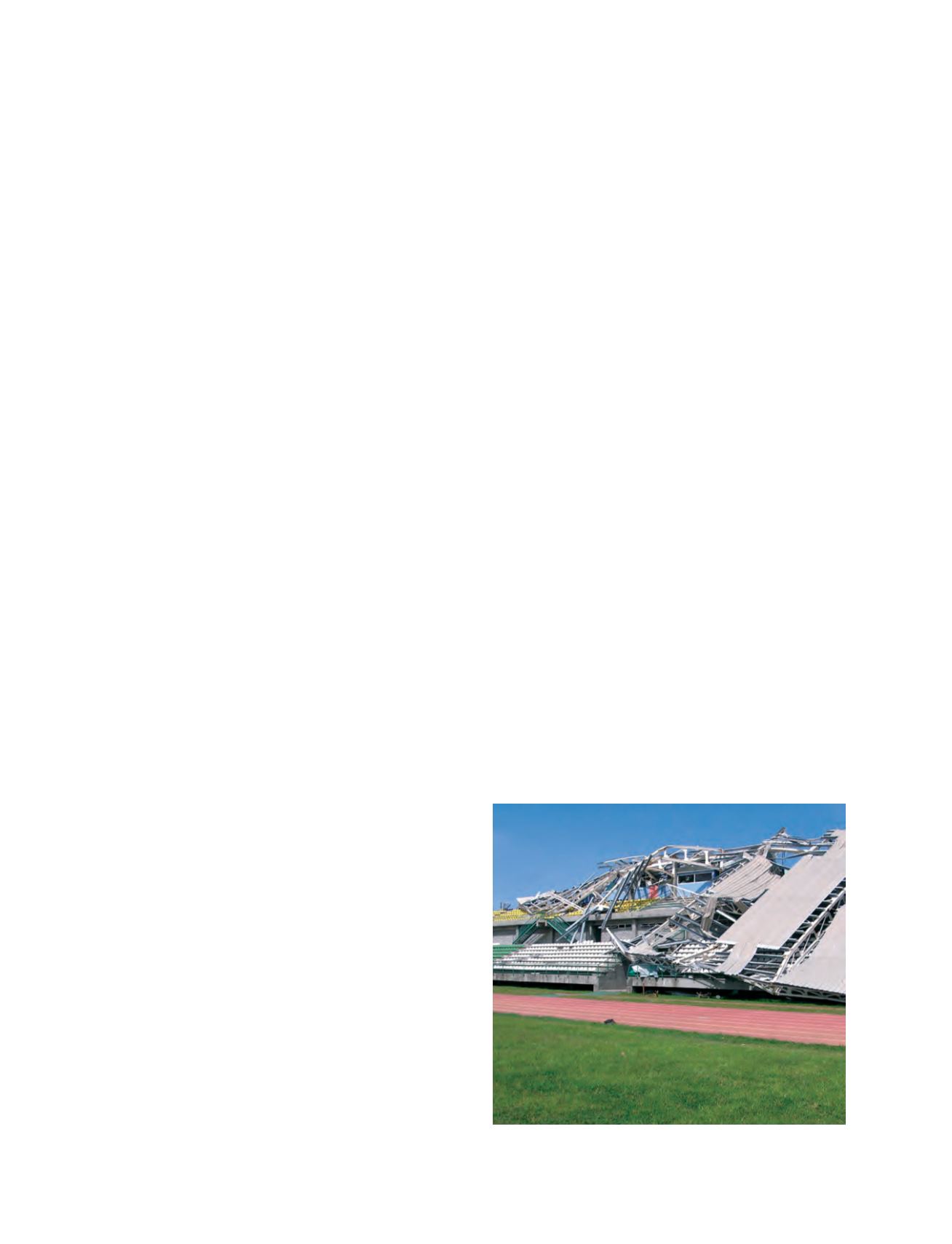
The effects of Ivan on Grenada’s National Stadium
Photo: ECLAC