


 30 / 156

[
] 30
clearing house, matching requests and offers of assistance.
Donations needing transportation were coordinated by the Allied
Movement and Coordination Centre, in conjunction with the
EADRCC. Additionally, two civil aviation experts were deployed
to the EADRCC on 9 September to help coordinate civil trans-
port requirements.
Relief items were consolidated at Ramstein Air Base in
Germany. Donations were moved there either by road or by NRF-
assigned tactical airlift under the command of Joint Command
Lisbon. All cargo consolidation in Ramstein from European
donors was completed by 19 September 2005. More than 90
flight hours were flown by French, German, Greek and Italian C-
130 and C-160 tactical NRF-assigned transport aircraft.
By 2 October, 12 NATO cargo flights had taken relief supplies
from Europe to the United States and some 189 tons of relief
goods, including food, first-aid kits, medical supplies, generators
and water pumps, were delivered via the NATO air-bridge.
Pakistan relief operation
Two days after the South Asian earthquake of 8 October that left
more than 73,000 people dead, 70,000 injured and some 4
million homeless, Pakistan requested NATO assistance for the
humanitarian relief operation it was mounting. The North Atlantic
Council agreed to help and approved a two-stage alliance
response.
The first stage focused on the air-bridge. The EADRCC estab-
lished links to its members’ national aid coordinating bodies and
the Pakistani authorities. The EADRCC worked in conjunction
with the NATO military authorities to coordinate the response
of members of the EAPC willing to channel their assistance
through this mechanism.
On 13 October 2005, the EADRCC received the first request
from the office of the UN High Commissioner for Refugees
(UNHCR) to airlift 10,000 tents, 104,000 blankets and 2,000
stoves from Turkey to Pakistan. Several other requests from UN
agencies followed. The first NATO relief flight to Pakistan arrived
on 14 October. At the request of the Pakistani authorities, prior-
ity was initially given to moving tents and blankets, with the
majority of the relief items being provided by the UNHCR.
Eventually, some 160 flights delivered about 3,500 tons of relief
goods.
Forty-two out of 46 EAPC members provided assistance to
Pakistan, including through the EADRCC. The NATO air-bridge
was used by 19 EAPC and two non-EAPC countries – Malta, and
Bosnia and Herzegovina – as well as by the UNHCR, the World
Food Programme and the UN OCHA.
Military liaison officers were dispatched to the EADRCC and
embedded in the Centre’s working structure while civilian experts
from the Senior Civil Emergency Planning Committee’s Transport
Planning Boards provided assistance to the EADRCC, Supreme
Headquarters Allied Powers, Europe and the NATO Maintenance
and Supply Agency from their usual places of business when
needed. By the end of the operation, all assistance offered to
Pakistan through the NATO air-bridge had been delivered.
The second stage of the operation added elements drawn from
the NATO Response Force, including a deployed headquarters
command and control structure, engineering units, helicopters
and military field hospitals, all with appropriate support. NATO
worked closely with both the Government of Pakistan and the
UN on a daily basis and was plugged into the UN cluster system.
NATO’s contribution to the relief operation was to maintain the
air-bridge, support intra-theatre lift, restore critical road infra-
structure and provide makeshift shelter and medical support. The
aim of these relief activities was to help earthquake survivors make
it through the winter.
By early December 2005 most elements were in place and
contributed effectively to the relief efforts in the Bagh region,
which the Pakistani authorities had identified as the area for the
NATO relief operation on the ground.
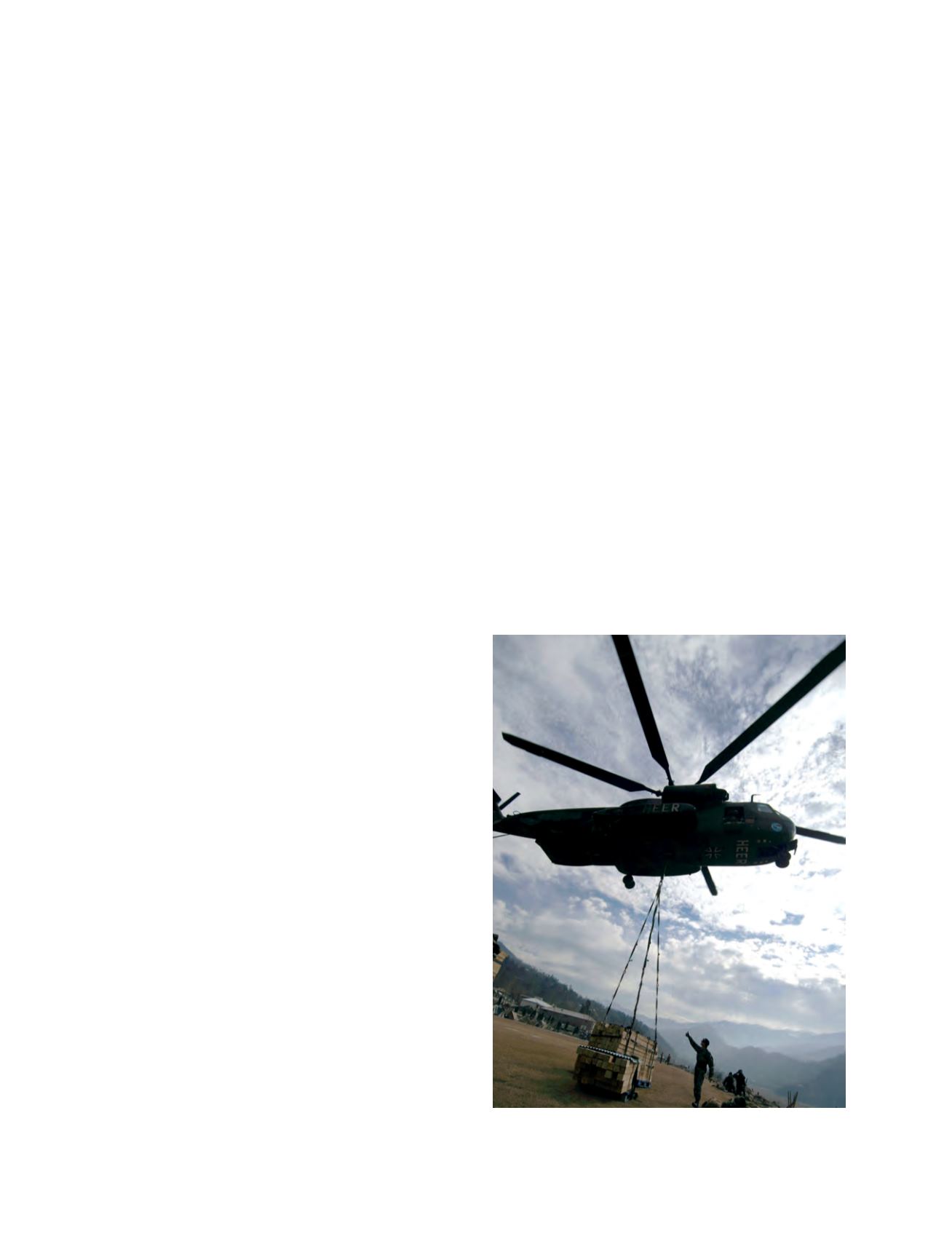
NATO helicopters lifted more than 1,700 tons of relief from
Islamabad to forward supply dumps and from there directly to
the point of need. They moved more than 7,500 sick, injured and
displaced from the immediate earthquake zone. The NATO heli-
copter-refuelling site refuelled more than 1,000 helicopter flights
from the international helicopter force. The NATO field hospital
accepted nearly 5,000 patients and treated a further 3,500 with
mobile medical teams. NATO engineers built more than 110
multifunctional shelters at high altitude and cleared and repaired
60 kilometres of road, removing some 42,000 cubic metres of
debris. NATO engineers also provided fresh water for more than
1,000 people per day and repaired a permanent spring water
distribution and storage system to serve a further 8,000 people
per day. By 1 February 2006, all NATO units had left the Bagh
region for a staging area, from where they then travelled back to
their home countries.
In addition, after initially contributing to the relief effort on a
bilateral basis, Canada placed its Disaster Assistance Response
Team (DART), under the NATO operation. DART medical person-
nel treated some 10,000 patients and left a clinic behind when
they withdrew. Ottawa also made helicopters and water-purifi-
cation units available and financed three helicopters for three
months for the UN.
1
Helicopters have proven essential in the first phase of a disaster-relief
operation when roads are too badly damaged to be passable
Photo: SHAPE