



 29 / 156

Firstly, only very few allies, such as the US, are capable of trans-
porting significant relief capabilities rapidly over great distances
to stricken areas and to sustain the effort. Secondly, NATO’s
primary contribution is the coordinating, liaising and facilitating
function that the EADRCC and the alliance’s military structures
provide. These enable smaller allies to contribute capabilities,
such as a military hospital or water purification unit, that they
would not be able to contribute on their own. In addition, this
coordination role that characterizes NATO-led operations has
proven useful both to the authorities of the receiving country and
to the UN, which was thereby able to deal with a single actor
rather than many.
Can NATO take a decision on disaster relief almost as quickly
as a national government? In general, when there is a precedent,
the alliance is able to move rapidly. The decision to set up an air-
bridge to Pakistan, for example, could be taken quickly, above
all, because there was already a precedent, namely the airlift to the
US in the wake of Hurricane Katrina. The decision to send
medical personnel and engineers to Pakistan, by contrast, took
longer as there was no precedent at the time for sending military
personnel to a non-NATO (or partner) country for a disaster relief
operation.
In the wake of both the Hurricane Katrina and Pakistan relief
operations, the alliance is now carrying out a lessons-learned exer-
cise. Once this has been completed and issues such as the
funding of certain elements of the operation are resolved, it might
be possible further to reduce response times. In this way, NATO
decision-making could be almost as quick as that of the national
authorities of an individual ally.
Funding reform
Looking ahead, one of the most important issues that needs to be
resolved before either NATO as a whole or individual allies again
make military capabilities available for disaster relief operations
is that of appropriate funding mechanisms. If, as at present, the
defence ministries of those countries that are asked to provide
helicopters for a future disaster relief operation are also expected
to carry the entire financial burden of their engagement, they may
decide that they cannot afford to become involved. Unless new
funding mechanisms are developed, intervention for disaster relief
would eat up a great portion of the defence budget. Meanwhile,
the first responders, both nationally and internationally, would
essentially be receiving help for free.
Some steps to reform and improve funding mechanisms were
already put in place during the Pakistan relief operation by indi-
vidual countries. In the United Kingdom, for example, the
Minister for International Development, Hilary Benn, decided to
cover the additional operating costs caused by the deployment
of three Chinook helicopters and a regiment of engineers out of
the international development budget. By using another budget
line, Benn was also able to make a significant financial contribu-
tion to the NATO ‘trust fund’ that met the costs of the air-bridge.
The benefits of Benn’s improvised arrangement are clear. In
this way, a department for international development does not
need to operate and deploy its own fleet of helicopters, thereby
avoiding duplication of assets. Moreover, depending on how costs
are calculated, this solution is likely to be considerably cheaper
than any arrangement involving the leasing of commercial heli-
copters if, indeed, they are available. Of course, there may be
other consequences of such an approach. A defence ministry
might, for example, decide to acquire more helicopters. But even
in this case, overheads, training and maintenance can be limited
to one organization instead of two or more.
In order to institutionalize such arrangements, however, it will
also be necessary to revise definitions of what constitutes official
development assistance (ODA). It seems that the financing of
military helicopters for disaster relief operations does not qualify
as official development assistance under current definitions. As
a result, there is a disincentive for development ministers to copy
the initiative of their UK counterpart in Pakistan. But given that
many countries are forging ever-stronger working relationships
between ministries of international development, defence and
foreign relations, it might be time to reassess the ODA criteria.
In the case of the Pakistan relief operation, such a move would
be especially appropriate since the UN asked NATO to provide
an air-bridge and to deploy helicopters. Logic demands that either
NATO nations be allowed to book some of the additional costs
incurred by their militaries to the international assistance and
development budgets or that the UN reimburse them directly out
of funds collected to pay for the relief operation. Since 1989,
many walls – both real and virtual – have been removed. It may
now be time to tear down some of the institutional divisions that
exist between the worlds of international assistance and devel-
opment on the one hand, and the military on the other.
Katrina relief operation
As the scale of the devastation wrought by Hurricane Katrina in
the states of Alabama, Florida, Louisiana and Mississippi on 29
August 2005 became apparent, the EADRCC offered its services
to the US. That was on 2 September. A day later, an official US
request for assistance was received and forwarded within an hour
and a quarter to the capitals of all 46 members of the Euro-
Atlantic Partnership Council (EAPC). At Washington’s request,
an EADRCC liaison officer was deployed on 4 September to work
with the Federal Emergency Management Agency and the Office
of Foreign Disaster Assistance in Washington, DC.
The first two offers of assistance arrived on 4 September and,
in total, 39 EAPC members provided assistance through the
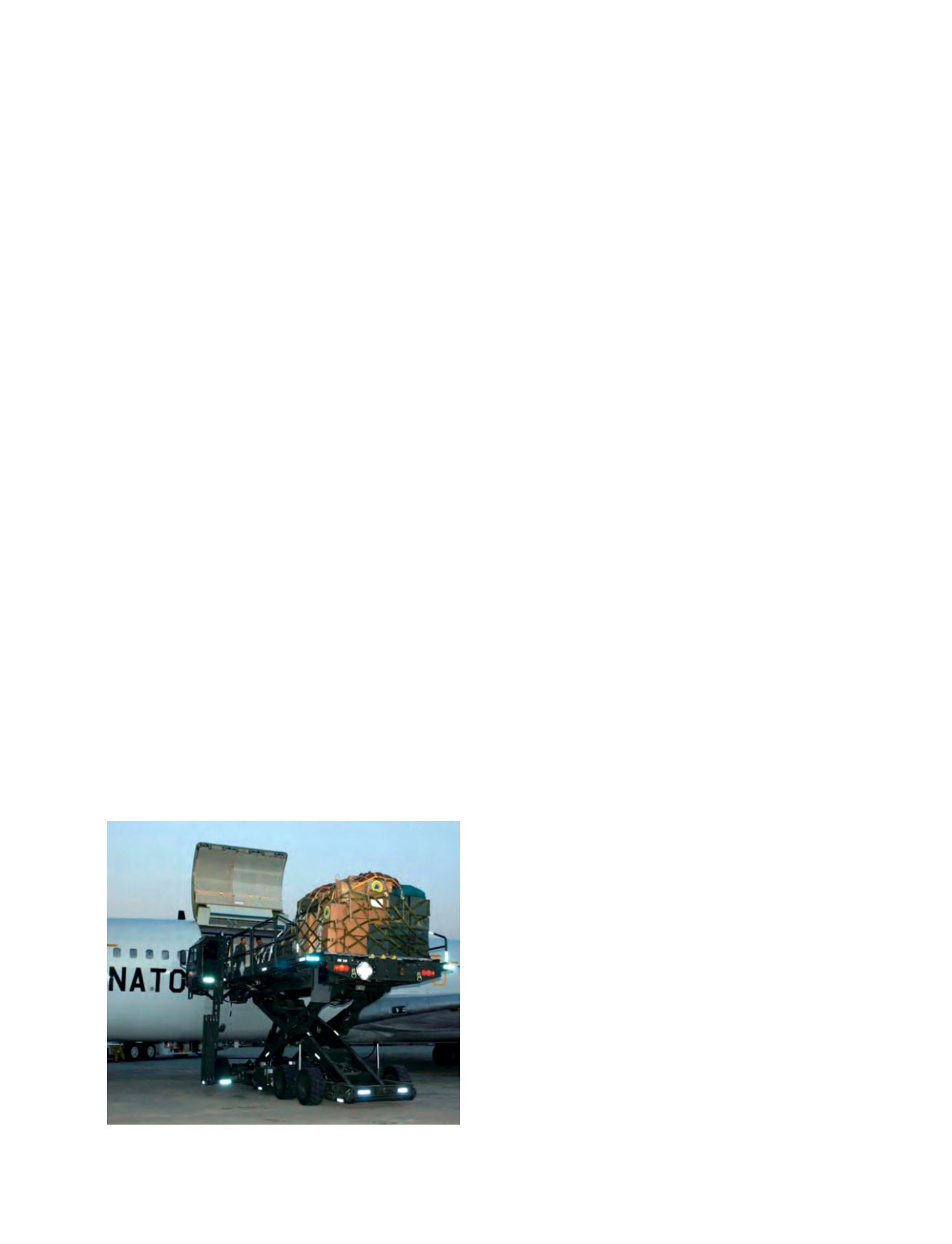
EADRCC. On 8 September, the North Atlantic Council autho-
rized a NATO transport operation consisting of NATO’s Airborne
Early Warning fleet training and cargo aircraft and NATO
Response Force (NRF) air and sealift to help move urgently
needed items from Europe to the US. The EADRCC acted as a
[
] 29
Loading relief aid for Hurricane Katrina victims
Photo: SHAPE