


 34 / 156

ling companies. Traditionally, modelling companies have based their
forecasts on averages, calculated over a period of 100 years or so. No
explicit account was taken of shorter-term phenomena with decadal
intervals of higher or lower than normal years of storm activity.
In early 2006, one of the leading modelling companies announced
that it was adopting a five-year, forward-looking view of risk for esti-
mating potential catastrophe losses rather than using a long-term
historical average baseline in its modelling. This was done to address
the company’s perception that there is likely to be a period of more
frequent and more intense storms related to higher sea surface
temperatures in the tropical North Atlantic, and to associated
changes in the atmosphere. As a result, the modelling company’s
US hurricane model will increase modelled annualized insurance
losses by 40 per cent on average across the Gulf Coast, Florida and
the Southeast, and by 25-30 per cent in the Mid-Atlantic and
Northeast coastal regions, relative to those levels derived using long-
term 1900-2005 historical average hurricane frequencies.
Ratings agencies have also changed their methodologies as a
result of the severe hurricane season. In the autumn of 2005,
insurance information company A.M. Best announced that it
would continue to use the Best Capital Adequacy Ratio (BCAR),
but will update the underwriting risks to reflect the current envi-
ronment. According to A.M. Best, these changes are not likely to
lead to rating downgrades. However, reinsurers are responding
to the rating and modelling changes by reducing limits in high
catastrophe zones as well as attempting to move exposures to
other financial sectors.
Capital comes charging
The losses of 2005, compounded by the pressure for more capital
from ratings agencies, have led to the need for more risk capital.
Capital markets have responded in a dynamic fashion to this need
for more risk transfer. For example, within a few months following
Hurricane Katrina, the group of 17 top reinsurers in Bermuda had
replaced all of the capital lost in 2005. At the same time, capital was
forthcoming to finance the start-up of 13 new companies.
Further evidence that insurance markets had attracted the inter-
est of investors can be observed in the increased activity in
catastrophe bonds, which directly link investors to insurance risk.
In 2005, total issuance was a record USD2 billion, a 75 per cent
increase over the USD1.14 billion of issuance in 2004. And this
momentum has continued in 2006. In fact, based on our knowl-
edge of transactions completed this year and those in the pipeline,
total new issues in 2006 could be double those of 2005.
1
In terms of less direct investment in reinsurance ventures,
following the record losses from Hurricane Katrina, new capital
raised for insurance and reinsurance entities exceeded USD20
billion, of which USD8.5 billion went to new start-ups.
Hedge funds increased their presence in insurance markets in
2005, investing in start-up reinsurers and other insurance vehi-
cles, or ‘sidecars,’ which were brought to the market after the
2005 hurricanes. A sidecar is a special purpose vehicle in which
third-party private investors, such as hedge funds, provide extra
[
] 34
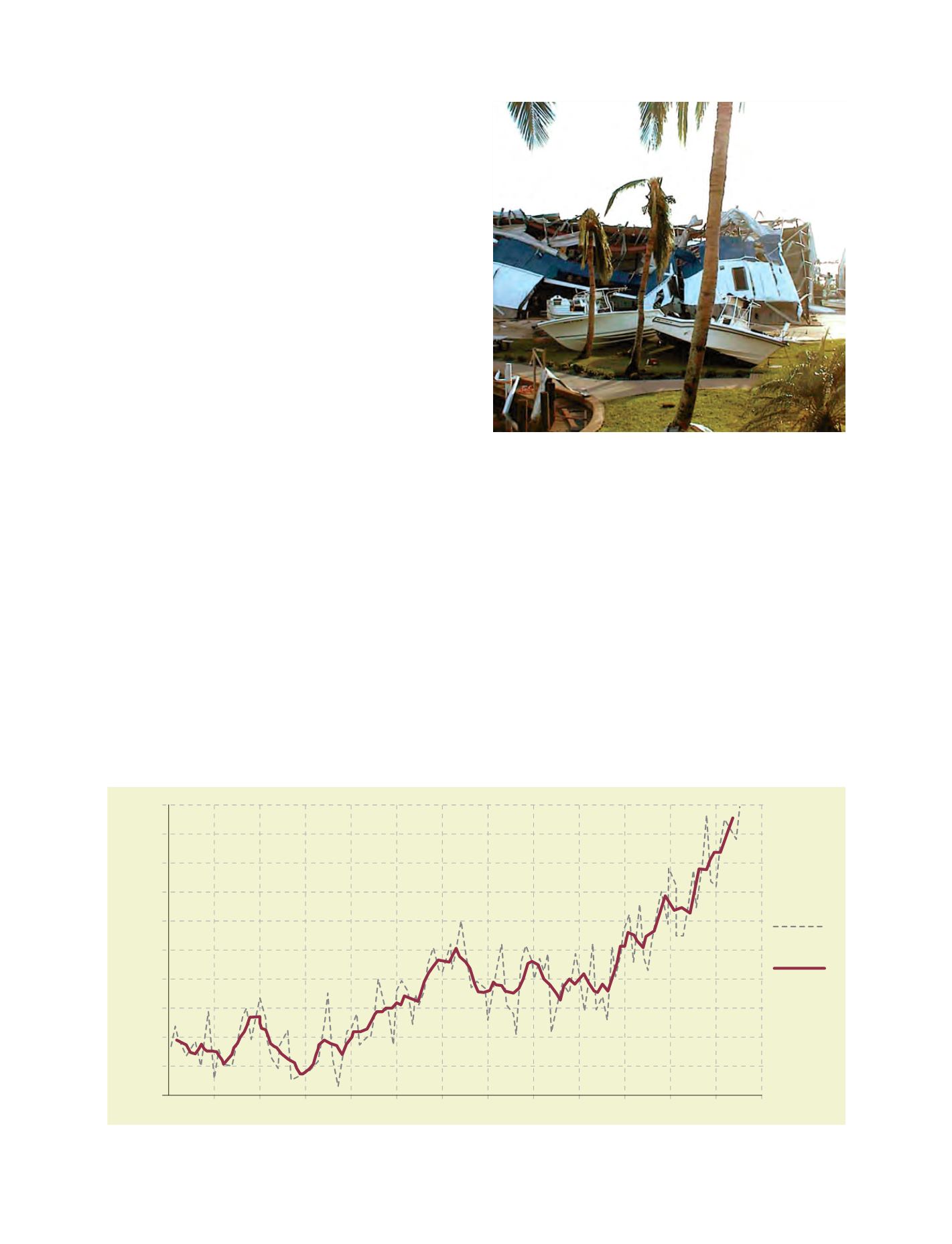
Hurricane damage in the Caribbean
1880
-.4
-.2
.0
.2
.4
.6
1900
1920
1940
1960
1980
2000
Temperature Anomaly (˚C)
Annual Mean
5 Year Mean
Hurricane severity: Increases in land and sea temperature
Source: Goddard Institute for Space Studies, Global Temperature Increases
Photo: courtesy of Herman Kokojan