


 37 / 156

Background of
Afat Vimo
“Microinsurance is the protection of low-income people against
specific perils in exchange for regular monetary payments (premi-
ums) proportionate to the likelihood and cost of the risk involved.
As with all insurance, risk pooling allows many individuals or
groups to share the cost of a risky event.”
7
Microinsurance products are increasingly important for disas-
ter risk reduction. They transfer financial risk from vulnerable
individuals to the insurance market. Generally, insurers bundle
several hazards in one contract; this allows premiums paid for
better-understood hazards to reduce the rates of less predictable
ones such as earthquakes.
8
Afat Vimo
is a version of microinsur-
ance designed for the poor among the vulnerable. It protects
people from the impacts of hazards on their assets by providing
cash payouts in the aftermath of a disaster. Monthly premiums are
paid to the insurance companies through AIDMI.
Afat Vimo
promotes learning across insurance companies,
authorities, donor communities, and non-governmental orga-
nizations (NGOs) to facilitate the convergence of microfinance
tools and disaster risk reduction strategies. The
Afat Vimo
scheme represents an innovative approach to risk identification,
pooling and transfer, which recognizes the fact that the major-
ity of poor disaster victims have little or no access to risk transfer
schemes.
The
Afat Vimo
project has arisen under the Regional Risk
Transfer Initiative of the ProVention Consortium; it builds upon
the significant work done on risk identification undertaken by
the ProVention Consortium through the Disaster Management
Facility and Hazard Management Unit of the World Bank and the
International Federation of Red Cross and Red Crescent Societies.
The main objective of
Afat Vimo
is the convergence of micromit-
igation and microinsurance as a precondition for effective local,
low-cost risk transfer.
Demand for insurance
In 2002, the majority of beneficiaries from Gujarat earthquake
relief were still exposed to disaster induced financial losses.
Studies including the Gujarat Community Survey of 2002 by
AIDMI and ProVention Consortium revealed that access to risk
transfer is correlated with sustainable economic recovery among
victims.
9
AIDMI found that only two per cent of those surveyed
had insurance. As a result, AIDMI designed a microinsurance
scheme to augment its ongoing Livelihood Relief Fund activi-
ties.
10
The resultant scheme was the product of extensive
discussions and negotiations with insurance providers who might
be interested in supplying low-premium insurance policies to
poor clients. This was a challenge.
Product description and client profile
Afat Vimo
policyholders are covered for damage or loss up to the
value of USD1,744 for non-life assets and USD465 for loss of life
– giving a total coverage of USD2,209. Current
Afat Vimo
clients
include individuals from low-income households with an annual
income of USD280. These households are mainly involved in
small enterprises in the informal sector and have assets worth
approximately USD209.
Disasters such as fire, explosion, riots, malicious damage,
aircraft damage, cyclone, tempest, flood, inundation, earth-
quake, lightning, implosion, strike, impact damage, storm,
typhoon, hurricane, tornado, and landslide are covered under
the scheme.
Afat Vimo
policyholders are also supported with
micromitigation measures such as fire-safety training, seismic-
safe construction practices and business development services.
The policy is available for an annual premium of less than USD4
(approximately three days’ wages). Damage to policyholders’
house, household assets, trade stock, and loss of wages incurred
by accidents are covered. The life of the earning household
member is also covered.
Afat Vimo
is a partner-agent microinsurance model, where
AIDMI has brought together a group of poor communities and
commercial and public insurance companies have developed a
policy to cover them against 19 disasters.
AIDMI is both the facilitator and intermediary of the
Afat Vimo
scheme. Firstly, the
Afat Vimo
team compiles a list of potential candi-
dates eligible for the scheme based on their registered demands.
Once the insurance companies have designed operational policies
[
] 37
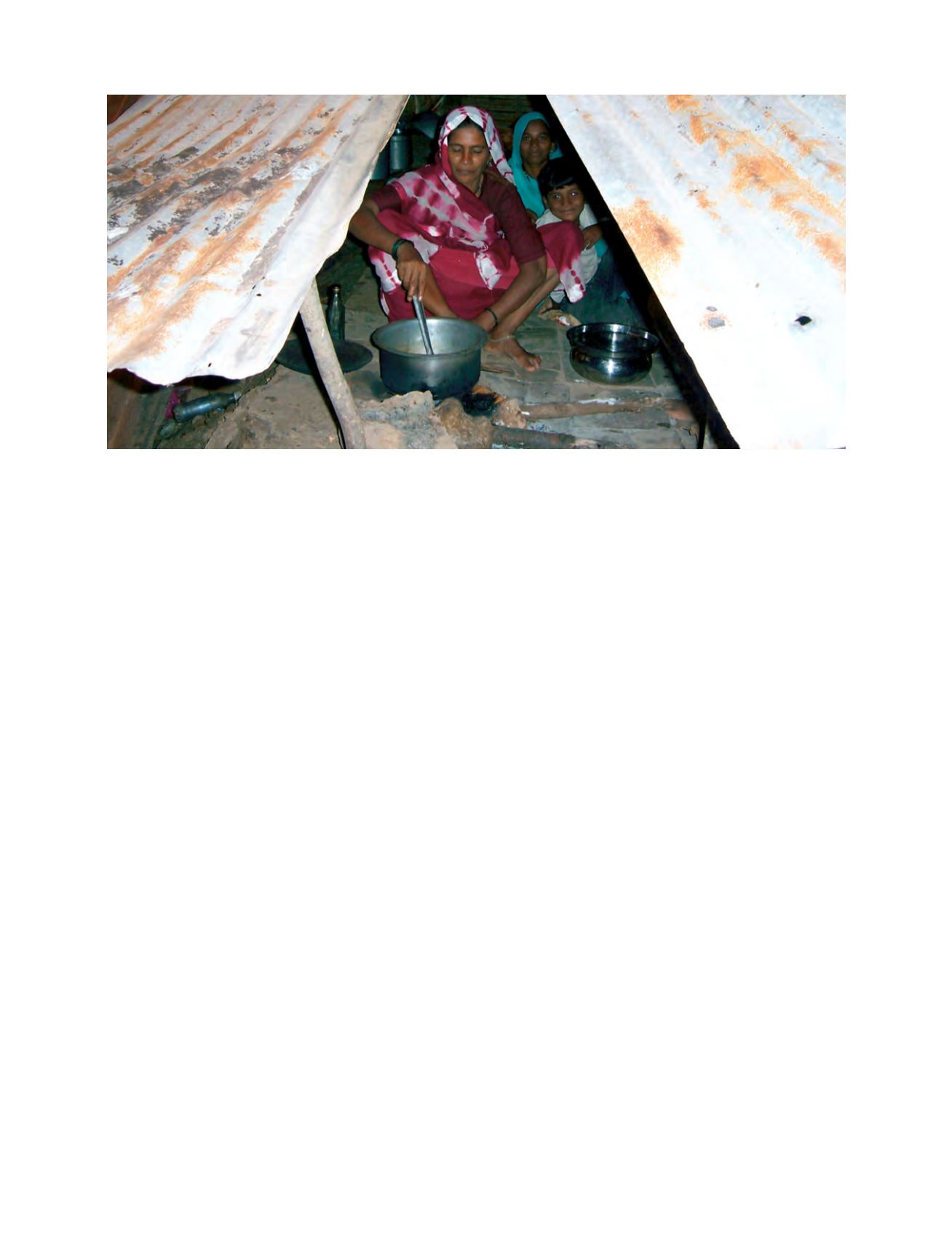
Though insurance can provide immediate cash for replacing essential assets following disasters, the poor are mostly unprotected
Photo: AIDMI, Gujarat flood recovery 2005