


 39 / 156

together under one policy. According to a recent study by the
International Labour Office, 45 per cent of the microinsurance
schemes researched cover only a single risk.
12
Only 16 per cent
of schemes cover three risks, making
Afat Vimo
one of the most
simple and comprehensive products in India. This not only makes
the policy more attractive to clients, but also makes investment
in it more efficient in economic terms. Another aspect that sets
Afat Vimo
apart from other microinsurance policies is the exten-
sive range of eventualities covered. To combine micromitigation
with microinsurance, community capacity building and involve-
ment in
Afat Vimo
has provided more stability and viability.
Reducing an entity’s disaster risk is possible through increasing
that entity’s physical/material, social/organizational, and behav-
ioural/motivational capacities.
13
Using this framework,
Afat Vimo
is successful in reducing community risks to disasters.
Physical/material goods are insured and can be replaced after loss
and damage; social/organizational capacity is supported as informal
businesses are brought together and receive a product unafford-
able to individuals directly; motivational/behavioural capacity is
built as understanding of risk and disaster issues is increased.
International initiatives have strengthened the impact of
Afat
Vimo
. The Hyogo Framework for Action has brought attention,
discussion, resources, and commitment to disaster risk reduc-
tion and to finding opportunities to address it. The United
Nations (UN) Year of Microcredit facilitated commitments via the
‘Disaster risk mitigation: Potential of microfinance for tsunami
recovery’ conference in October 2005. Delegates spoke on the
strengths of microfinance as a tool for poverty and disaster risk
reduction, and experiences of microcredit and tsunami recovery.
The
Afat Vimo
team was able to exchange lessons with other prac-
titioners on its microinsurance product and how microfinance
may be used for recovery. It learned about opportunities working
with primary stakeholders to combine support grants and
microinsurance services, and was able to share progress and
opportunities from the
Afat Vimo
experience.
Corporate sector
Increasingly, partnerships with private commercial sector actors
are being forged for the application of microfinance and risk
reduction. Much can be learned from private sector insurance
providers in terms of risk management; they have a wealth of
experience that can be shared, and this can facilitate the provision
of microinsurance policies for the poor. AIDMI has engaged in a
commercial partnership with the Life Insurance Company of India
to provide life insurance, and the Oriental Insurance Company to
provide non-life insurance cover under the
Afat Vimo
scheme. It
also continues to raise awareness of the opportunities and bene-
fits of insurance provision to the low-income strata of
communities. There is additional scope within microinsurance
to motivate private sector insurance companies to develop and
provide products for low-income individuals as initiatives for their
own corporate social responsibility.
Challenges
Though defrauding is one of the most common challenges for the
microinsurance sector, AIDMI has experienced only one incident
of a false claim. Premium defaulting is another challenge, and the
retrospective collection of payments from clients can be seen as a
threat to the long-term sustainability of the
Afat Vimo
scheme.
At present, AIDMI must absorb all of the operating costs of the
programme, and recovers only the premium total from the benefi-
ciaries. AIDMI must therefore shoulder all the administration costs
and the costs of premium collection, field visits, supervision and
claims assistance. In terms of long-term sustainability, this means
that unless the clients meet the operating costs, the scheme is not
financially self-sustaining. In addition, there are a number of
reasons why beneficiaries do not renew their policies – migration,
inability to pay, and low desire to renew are believed to be factors.
On a broader scale, commitment among donors and interna-
tional organisations should exist for similar risk transfer initiatives
to refine and thrive. AIDMI is a core manager of the Tsunami
Evaluation Coalition’s forthcoming thematic evaluation on “The
Impact of Tsunami Response on Local Capacities”. Under this
initiative, stakeholders in Maldives and Sri Lanka (in April 2006)
have clearly identified the need for risk transfer. This need, however,
is not articulated broadly and remains latent.
The 2005 Community Survey by AIDMI and the Disaster
Emergency Committee identified low levels of risk transfer aware-
ness among communities of India, Sri Lanka and Indonesia.
Organisations across the Asian Region should identify and initi-
ate opportunities for similar experiments for transferring risk
from the poor.
Next steps
There is clearly scope for additional capacity building exercises
designed to impress upon beneficiaries the long-term benefits of
insurance coverage and the importance of continued coverage.
Additionally, greater emphasis on adherence to the correct proce-
dures for making claims to the insurance companies should
[
] 39
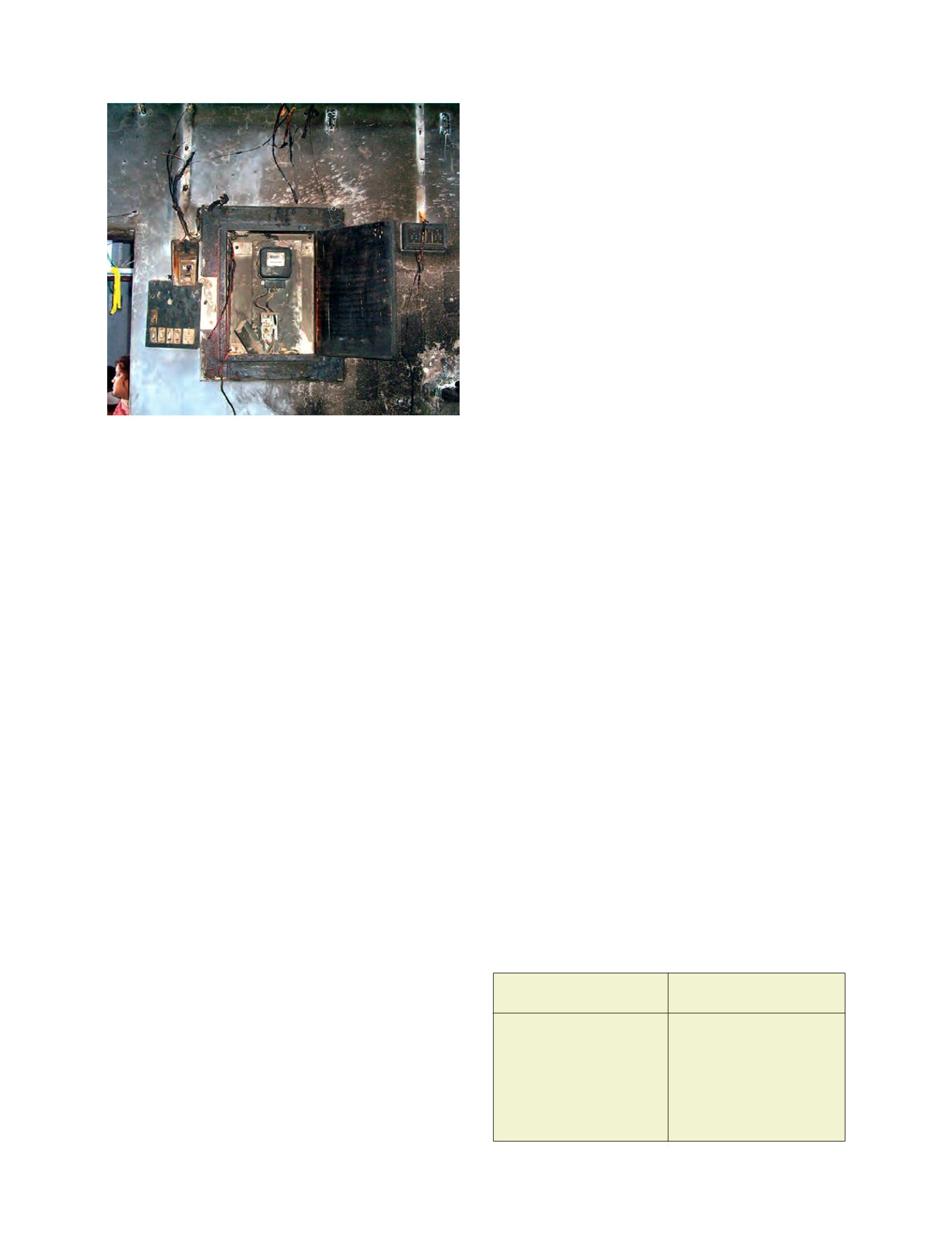
The poor face disasters on a day-to-day basis.
Afat Vimo
covers risks that
have impact on a small and large scale
Photo: AIDMI, Gujarat communal riot recovery 2002
Disasters covered by
Afat Vimo
Cyclone/hurricane, flood,
earthquake, fire, explosion, riot,
malicious damage, aircraft
damage, tempest, inundation,
lightening, implosion, strike,
impact damage, storm, typhoon,
tornado, and landslide.
Typical loss/damage from
disasters in South Asia
Life, income, livelihood assets,
household assets, shelter, health,
livestock, crops.