


 45 / 156

[
] 45
Furthermore, disaster risk analysis is not an activity that should
be led from the office meeting room. Assessment must happen ‘on
location’ where the risks are faced: in the community. This core
agenda suggests the classroom as a prime location for community
vulnerability assessment. Participatory vulnerability tools are now
numerous,
4
and ActionAid’s Participatory Vulnerability Analysis
(PVA) tool is one example.
5
Aside from schoolteachers, local and district civil servants are on
the front-line of any ‘culture of safety’ drive. Governments must
consider the training needs of their local and district offices, and
must develop an ongoing training programme that will cope with
the reality of high staff turnover. The successful completion of the
‘last mile’ of DRR will rely on this.
A thriving culture of safety cannot rely only on government
actions. All children and communities should learn about local
hazards and what to do about them, and sometimes schools will
not be the most effective way of reaching the most vulnerable.
Non-formal education and the role that the media has to play must
be considered simultaneously.
On the global scale, the media can set agendas, push debate and
spark political will. Governments and NGOs have an ongoing chal-
lenge to work with the mainstream media to find the story in
disaster prevention and risk reduction, not just response. There
are some excellent efforts already. Reuters established AlertNet
6
and has set the benchmark for publishing humanitarian stories
and communicating DRR to a wider audience. The key role of local
media must not be overlooked. In focusing on reducing hazards
and risks in a local context, governments must look to existing local
communication channels to disseminate messages.
Governments should establish working groups that link up jour-
nalists, academics and NGOs to create a regular exchange of
information and resources that bring all to a common understand-
ing of the nature of hazards, the ways different actors can reduce risk
and how to communicate this to the public. The public engagement
opportunity in times of high-profile response must be better exploited
to communicate messages on DRR.
No easy challenge
The ‘last mile’ is really tough. There are several hurdles that stand
between the current situation and the finish line where schools
are safe and playing a role in a culture of safety in the community.
One major obstacle is political will; with many competing prior-
ities, the case for dedicating resources to DRR must be carefully
presented. Another challenge is coordination, or lack thereof,
between key stakeholders. Most obviously, work done at policy
level – for example the Hyogo Framework for Action – must be
put into practice on the ground.
The most vulnerable communities are so often the poorest and
least accessible, and the most overlooked. The finish line will
have been crossed only when any DRR strategy has reached the
most vulnerable. And it is the teachers in these communities who,
with their poor working conditions, low pay and lack of support,
will be expected to lead any widespread programme on DRR
through schools.
Governments have made their commitment to the Hyogo
Framework. Now it is time to put words into practice. With this core
agenda as a starting point, governments must draw up their own
DRR policy agenda and implementation strategy.
This will first mean a revision of the national curriculum at primary
and secondary level. Issues of hazards and reducing risk in the local
reality must feature in the curriculum in order to reduce the vulner-
ability of whole communities to disasters. This is not a blank slate
– around the world, there is a wealth of experience in teaching prac-
tice to draw on, and initiatives such as ActionAid’s DRR in Schools
project will reinforce the efforts of governments.
Children have the right to be safe in school, and governments are
obliged to make systematic efforts to improve the safety and
resilience of schools. A safe school can be a safe haven in disasters
for entire communities. Building standards for school buildings –
both new and existing – must be government-regulated and rele-
vant to local hazards.
A safe school can be a used to instil a culture of safety in a commu-
nity. Governments should take responsibility for promoting a culture
of safety and show leadership. Schools can act as centres for chil-
dren and parents to assess their vulnerability to local hazards. As is
set out in the Hyogo Framework, a culture of safety permeates all
levels of society, and is reliant also on local and district government
and the media. The training and support of local and district public
servants and teachers is fundamental.
Governments are lucky: the steps towards integrating DRR into
existing commitments are clearly marked out. The disastrous
effects of earthquakes, floods and other natural phenomena will
only be reduced once DRR moves into the mainstream public
agenda. Reducing risk through education and knowledge – with
schools at the centre – is a manageable, tangible way for govern-
ments to start. With this core agenda as a foundation that
addresses the curriculum, building safety and a culture of safety,
governments can now negotiate their own specific targets and
objectives with their civil society.
Yasmin McDonnell is Policy Analyst and Jack Campbell is Communications
Officer on ActionAid’s International Emergencies and Conflict Team.
ActionAid is an international development agency with its headquarters in
Johannesburg. Its new five-year rights-based strategy, “Rights to End Poverty”,
tackles head-on the unacceptable truth that poverty and injustice remain deeply
entrenched in many parts of the globe. As part of this strategy, ActionAid works
in emergency and conflict situations with a long-term development perspective,
and is a leading voice on Disaster Risk Reduction.
For more information.visit
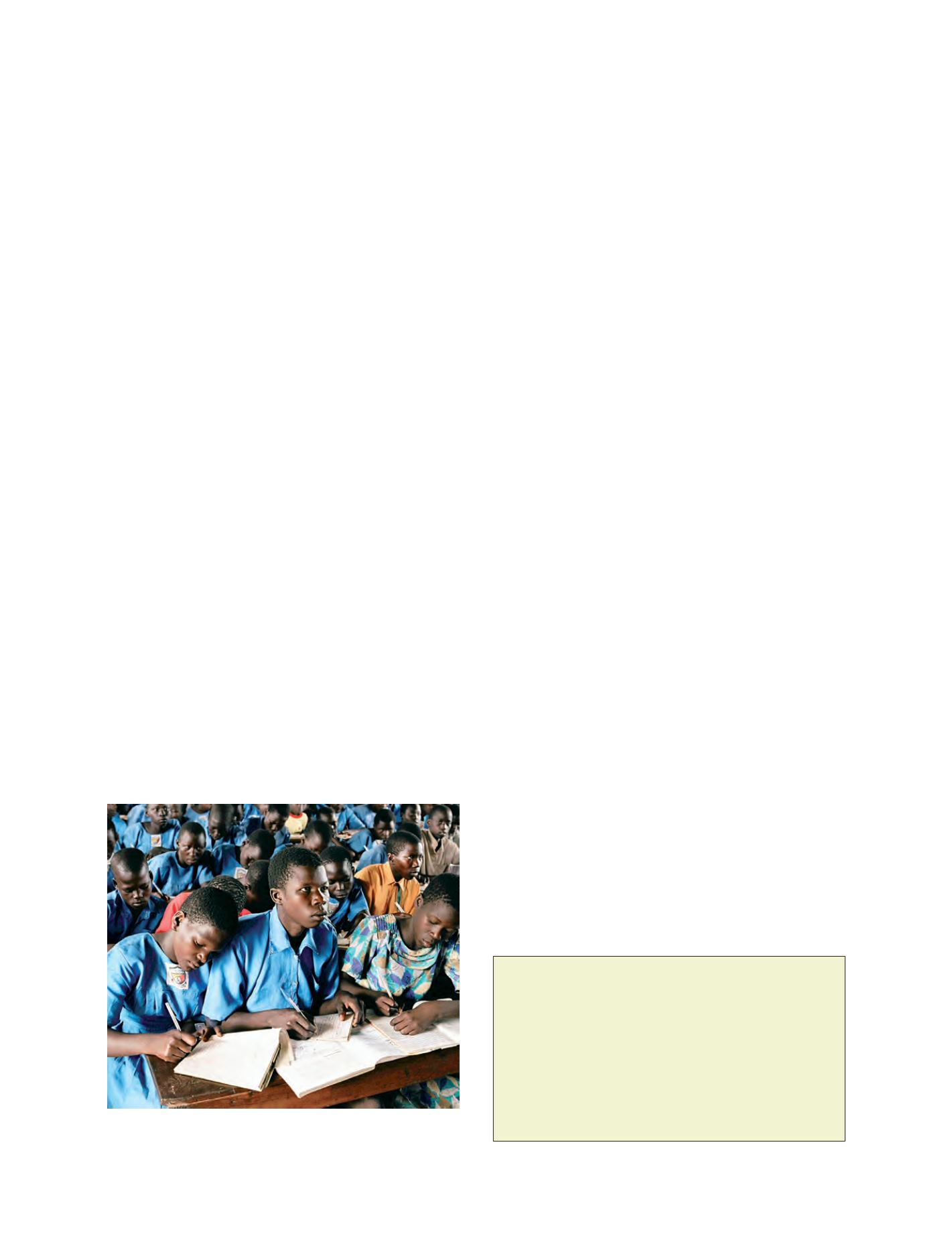
http://www.actionaid.org.uk/100261/disaster_risk_reduction.htmlSchools, both new and existing, must be designed and located to be
resilient to disaster. Children have the right to be safe at school
Photo: Gideon Mendel / Corbis / ActionAid