


 50 / 156

The micro radio programmes were listened to by all school
students during break times and free classes. A competition
provided motivation for students to listen: on filling out the ques-
tionnaire the second time, students voted anonymously for the
most creative programme and the one that had touched themmost.
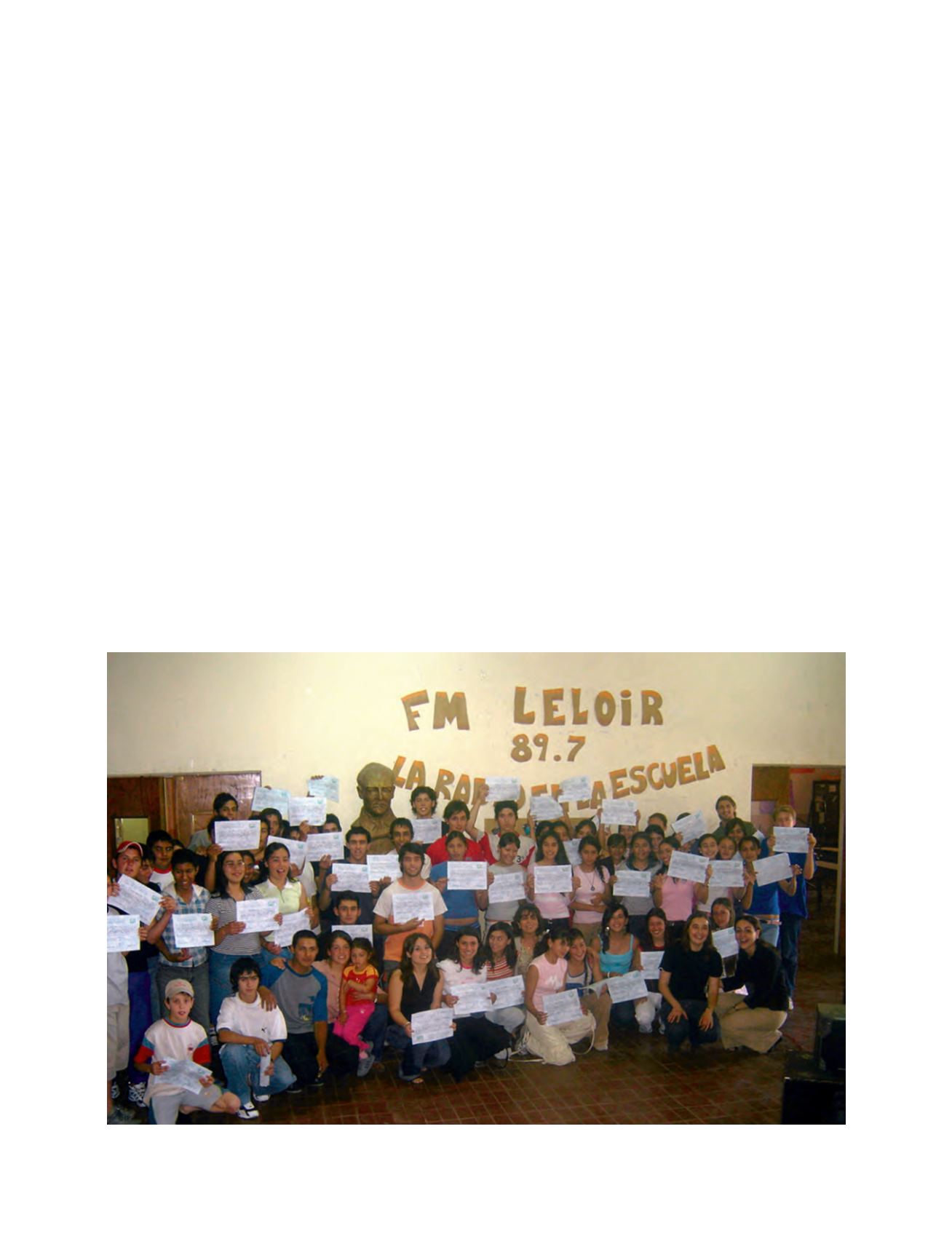
In addition, a special event was organized to hand out certificates
to students that participated in the workshop as a way of recog-
nizing their work and effort. Teachers also received certificates.
Some programmes were jointly listed during this event.
Finally, to disseminate the project, a local newspaper published
details about it and a website is being created. In addition, letters
and e-mails were sent to different mass media.
Further supporting activities accomplished to reach the objec-
tives included the following:
• Meetings in Mendoza with the team, the mentor, the school
principal, and a member of the non-governmental organiza-
tion Psychologists Without Frontiers
• Visits to the school and the radio
• Bibliographical research to compile special materials about the
chosen risks
• Selection of social communication teachers, meeting them,
providing teacher training sessions about the risks, and coor-
dinating workshops to prepare the microprogrammes
• Invitation posters to participate in the workshops were placed
throughout the school.
Conclusions
Results of the project are being processed. Although we do not yet
have exact quantitative results, the first comparison between the
knowledge on the subject the pupils had before and after listening
to the microprogrammes shows a general increase in knowledge.
In addition, teachers who participated in the project and the
team think that the workshops have prompted reflection about
risk that is not usual in children as well as among adults. This
contributes to raising awareness of the natural risks chosen for the
project, and to spread knowledge on disaster mitigation, especially
among students but also among teachers, the community radio
listeners where the school is located, the students’ families, and
people with access to the Internet or newspapers.
The project also helps to achieve a better use of the school radio
as an educational tool for many subjects. As the workshops are an
enjoyable activity, they enable the children to take part in knowl-
edge building, and thus to learn in a deeper way. Further, tape
recordings of the microprogrammes are a sustainable practice to
introduce material and information about natural risks and their
mitigation into school curricula. This practice is cheap and easy to
embrace in developing countries especially, where the money
destined for prevention is a lot less than is really needed.
What has been carried out so far can be considered the pilot
phase. It is sustainable beyond this point because it could be carried
out in other schools and new programmes could be produced
focusing not only on the natural risk reduction, but also on tech-
nological risk reduction.
In order to reduce the impact of natural risks, it is important to
undertake in-depth studies about the close relationship between
risk mitigation and radio education as an effective strategy to stim-
ulate a preventive culture.
This pioneering idea in this province could motivate the creation
of others in the country and around the world, which grows more
conscious every day of the importance education has in disaster
and risks. Using the radio as an educational tool is a new approach
to education on these topics.
2
[
] 50
Students received certificates at a special event as part of the project
Photo: Maria Alejandra del Campo