


 46 / 156

[
] 46
A
SERIES OF
catastrophic events claiming tens of thousands
of lives in the earlier part of the current decade created
considerable concern among Gujarat citizens, leading to
rethinking about the disaster risk management systems being
followed in the region. The Gujarat earthquake on 26 January
2001 claimed 13,805 lives and amounted to direct losses of over
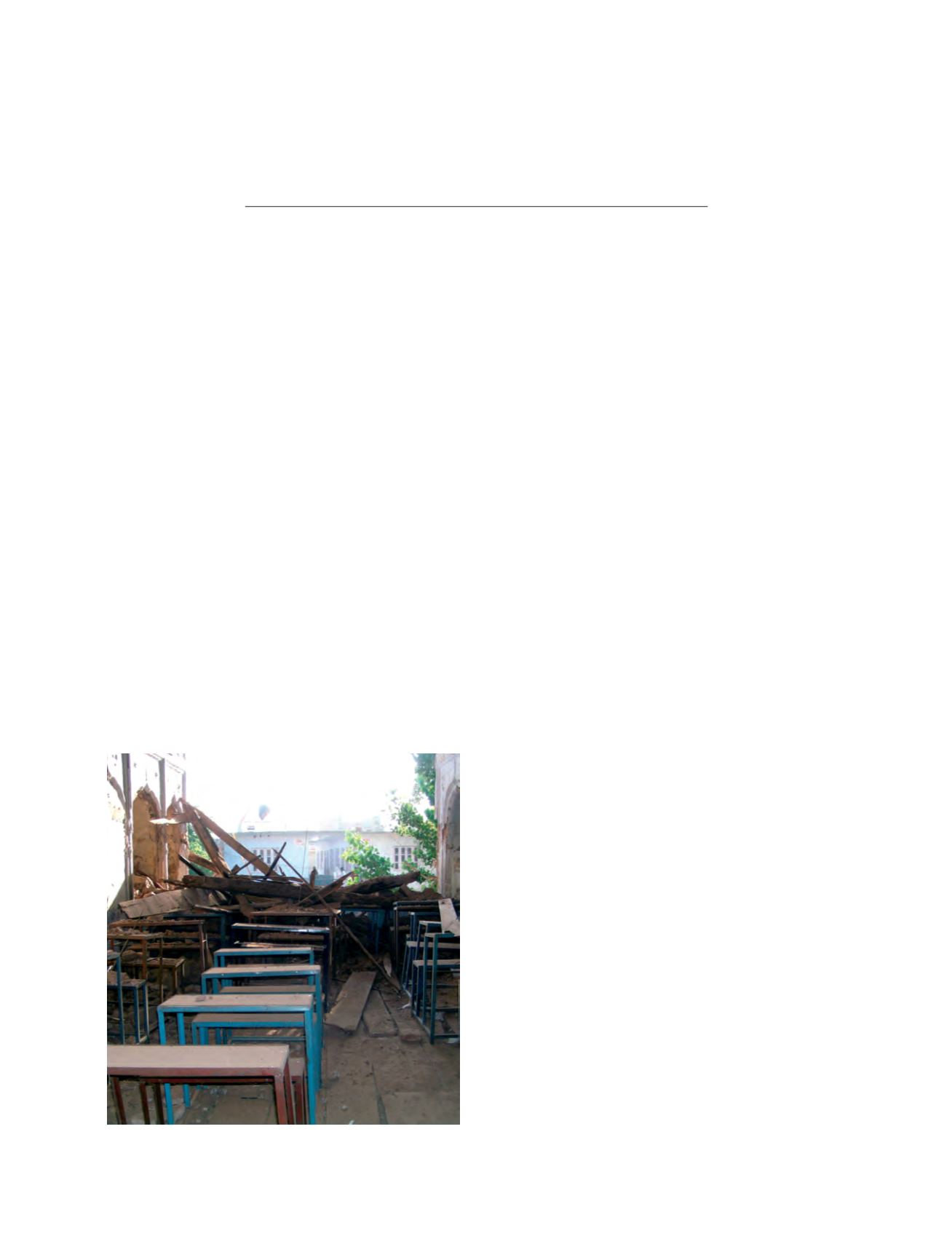
USD3.1 billion. At least 1,884 school buildings collapsed and
5,950 classrooms were destroyed.
The earthquake occurred on a public holiday when the
country was celebrating its anniversary of becoming a repub-
lic. Schools were closed, and therefore classrooms were empty.
However, small contingents of students and teachers who had
gathered for public celebrations were buried under falling
debris. A total of 971 school children and 31 teachers were
killed, while 1,051 students and 95 teachers were seriously
injured. The loss of precious young lives through the destruc-
tion of schools in disasters has fuelled public demand for safety
in schools. The lack of an institutional framework and policy
on disaster mitigation became the biggest barrier for any desired
change.
This earthquake took everyone unaware. The last earthquake
had struck the region almost 50 years ago, and had caused great
damage. However, the lessons learnt then were never put into
practice, and even the fact that the area is earthquake-prone was
lost from public memory. As a result, the town of Anjar, which was
rebuilt after the 1956 earthquake, collapsed yet again in the 2001
earthquake.
Community participation
One significant outcome was the shift of focus towards commu-
nity based disaster risk management. Recognizing communities
as the first responders in disasters, both the Government and
humanitarian agencies began equipping local village communities
and urban neighbourhoods against possible disasters. These
communities were now directly involved in planning, imple-
mentation, monitoring and evaluation at each stage of the disaster
management cycle.
Within communities, specific groups such as school students
and teachers, women, leaders, construction workers and other
‘change agents’ became targets for specialized training and capac-
ity interventions. The Government of India, with support from
UNDP, initiated the Disaster Risk Management programme, cover-
ing 169 multi-hazard districts in the country. This programme
has created a strong institutional structure within the current
administrative set-up that can respond more quickly to disasters.
The recent Disaster Management Act, and the establishment of
the National Disaster Management Authority, has not only vali-
dated but also institutionalized the process of disaster
management in the country.
Schools as pillars of change
Among the various interventions carried out towards disaster
mitigation and preparedness, schools responded most earnestly.
Teachers and students more often took the lead in taking disas-
ter reduction issues into the community. The Government’s
Central Board of Secondary Education introduced disaster educa-
tion into the curriculum for senior classes. The board caters to
900,000 children in schools across India.
Encouraged by the enthusiasm of teachers and students, the
Sustainable Environment & Eco Development Society (SEEDS),
along with the Gujarat State Disaster Management Authority,
designed a pilot programme to promote school safety in the state.
For people in Gujarat this was a case of learning and applying
lessons from their most recent experience in which they had lost
friends and family members. The mutually reinforcing efforts of
government, civil society organizations, school community and
parents have resulted in the programme gaining significant
momentum and appreciation.
In July 2004 an accidental fire at a school in Southern India
claimed the lives of 93 children in a few minutes. Six months
later, in the devastating Indian Ocean tsunami, more than
Disaster reduction in schools
Manu Gupta and Anshu Sharma
Sustainable Environment and Eco Development Society
The Gujarat earthquake of 2001 devastated school buildings and cost lives
Photo: SEEDS