


 44 / 156

curricula to use schools as a conduit for physical scientific knowl-
edge to communities, to inform their practical actions for reducing
the risks they face.
Governments must make commitments to teacher training and
curriculum development to support large-scale teaching of DRR. In
centralized state education systems, teaching on locally relevant
hazards could be incorporated into existing subjects such as earth
science or geography. In decentralized state systems, community-
based vulnerability analysis tools can be used to develop teaching
methods on hazards and risk from the bottom up – centralized
systems should also learn from these tools. Partnerships with non-
governmental organizations (NGOs) and the private sector will be
key to provide training, resources and learning networks.
Physical safety and resilience of schools
It is the right of every child to be safe in school, just as it is for their
parent to be safe at the public library. It is therefore the responsibil-
ity of governments to ensure the physical safety and resilience of
school buildings. This is not a question of cost analysis: safe schools
should be a given.
This can and is being done in some places. The Iranian
Parliament recently announced a new bill (after years of campaign-
ing) that will see the improvement in seismic safety (through
retrofitting and reconstruction) of 39 per cent of its school build-
ings with a budget of USD4 billion. This was based on a
countrywide review of school safety.
2
But the startling statistics that emerged from the 2005 Pakistan
earthquake expose the urgent need for all governments to face up to
their responsibility to ensure disaster risk factors are systematically
incorporated into new school building design and location, and in
the retrofitting of existing buildings. This, as in Iran, may well require
widespread reviews of school safety in the context of local hazards.
The death toll of children in schools in Pakistan is an extreme
example, but other cases where poor design or location decisions
killed children are too numerous. In Italy in 2002, 26 children were
killed when a school collapsed during a moderate earthquake. In
Turkey in 2003, it did not take a powerful earthquake to kill 83 chil-
dren in their building. In the Philippines in February 2006, 200
children perished when a mudslide engulfed their building.
Lessons should and can be learnt. History tells us that they have
– albeit sporadically. In the US, a 1908 school fire killed 172 chil-
dren in Ohio when they were trapped behind inward opening exit
doors. This led directly to a Government ruling on mandatory
outward opening doors and ‘panic-bar’ latches on schools and all
public buildings – an excellent example of how governments can
take a lead in changing practice to save lives.
The MDG and other education initiatives have implications for
the number of new school buildings. No special attention is given in
these initiatives to disaster preparedness. One estimate proposes that
if all EFA initiatives are successful in the 20 most earthquake-prone
countries, an extra 34 million children could be exposed to risk while
attending school – illustration enough of the need to integrate DRR
into existing commitments.
Research finds that simple, cheap changes in building practice
would save lives in disasters. But the technical know-how rarely
reaches the people. This core agenda not only recommends that
governments play a lead role in school building regulation and
retrofitting, but also in disseminating public safety messages and
bridging the gap between scientific knowledge and practical reality.
Policy change and high-tech early warning systems at the national
level are one thing; practice change and dissemination of infor-
mation on the ground is the ‘last mile’ in disaster risk reduction.
3
Governments should seek to develop a legal and institutional
framework for systematically implementing, monitoring and evalu-
ating school protection. This process should involve stakeholders
from all levels.
Promoting a culture of safety through schools
A culture of safety is an environment where everyone is aware of
their local hazards and is active in reducing the resulting risks –
behavioural change must happen at all levels. Governments must
demonstrate commitment and leadership in promoting a culture
of safety.
Schools can play an important role in instilling values of safety
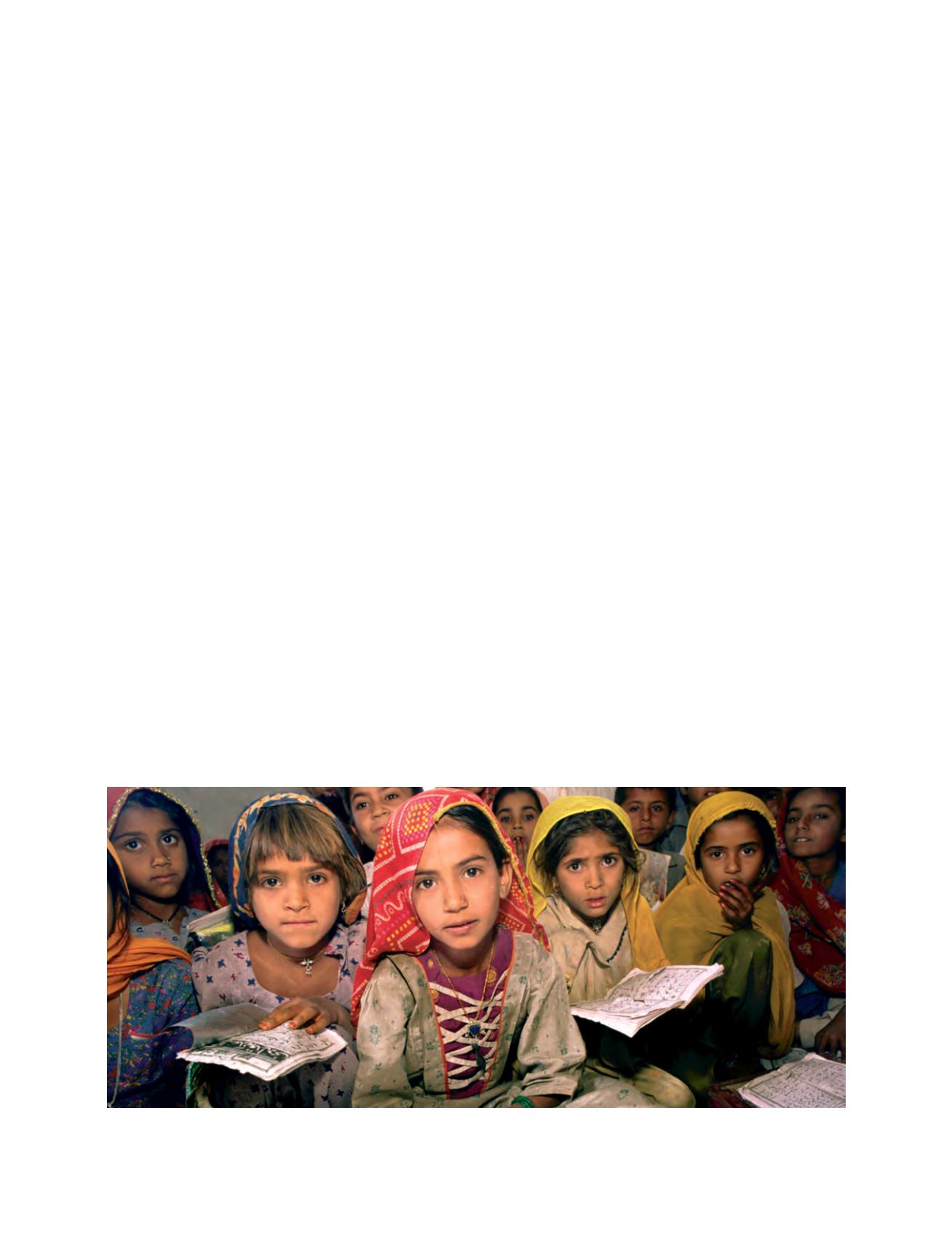
in community life. Children in the classroom can act as a route for
information to families at home. To build a culture of safety at the
community level, governments should look to their education
system to disseminate knowledge and information.
[
] 44
Photo: Liba Taylor / ActionAid
Children must learn about local hazards and reducing risks in the classroom. They can be a route for taking risk reduction messages to parents and
whole communities