


 40 / 156

[
] 40
perhaps be made. This would both reduce the likelihood of claims
being rejected, and increase client satisfaction.
The
Afat Vimo
scheme has tremendous potential for rapid expan-
sion. Currently, microinsurance coverage under the scheme is only
available to communities where AIDMI has presence. Offering a
similar policy in earthquake-affected Jammu and Kashmir and
tsunami-affected areas is being considered. An emergent area of
experimentation and international debate, weather-indexed insur-
ance is being explored as a means of effective management of
catastrophic risk, particularly in vulnerable rural areas. Based on
a round table meeting with the Agriculture Insurance Company of
India and a group of farmers from Kutch, Patan, and
Surendranagar, AIDMI will be covering 1,000 small and marginal
farmers in June 2006 against monsoon. In addition, AIDMI is
about to launch insurance coverage for school children and staff.
Converging interests
In India, partnerships between the commercial sector and NGOs
are increasingly emerging for microinsurance provision. Much
can be learned from private sector insurance providers in terms
of risk management. The impact of
Afat Vimo
has been strength-
ened through national policies that encourage private insurance
companies to provide support to poor clients. The Insurance
Regulatory and Development Authority (IRDA) also plays an
important role in the provision of insurance to the poor. In March
2002, IRDA published a set of regulations applicable to insur-
ance companies operating in India, entitled
Obligations of insurers
to rural social sectors
. Essentially, these regulations establish quotas
of insurance provision to low-income clients.
The establishment of such regulations has greatly increased the
volume of microinsurance policies being supplied to poor clients.
The quota rises each year, reaching a maximum of 16 per cent
after five years of the total number of life policies sold for life
insurance, and five per cent of premium income for other types
of insurance. This condition has generated massive pressure on
insurers, as without selling microinsurance they cannot sell their
more profitable products. IRDA has fined a number of insurers
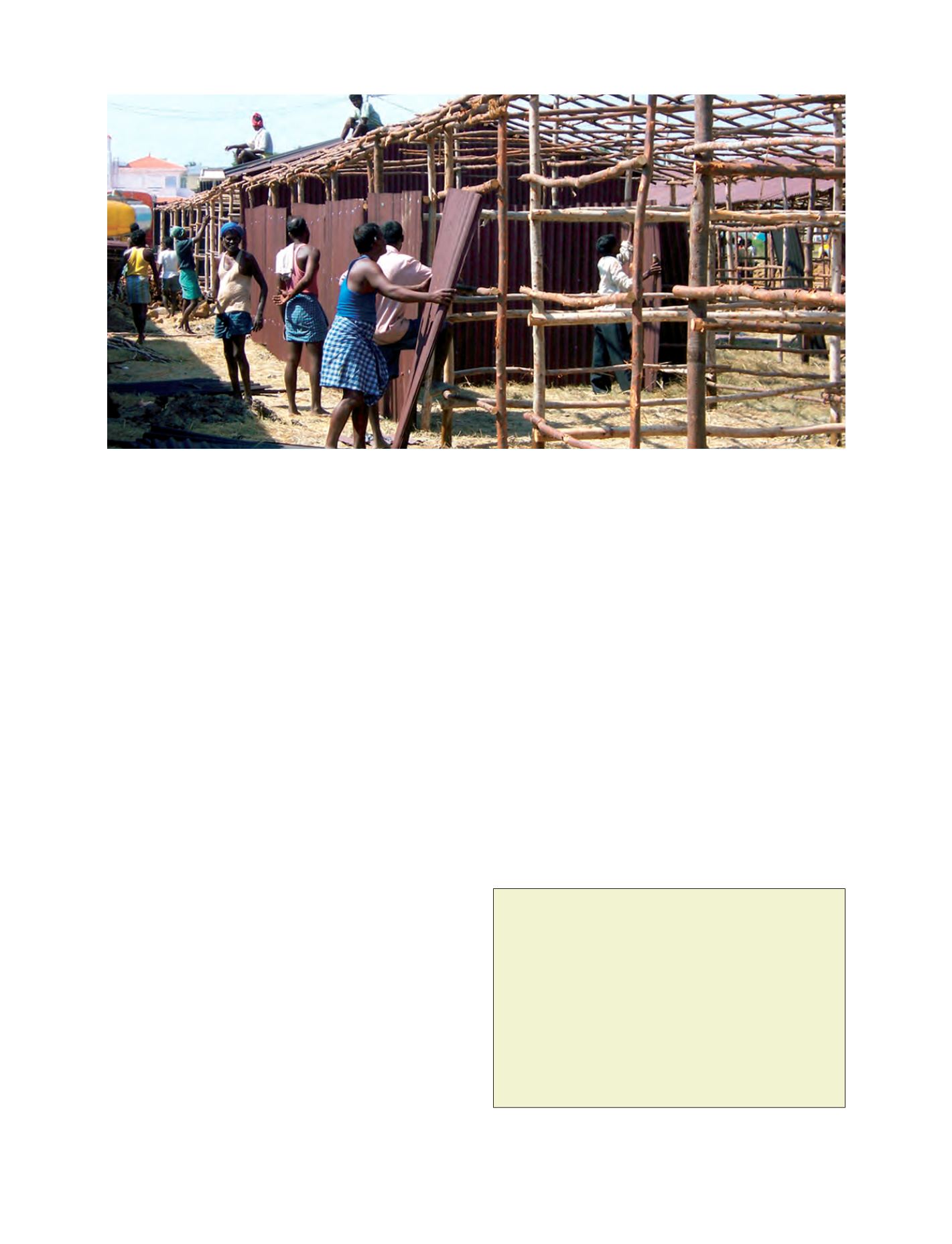
Tsunami recovery is a huge opportunity to transfer financial risks of the poor. Following a major disaster like the 2004 tsunami,
people understand the value of insuring their assets
Photo: AIDMI, Indian Ocean tsunami recovery 2005
Rural areas:
more than 400 population per km
2
or 25 per cent of
workers in agricultural pursuits:
•
Life insurance:
5 per cent of total policies in year 1, up to 16 per
cent in year 5
•
General insurance:
2 per cent of gross premium income in year 1, 3
per cent in year 2 and 5 per cent thereafter.
Social sector:
casual workers, economic vulnerable or backward
classes in urban and rural areas:
• 5,000 policies in year 1; up to 20,000 in year 5 for both life and
general insurance.
Source: Roth, J. et al (2005). ‘Microinsurance and Microfinance: Evidence from India,’
CGAP working group on microinsurance ‘Good and bad practices: Case study #15.’
14
Obligations of insurers to rural social sectors
for failing to meet their targets, but there have also been a number
of perceived and reported problems associated with the imposi-
tion of quotas.
Pro-poor financial risk transfer initiatives combined with risk
reduction measures such as
Afat Vimo
are rare in South Asia.
There is a real potential for disaster risk management at commu-
nity level through insurance. The 2004 tsunami and the 2005
Jammu and Kashmir earthquakes provide a huge opportunity
for local institutions to transfer the future financial risks of
victims by facilitating access to the microfinance services.
However, this is not easy. It needs planning, awareness build-
ing, suitable services, and long-term commitment. Convergence
of interest and attention from academics, researchers, policy
makers, donors, and risk mitigation practitioners along with
victim communities is also highly desirable.
Generating the awareness – and building the commitment –
to initiate microinsurance costs money, time, and effort. These
must be found if
Afat Vimo
is to be suitably resourced. AIDMI
welcomes inputs and ideas for recasting and up-scaling
Afat Vimo
,
or similar microinsurance schemes, in India and outside.