


 35 / 156

[
] 35
underwriting capacity to existing reinsurers for property cata-
strophe retrocession and other short-tail lines of business.
Given the revised outlook for major North Atlantic storms, insur-
ers are seeking higher prices for property insurance in areas of heavy
exposure. Rate increases as high as 400 per cent have been filed
along the Gulf Coast. In addition, insurers are very closely manag-
ing their book of business to avoid over-concentrations of risk.
Insurance markets play a critical role in society by signalling
through the price system that costs are reaching unsustainable
levels. In parts of Florida, we already see that the price of resi-
dential insurance is reaching economically prohibitive levels. The
net impact of such price signals, coupled with pressures from
emergency managers and environmentalists, is likely over time to
reshape basic development patterns along the coastline in exposed
areas of the Caribbean, and the Gulf and Atlantic coasts of the
United States. Parks and entertainment venues may be expected
to take up more of the shoreline, with residential and commercial
structures moved back to higher and less exposed land.
While the 2004-2005 storm season was a harsh reminder that the
destructive force of nature cannot be stopped, there are ways to
reduce its impact by mitigation and intelligent land use. The storms
of 2004-2005 can provide the necessary spur to such efforts, over-
coming the normal lethargy of the political and regulatory process.
Case in point: Long Island
2
In 1938 a violent hurricane known as the Long Island Express
tore through the south shore of Long Island, causing waves up to
50 feet tall and killing 50 people and 750,000 chickens in Nassau
and Suffolk counties. Now, instead of chickens, some of the most
expensive homes in the US are located in these areas.
In Long Island and New York City, Allstate has been dropping
customers while MetLife Auto & Home is restricting new poli-
cies in hurricane-prone areas. Premiums are increasing by 20-30
per cent and hurricane deductibles are expected to follow.
Residents of Long Beach are finding it increasingly difficult to
find any hurricane coverage at all, and where it can be found it
is expensive. Federal flood insurance figures suggest that many
residents of Long Island are not protected against a hurricane,
although it is thought that another major event of this kind is
statistically overdue. Around 40 per cent of households in Long
Beach are covered by the federally-backed flood insurance
programme, compared with more than 60 per cent of households
in many of the metropolitan parishes of New Orleans when
Hurricane Katrina struck. Indeed, in many areas of Long Island,
the percentage of households with flood insurance falls below 40
per cent. In Freeport, the figure is just over 20 per cent, while in
the richer precincts of Southampton it barely reaches 16 per cent.
The damage done by the Long Island Express was limited because
of the large proportion of farmland in the area. Now, the 600,000
population of 1938 has grown to more than 2.8 million, while
median home values have risen 30 per cent in the past three years
to become some of the highest in the US – the cost of a major storm
would now be extremely high in both human and material terms.
50
$0
100
150
200
250
300
1950
1960
1970
1980
1990
2000
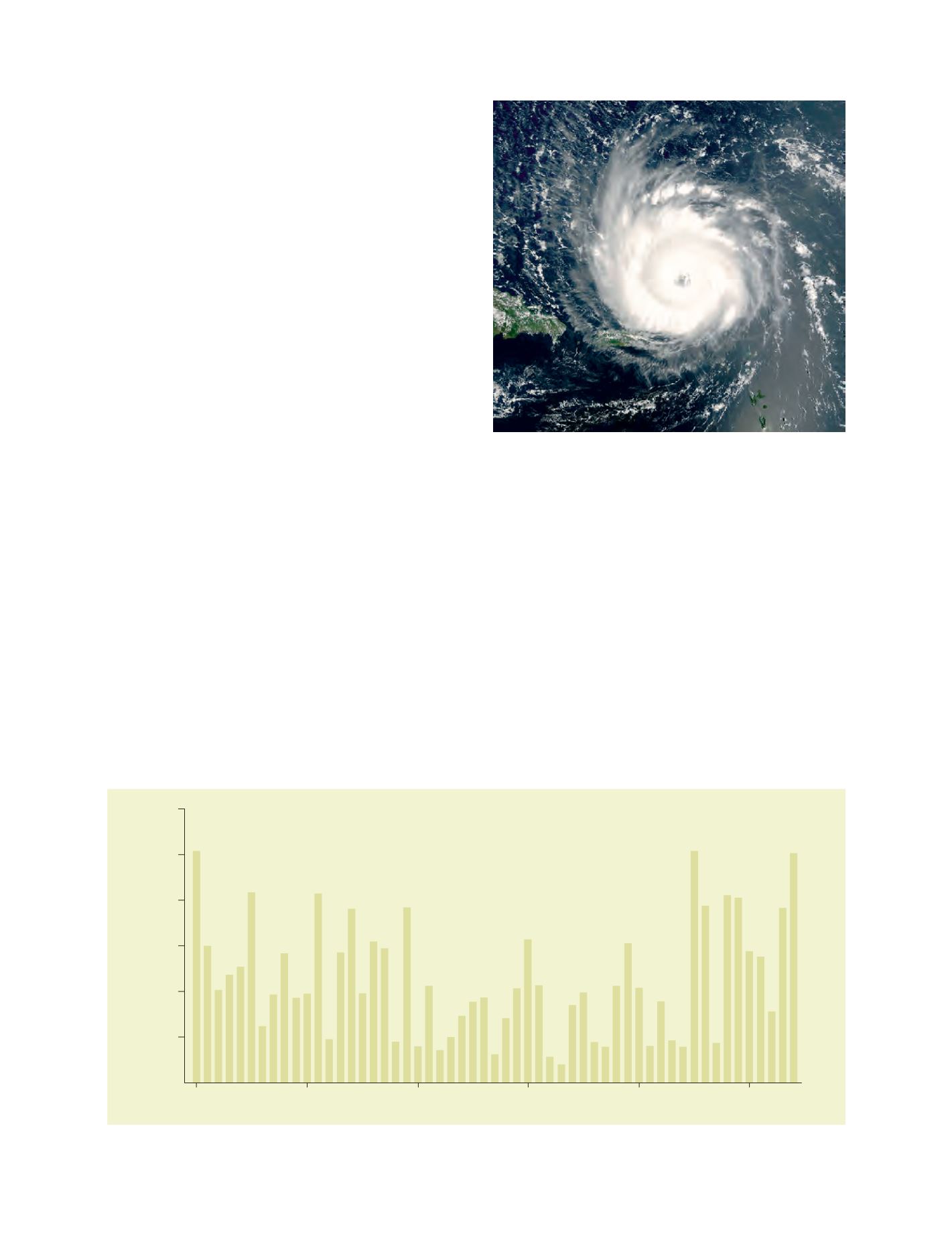
ACE (% of Median)
NOAA's accumulated cyclone energy (ACE) index
Decadal North Atlantic hurricane activity
Source: NOAA,
The 2004 North Atlantic hurricane season – A climate perspective
Hurricane Francis, 2004
Photo: courtesy of NASA