


 33 / 156

[
] 33
F
OR THE HURRICANE
-
EXPOSED
regions of the Americas, 2005
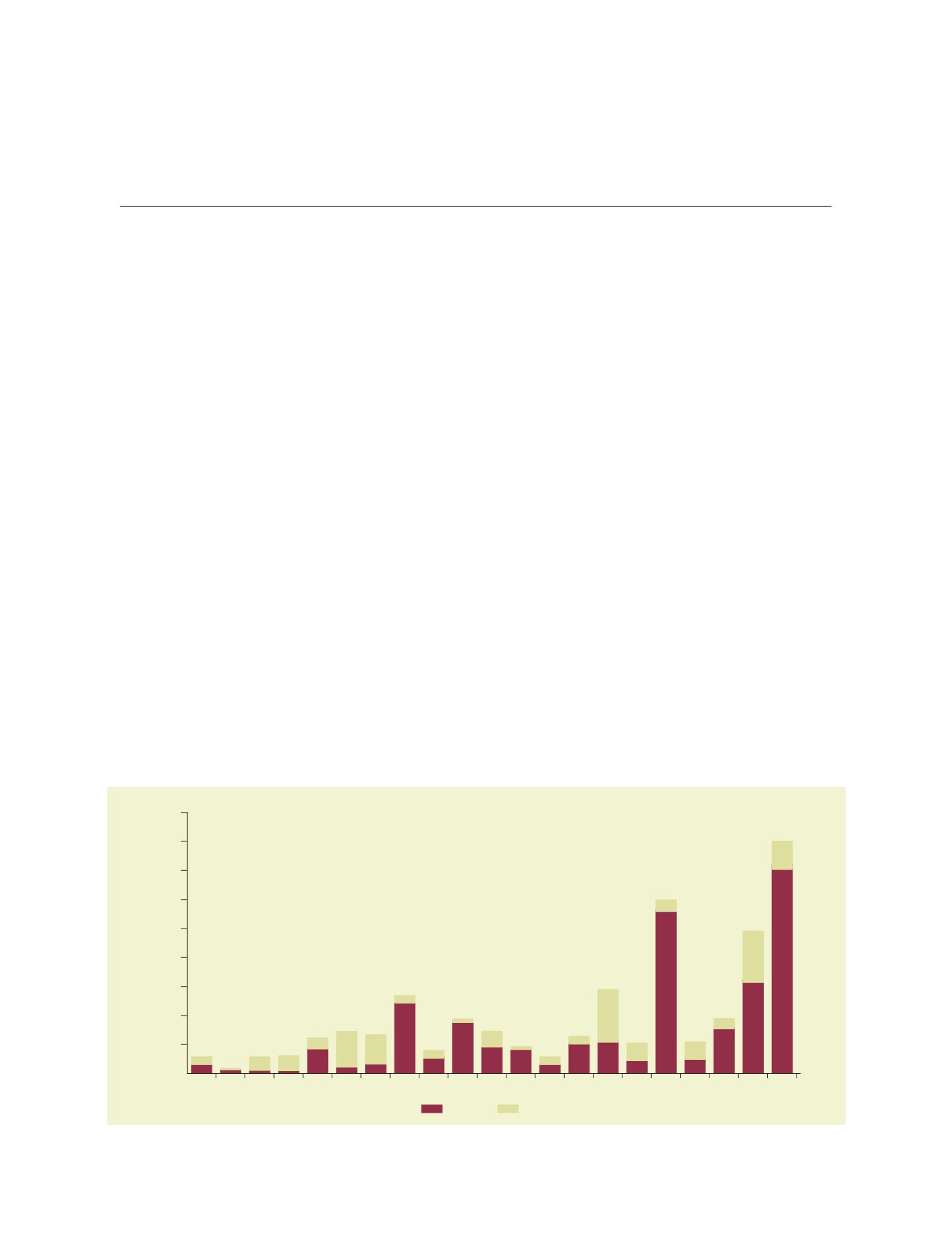
was a watershed year. Worldwide, estimated insured prop-
erty catastrophe losses currently stand at an all time record
of USD83.4 billion; USD72.6 billion of those insured losses
occurred in North America. That figure could prove to be conser-
vative, as litigation continues on key issues such as wind versus
flood cover. The level of global losses owing to catastrophes is
increasing, and seven of the ten most costly hurricanes have
occurred within the past two years.
The storms of 2005 imposed a disproportionate burden on the
reinsurance industry, members of which provide ‘insurance for
insurance companies’. Reinsurers have reported estimated losses
of USD20 billion from Hurricane Katrina alone. With assumed
total insured losses of USD45 billion, according to Swiss Re, close
to 50 per cent of Katrina losses were ceded to reinsurers, a much
higher proportion than the historical average of approximately
one-third for major catastrophes (Swiss Re defines a catastrophe
as an event with losses over USD77.5 million).
Caribbean nations have had a tough time over the past two
years. The 2004 wind season in the Caribbean was one of the
most active and destructive on record. Four major hurricanes
affected the region and the total industry loss for the Caribbean
was in the billions. This loss was distributed among various
islands, with the Cayman Islands, Bahamas, Dominican Republic,
Puerto Rico and Grenada all suffering losses. In 2005, the region
was again struck by hurricanes, with six major storms making
landfall in the Caribbean and inflicting heavy losses.
Changes in weather patterns
Studies by climatologists have suggested that recent increases in the
severity of US hurricanes may be linked to the sharp rises in land
and sea temperatures that have been recorded over the past 10-15
years. While land and sea temperatures have increased over the past
100 years, there has been a steep incline in the past 20 years.
Experts also believe that temperature changes influence the
increased hurricane frequency that has occurred during the past ten
years. Scientists theorize that the frequency of hurricanes is proba-
bly related to long-duration changes in the surface temperature of
the sea. These changes typically run on a cycle period of 20-50 years.
This cyclical event, called the ‘Atlantic multidecadal oscillation’, is
projected to continue for another 10-30 years. These cycles of hurri-
cane activity have been monitored over the past 50 years.
Above-normal activity was recorded from 1950 to 1969, followed
by below-normal activity from 1970 to 1994. From 1995 to the
present, we are witnessing a return to above-normal activity levels.
Impacts of increased North Atlantic storm activity for the
insurance industry
For the purposes of rate-making and risk management, insurance
companies increasingly rely on the information provided by model-
Property insurance in the post-Katrina world
Geoffrey Bromley, Chairman, Europe and Asia, Guy Carpenter
85
$10,000
$0
$20,000
$30,000
$40,000
$50,000
$60,000
$70,000
$80,000
$90,000
86 87 88 89 90 91 92 93 94 95 96 97 98 99 00 01 02 03 04 05
USA
Non-US
Worldwide insured property catastrophe losses (USD millions)
Source: Swiss Re, sigma No 2/2006