


 42 / 156

human and economic toll of disasters is still to be determined.
Reducing disaster-related poverty through microinsurance
presents formidable challenges to local, national and international
communities.
A major challenge is assuring the financial sustainability of
microinsurance providers and at the same time providing afford-
able premiums to poor and high-risk communities. Many people
support subsidies to meet this challenge and caution against shift-
ing responsibility from national or international solidarity to the
poor, while others warn against the negative incentives promoted
by subsidies. One of the most salient observations of this review
is the different roles played by national and international soli-
darity in supporting microinsurance schemes. India is playing a
leading role with its pro-poor insurance regulation, which
provides pre-disaster solidarity through a cross-subsidized insur-
ance system. At the international scale, the World Bank is
exercising global solidarity through its financial and technical
support, mainly for starting up risk-transfer systems for low-
income households, farms and governments. At the same time,
many microinsurance programmes are providing products to
clients, who can purchase protection in the absence of subsidies,
and private insurers are optimistic that they can market affordable
products.
If microinsurance is to become a welfare-enhancing instrument,
an equally challenging prerequisite is its propensity to reduce the
unacceptably high human and economic impacts of disasters on
the poor. While some schemes embed insurance within a disas-
ter risk management framework, this review has revealed a lack
of direct links and incentives on the part of present microinsur-
ance programmes to reduce the direct losses from disasters. This
finding is not unique to insurance in developing countries, but
it flags a more general concern about integrating risk financing
into risk management programmes that combine regulatory and
citizen oversight to assure incentives and effective regulations.
Sceptics rightly warn that insurance may conversely present disin-
centives to taking proactive risk reduction measures. Index-based
schemes offer a possible exception insofar as a physical trigger
minimizes such moral hazard.
Microinsurance is only viable to the extent that private insur-
ers remain solvent following large-scale or sequential disaster
events, or that they choose to enter these high-risk markets. If
insurers with limited capital reserves choose to indemnify large
covariant and recurring risks, they must guard against insolvency
by diversifying their portfolios geographically, limiting exposure
and/or transferring their risks to the global reinsurance and finan-
cial markets. This review shows little transparency or
commonalities in the financial backup arrangements of private
market providers. Since many programmes are in the start-up
phase or have not experienced major disasters, further research
is needed to track the performance of existing schemes.
A related challenge is creating partnerships and institutional
frameworks that contribute to credible and trusted microinsur-
ance systems. Safety nets for high-risk poor communities cannot
be put into place without public-private alliances since no one
partner can operate without the assistance of the others: highly
exposed and fiscally unstable developing country governments
cannot fully absorb the risks; informal community solidarity and
family systems are overtaxed by large covariant losses; and private
insurers cannot offer low-cost policies given the need for expen-
sive reinsurance and large uncertainties in the projected loss
estimates. One of the findings of this review is the creative
alliances among NGO/community groups, microfinance organi-
zations, government regulators, entrepreneurs and international
financial and donor institutions in pioneering microinsurance
programmes.
Of special interest is an emerging new role for donors in
supporting these schemes. The Global Index Insurance Facility
(GIIF), which is already eliciting contributions from donor insti-
tutions, may be a milestone in shifting donor focus from reaction
to risk pooling. Coupling the GIIF and other initiatives with disas-
ter loss prevention will require up-front capital, but the outlays
may be small compared to the international humanitarian assis-
tance and development finance currently channelled into
post-disaster relief, recovery and reconstruction.
For disaster microinsurance to serve as a wide-scale safety net
for the poor, the current pilot and fledgling programmes will need
to be scaled up to cover the large number of low-income house-
holds and farms facing risks from natural disasters. The potential
is large, and upscaling is occurring, but there is insufficient expe-
rience with current programmes to judge their future viability.
The research community can contribute by collecting evidence
and eliciting lessons from operating experience. The challenge of
disaster microinsurance as a pro-poor instrument, and the many
unanswered research issues, will be the focus of continued
ProVention–IIASA collaboration.
[
] 42
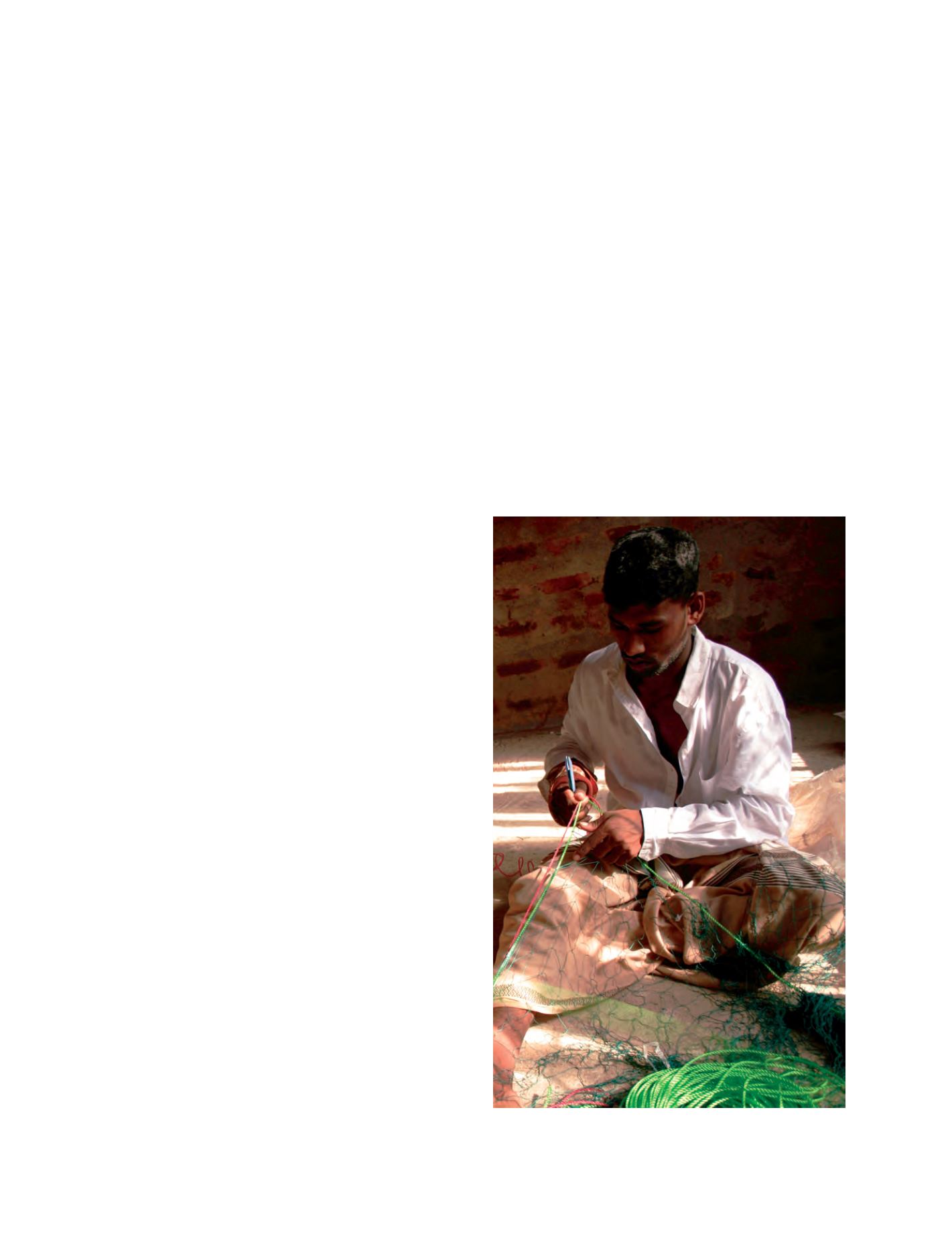
Microinsurance can help low-income households and businesses
protect their assets and livelihoods against disasters
Photo: Yoshi Shimizu/International Federation of Red Cross and Red Crescent Societies