



 48 / 156

[
] 48
Approach to school safety
Addressing safety in schools has been a challenging process.
Schools and the education system in India face heated public
debate on the usefulness of the current curriculum and the need
to address rapidly changing social and economic realities.
Introducing a new subject, therefore, was not always welcome.
The programme had to be designed to cause minimal additional
stress to students, while sending the message across succinctly in
a manner that makes the absorption process natural.
Dr Daisaku Ikeda’s proposal,
The challenge of global empower-
ment: education for a sustainable future
, aimed at introducing
environmental education in schools, provided a useful cue in
designing the disaster education intervention. The approach
adopted was to help students, teachers and school management
to learn, to reflect and to empower.
To learn
– Students deepen their awareness about hazards and
risks through understanding realities and knowing facts. Recent
natural disasters have been well documented and shared. These
serve as case studies for teachers as well as students. Wherever
needed, disasters are simulated with the help of portable models.
Curriculum changes strengthen the learning process.
To reflect
– Students analyze reasons that have led to loss of
life and injury in disasters. They are able to make distinctions in
development practices and people’s actions that can cause disas-
ters or prevent them. Students connect to their own local
communities and families and share their learning with them.
To empower
– Students take concrete action towards lowering
risks in the environment. Classroom and school exercises are intro-
duced to help them take small definitive actions that can become
a precursor to bigger investments for disaster risk reduction. School
management prepares school disaster management plans in which
roles and responsibilities are identified and rehearsed periodically.
Lessons acted upon
Following the Gujarat earthquake, mitigation programmes in
India have been accelerated. The techno-legal regime in the
country has been strengthened with the revision of the Indian
Building Code (IS1893) in 2002. Disaster management acts
have been introduced at state and national level. A targeted
urban earthquake vulnerability programme has been introduced
in 38 cities that face the threat of earthquakes. Public
campaigns have been introduced to build awareness among
communities at risk.
But have changes such as these really percolated to the grass-
roots level? Not necessarily. With limited progress being made to
foster partnerships between scientists, governments, civil society
organizations and community-based organizations, most lessons
learnt are not being translated into actions to the extent one
would have desired. Response mechanisms have strengthened,
but mitigation is still a big dream. The result: earthquakes such
as the one on 8 October 2005, with a magnitude of 7.6 in the
Kashmir region, continue to kill large numbers of people and
wreak havoc in the daily lives of others.
Fortunately though, unlike the little progress made in other
areas, school safety has found quick acceptance among stake-
holders in the country. Events that occurred in the earlier part
of the current decade and directions provided by the Hyogo
Framework for Action have contributed to strong government
support through legal and policy instruments that would ensure
that current initiatives have the capability to make a definite
impact. Civil society organizations have taken up the safety and
protection of school children as an important concern in their
agendas. Parents and teachers are increasingly voicing their
worries about the need for attention in this area.
Over a third of India’s billion-plus population is of school-
going age. The country is vulnerable to multiple hazards. In
order to be able to make a tangible change, at least a decade of
sustained effort is required. The success of the programme will
lie in promoting policies and programmes, and most impor-
tantly in fostering partnerships among stakeholders so that we
are able to save every child from the next big disaster.
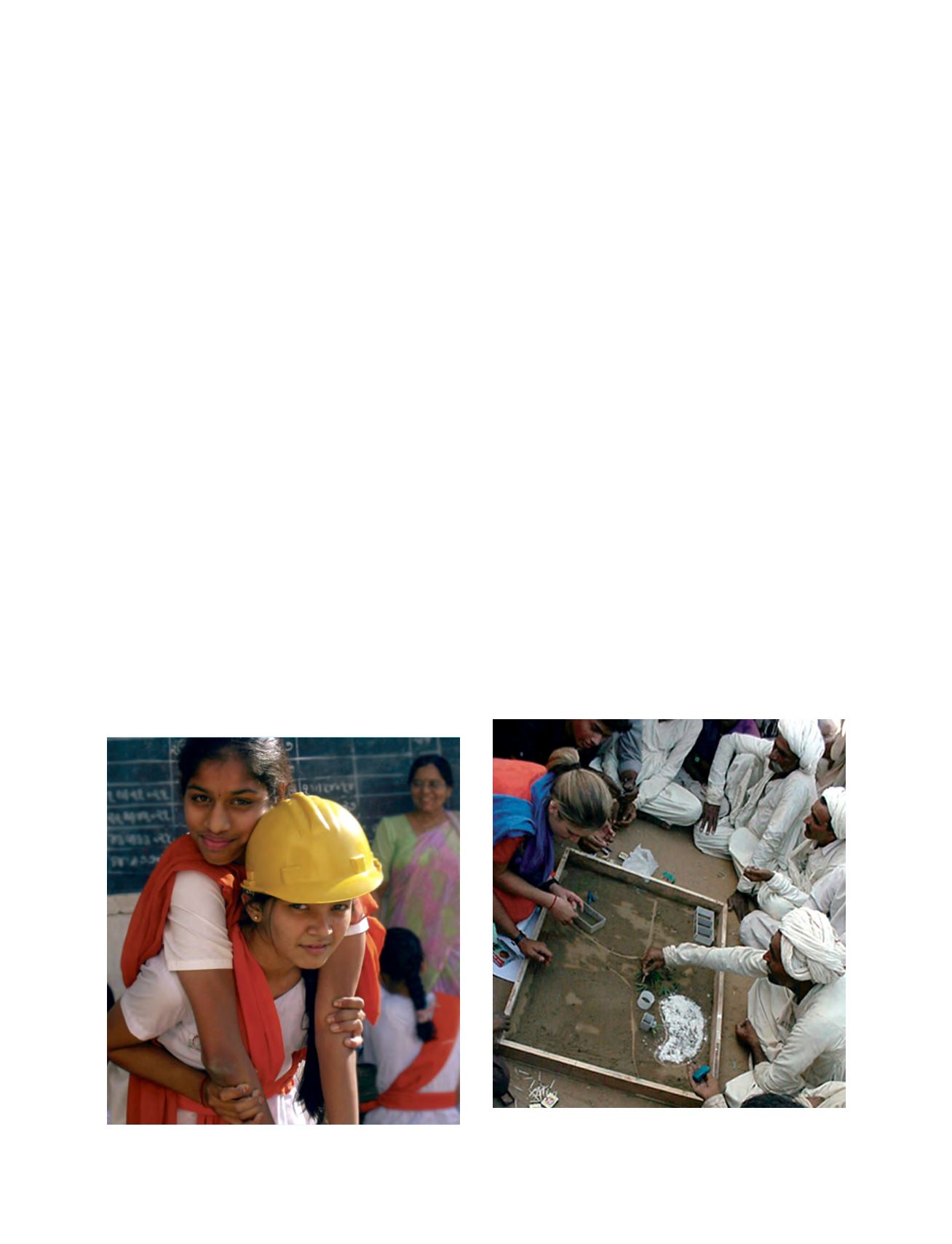
Education programmes are helping students to turn lessons into actions
Photo: SEEDS
Public campaigns have been introduced to build awareness among
communities at risk
Photo: SEEDS