


 49 / 156

[
] 49
S
AN
R
AFAEL IS
a city in a district south of Mendoza province,
on the east side of the Andes mountains in Argentina, which
border the entire east side of the province. In this region, a
wide range of natural adverse hazards are likely to occur, such as
earthquakes, alluvium, drought, Zonda wind, floods and land-
slides. On account of this, there is a great need to spread a
preventive culture throughout the region.
Education is one of the best ways to spread this culture. For
this reason, a research project
1
was set up, using closed-circuit
radio in a school as an educational tool to transmit knowledge
and raise awareness that will enable the identification and miti-
gation of natural risks. It is a means of knowing about preventive
and mitigation measures and what to do before, during and after
different events. The project’s focus is on risk reduction, which
includes avoiding hazards and reducing vulnerabilities.
The project was developed in a school that has its own closed-
circuit radio, and included the production of 16 radio
microprogrammes involving subjects related to natural risk reduc-
tion (earthquakes, Zonda wind, alluvium, and drought).
It was an innovative project for several reasons – there is no
data in the region about radio programmes in the past decade
produced by teenagers for teenagers, and dealing only with
natural risk reduction. Using radio programmes to promote risk
reduction among teenagers is a different approach to standard
education in disasters. It facilitates links between disaster risks,
development and the environment in developing countries by
addressing these elements through learning about how to reduce
vulnerability. By working to learn how to reduce vulnerability,
which is an element of risk, we are working to reduce disaster
risk. In this way, development is enhanced, and the environment
is preserved against the enormous damages disasters cause. In
addition, prevention and mitigation are development functions.
The team chose to produce microprogrammes instead of
programmes, because these are no more than 15 minutes long.
They are intended for inclusion within a programme or to stand
alone in a radio station’s programming, and provide an easy way
to address specific subjects using the characteristics of the radio-
phonic genre.
General objectives of the project included:
• To produce 16 radio microprogrammes about natural risk
prevention targeted at and with the collaboration of teenagers
of a school at the south of Mendoza
• To measure the knowledge on the subject acquired before
and after listening the microprogrammes
• To compare the differences in knowledge after time has
passed
• To publish the results in local newspapers and web pages.
To address the first objective, microprogrammes were produced
by students at the School Luis Federico Leloir, a secondary school,
including students from every course together with teachers of
social communication. Participants were advised by a group of
psychologists specializing in prevention. Nearly 100 pupils, repre-
senting almost the 30 per cent of the school’s population, were
involved in the project. Pupils had the option to participate in
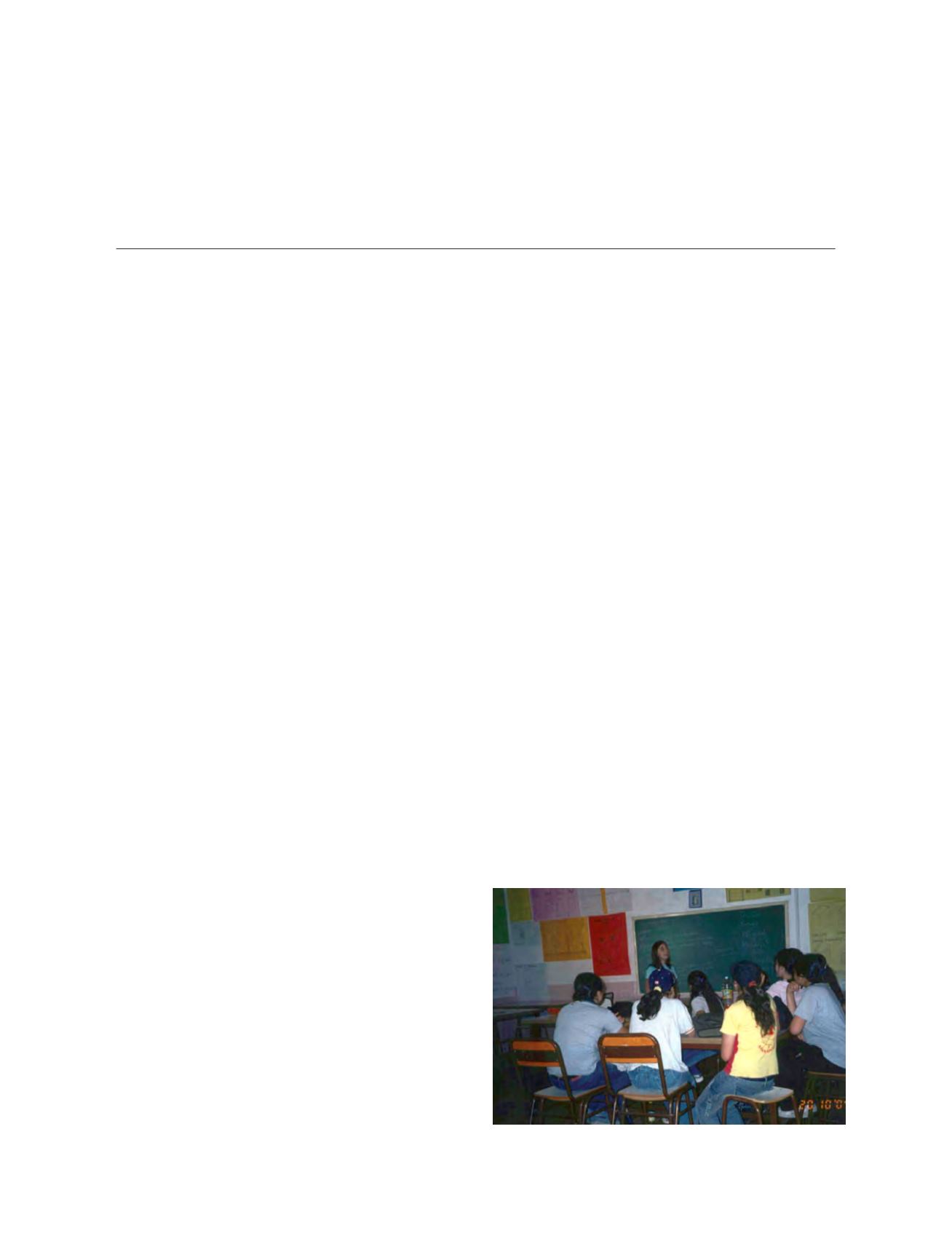
workshops that were organized in order to produce the micro-
programmes, since these were not obligatory and they were
carried out after class time. Each course was in charge of study-
ing and producing a script about one issue related to the main
subject, and some pupils of each course spoke in the radio
programme.
The workshops included the following topics and activities:
• Radio characteristics
• Radio genres and formats
• Elements of radiophonic language
• Music and broadcasting techniques
• Microprogramme production
• Microprogramme recording
• Microprogramme listening and evaluation of the radio
workshop.
To fulfil the second and third objectives, a questionnaire inquir-
ing about knowledge on the chosen natural risks was created.
Most of the school students answered the questionnaire before
the workshops had started, then again immediately after the 16
microprogrammes were completed, and once more two-and-a-
half months later in order to assess the effect of passing time on
what was learnt.
The radio at school: transmitting knowledge
and awareness for mitigation of natural risks
María Alejandra del Campo, Psychologist, Argentina
Students during a workshop
Photo: María Alejandra del Campo