


 52 / 156

One point of concern is that less than 14 per cent of students
undertaking the Masters in disaster management have previously
studied in that field. This causes a steep learning curve for
students since, where theoretical background is lacking, much
additional reading and studying is required to understand the
basic principles. About 12 per cent of students enter the
programme through the Recognition for Prior Learning (RPL)
programme, but with the first RPL students only commencing
their research during 2006, the success of this scheme cannot
yet be established.
Course content
The Masters degree in disaster management is a part-time, multi-
disciplinary, two-year course with a good balance between theory
and practice, and with an emphasis on disaster risk reduction
theories and strategies. The course consists of eight first-year
structured modules, two elective modules, and a dissertation
during the final year. Students are required to complete an in-
depth scientific research study as the basis for their dissertation.
Although not compulsory for qualification, it is also expected
that students will publish at least one scientific research paper
pertaining to their research.
The part-time nature of the course makes it convenient for
students to participate in the programme. Students have to attend
a one-week contact session at the beginning of their first year,
followed by two more sessions during the end of the first semes-
ter, and a final session prior to the year-end examinations.
Evaluation is undertaken through assignments (two per module)
and examinations (one per subject).
Student feedback on each specific element of the course is
obtained from all who participate in completion of that element.
Evaluation of these responses shows that most students find the
research and dissertation writing element to have the greatest
value (it should be noted that student research comes as a culmi-
nation of the taught theory, converted into practical application).
Beyond this, the evaluation showed no statistically significant
difference in value between the structured modules. One signif-
icant point noticed, however, is the issue that few students opted
to choose options based on quantitative analytical methods, with
most students choosing those such as ‘Management of Media
Relations’, and ‘Ethnic and Cultural Conduct.’
Analysis of research topics chosen by students shows no
specific pattern or specific topic tendency. Research topics under-
taken included a focus on the vulnerability of communities for
droughts, floods, HIV/AIDS, wildfires (veld and squatter camps),
and technological disasters. The psychological effects of disas-
ters, and media management, were also registered. It has been
noted, however, that very few quantitative research studies have
been registered to date. This is due to a lack of mathematical and
econometric skills among enrolled students causing a preference
for qualitative research methods. The shortfall in the current
process of research project identification has been caused by a
lack of collaboration between the National Disaster Management
Centre, the provincial disaster management structures and the
University.
The future
Critical evaluation of the programme has been undertaken on a
regular basis. Feedback from students and disaster management
practitioners has indicated the need for change after four years
of the programme. Currently, students can specialize by electing
two out of the following modules during their final year:
• Trauma management
• Political strategic planning
• Information management
• Ethnic and cultural conduct
• Management of media relations
• Environmental risk and impact assessment
• Disaster vulnerability and risk assessment.
An assessment by alumni and disaster management practition-
ers in South Africa and Africa showed the need for the
development and inclusion of the following electives in the
programme:
• Technological disasters
• Public/project management
• Conflict management/civil wars/civil strife/peace building.
The restructuring of some current modules is also under review,
with a view to increasing the emphasis on subjects such as mass
behaviour and health-related issues (such as HIV/AIDS). The chal-
lenge remains to ensure that the course stays relevant, in
compliance with international standards, and with a focus on
African issues.
The continuous growth of disaster management as an academic
subject can be expected, as can an increase in demand for
research-based training. A proposal to implement a research-
based Masters degree is already being prepared, and the university
should be able to register the first students for this degree from
2008. Students enrolling will be required to complete a full thesis,
with a greater emphasis on research than is required by the
current structured course.
Role players in South Africa, such as universities, research insti-
tutions, and the private and public sectors, need to combine and
coordinate their resources to produce a focused and efficient
research programme that will support the country’s commitment
to risk reduction. The biggest challenge for the DiMTEC
programme during the next few years will be to ensure that rele-
vant research provides answers for Africa’s disaster problems, and
as a result better collaboration with United Nations organiza-
tions, NGOs, governments and the private sector in Africa.
[
] 52
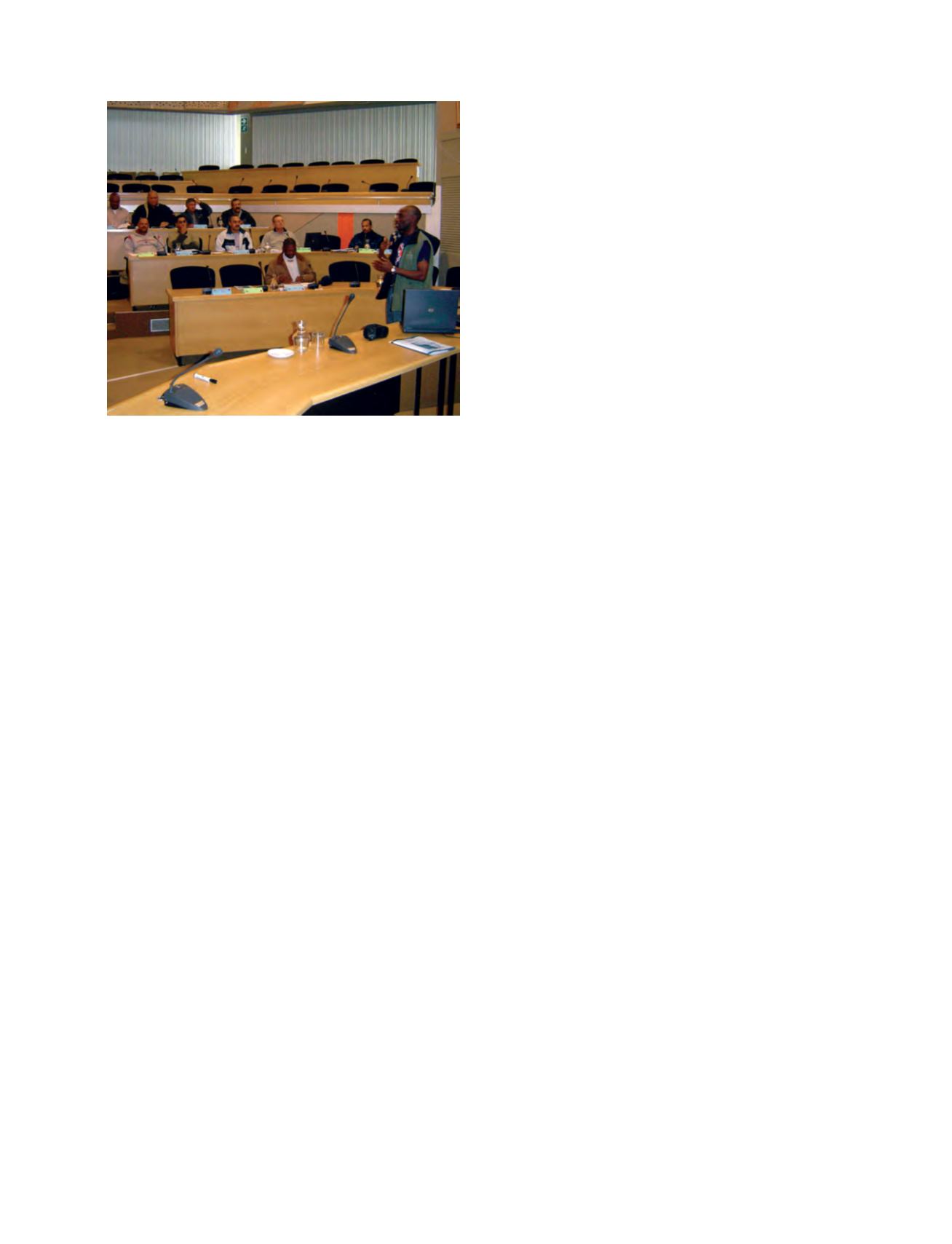
Pios Ncube, a member of the DiMTEC team, lecturing risk reduction to
local government officials in the Cape
Photo: Courtesy of A.J. Jordaan