


 56 / 156

[
] 56
D
EVELOPING COUNTRIES IN
the Asia Pacific region are
highly vulnerable to a range of natural hazards, includ-
ing cyclones, floods, landslides, droughts, volcanic
eruptions, earthquakes and tsunamis. Investment in disaster risk
management for vulnerable communities is critical to protecting
hard-won progress towards poverty reduction and sustainable
development.
The Australian aid programme, administered by the Australian
Agency for International Development (AusAID), assists govern-
ments and communities in the Asia Pacific region to develop their
own capacity to reduce the impact of hazards. Australia supports
a holistic and integrated approach to disaster risk management
within the context of poverty reduction and sustainable devel-
opment. This approach respects the central role that local
communities and all levels of government have in managing risk;
addresses multiple hazards; incorporates disaster prevention,
mitigation, preparedness and response activities; and integrates
disaster risk management into national development planning.
Australian support for disaster risk management is provided at
several levels:
Community and national level
– Through various bilateral
programmes strengthening the capacity of local communities
and national disaster management offices to prevent, mitigate
and prepare for the effects of hazards; and cooperation agree-
ments with five Australian non-governmental organizations
(NGOs) to develop their emergency response capacity and
foster indigenous disaster risk management in the Asia Pacific
region.
Regional level
– Through support to the South Pacific Applied
Geoscience Commission (SOPAC), the Asian Disaster
Preparedness Centre (ADPC), the Australian Red Cross and other
regional efforts to promote community-based disaster manage-
ment, strengthen monitoring and warning systems (including for
cyclone and other severe weather events, climate and sea level,
and tsunamis), analyse the humanitarian and developmental
benefits of investment in disaster risk reduction activities and
improve the implementation of laws which facilitate international
disaster response.
International level
– Through support to several United Nations
agencies and the Red Cross/Red Crescent Movement.
An excellent illustration of Australian aid programme support
to strengthen disaster risk management within the Asia Pacific
region is provided by Australia’s assistance to Central Vietnam.
Implementing a holistic and integrated approach to
disaster risk management in Central Vietnam
The combined pressure of poverty and the annual threat of
floods and typhoons in Central Vietnam present significant
development challenges. It is common for more than 20 per
cent of the population to be living below the poverty line in
many areas.
1
The region also has a topographical and climatic
environment that is vulnerable to rapidly rising floods and
intense typhoons.
Poor families in rural areas are particularly vulnerable to the
impacts of natural hazards because they have limited capacity to
absorb the loss or damage of their dwellings, livestock and crops.
Similarly, poor families in coastal communities are vulnerable
because the loss of fishing vessels results in long-term debt, a
situation which is sometimes exacerbated by the death of the
main breadwinner.
Central Vietnam is also experiencing rapid industrial and
commercial development. Unplanned development has the poten-
Australia’s aid programme:
promoting effective disaster risk
management in the Asia Pacific region
Australian Agency for International Development
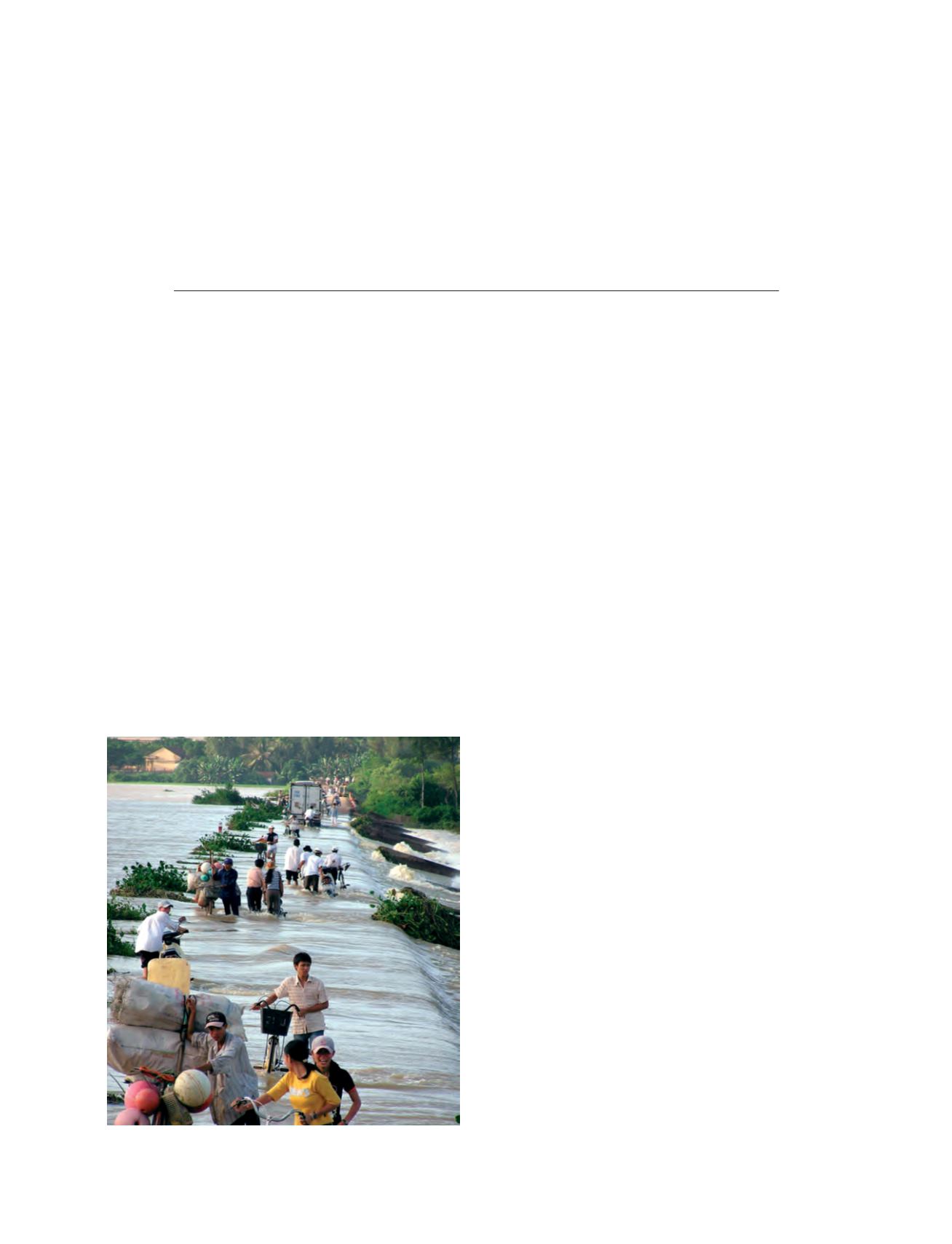
Living with floods is part of Vietnamese life on the floodplains
Photo: Kellogg Brown & Root Pty Ltd (KBR)