


 60 / 156

the capability of regional, national, and community authorities
and organizations to prepare for, respond to, and mitigate disas-
ters. CAMI programmes support readiness for the hurricane
season through the formation and training of community Rapid
Response Teams (RRTs), the establishment of community hazard
monitoring and early warning systems, and risk and resource
maps, among other activities.”
Such activities were implemented in Guatemala, Honduras, El
Salvador and Nicaragua, as well as similar projects in the
Caribbean. WVH received a grant to carry out CAMI activities,
under which the WV CAMI programme directly supported the
broader CAMI goal, to reduce or negate the impact of natural
disasters in Central America through the implementation of rele-
vant activities in some of the most vulnerable areas of Honduras.
WV initially chose two locations based on need, a high level of
vulnerability to disaster, and WV presence and experience. These
locations corresponded to the two most impoverished and Mitch-
affected programme areas within WVH. CAMI was first
undertaken in the Yoro (North) and Choluteca (South) regions
of Honduras.
The strategic objective of the WV CAMI programme was to
minimize the impact of natural and/or human-made disasters in
programme areas. Its expected result was the increased capacity
to successfully manage key aspects of disaster mitigation and
response at the community level in target areas. CAMI had three
specific objectives:
1. Incorporate risk management concepts into development
activities in communities served by WVH
2. Strengthen community and institutional leadership capac-
ity for monitoring threats, early warning systems, and
planning emergency response
3. Improve community response capacity through formation
and training of Local Development Committees (CODELs)
and community RRTs.
CODELs were at the heart of the CAMI and later CERDM
projects. Formed as community-based entities under CAMI, they
remain a key component in the sustainability of the projects, their
outcomes, and achievement of their vision.
Activities under the first objective, incorporation of risk manage-
ment into development, included participatory risk and resource
mapping, which dealt with the relationship between typical prac-
tices and environmental degradation leading to increased
vulnerability, and technical assistance to communities on how to
design and maintain risk and resource maps. Through the project,
RRTs in 154 communities gained the capacity to create nationally
standardized risk and resource maps and to regularly update
them. Additionally, a key step in the change process that CAMI
instigated in WVH was the adoption of a new policy that meant
all new agricultural and economic development projects would be
planned and implemented with mitigation components.
The second objective, strengthening ADP and community
monitoring, early warning and emergency planning capacity was
an important part of the WVH national emergency preparedness
and response plan. Training was provided in appropriate and
regular monitoring of risks, and 154 communities, 7 ADP and
2 regional offices began to use hazard monitoring and early
warning systems with evacuation capacity. Community RRTs and
ADPs gained the capacity through training to implement
Evaluation of Damages and Analysis of Needs (EDAN), comply-
ing with WVH and Commission Permanente de Contingencias
(COPECO, the national emergency commission of Honduras)
norms. Under this objective, agreement was made to share
information and standardize forms and reports with COPECO
and other non-governmental organizations and donors, assist-
ing in coordination with the Honduran Government.
Another important aspect of this objective was data process-
ing and analysis, the first stage of which was carried out at the
community level. Through CAMI, ADPs, regional and national
offices of WVH were able to efficiently consolidate information
from EDAN and use it to produce accurate, easy-to-read reports.
Under this objective, CODELs were organized and received
training in:
• Risk management and the relationships between risk, threat
and vulnerability
• Vulnerability mapping, mitigation plans, early alert systems
• Evacuation, rescue and refuge
• Response planning
• Organization and functioning of the network
• Organizational structure and management
• Emergency response and preparedness including EDAN, first
aid, security and logistics.
One key objective of the CODELs was to ensure the formation
of a community-level RRT. Through this, the third objective
resulted in significantly increased response capacity at the
community level, reducing the dependence of local communities
on outside assistance and empowering them to deal with the
initial response locally. This objective was the first to be imple-
mented, and the majority of the RRTs created was able to
efficiently respond to emergencies, reducing casualties, injuries
and damages.
The RRTs comprised one each of team leader, EDAN specialist,
data specialist, logistics coordinator and hazard monitoring, early
warning and evacuation coordinator. Community RRT members
were also trained, through agreement with the Red Cross, to
provide first aid treatment to the injured during an emergency. In
Yoro department, which is extremely prone to flooding and land-
slides, training was given in evacuation and rescue through
agreement with the fire department.
[
] 60
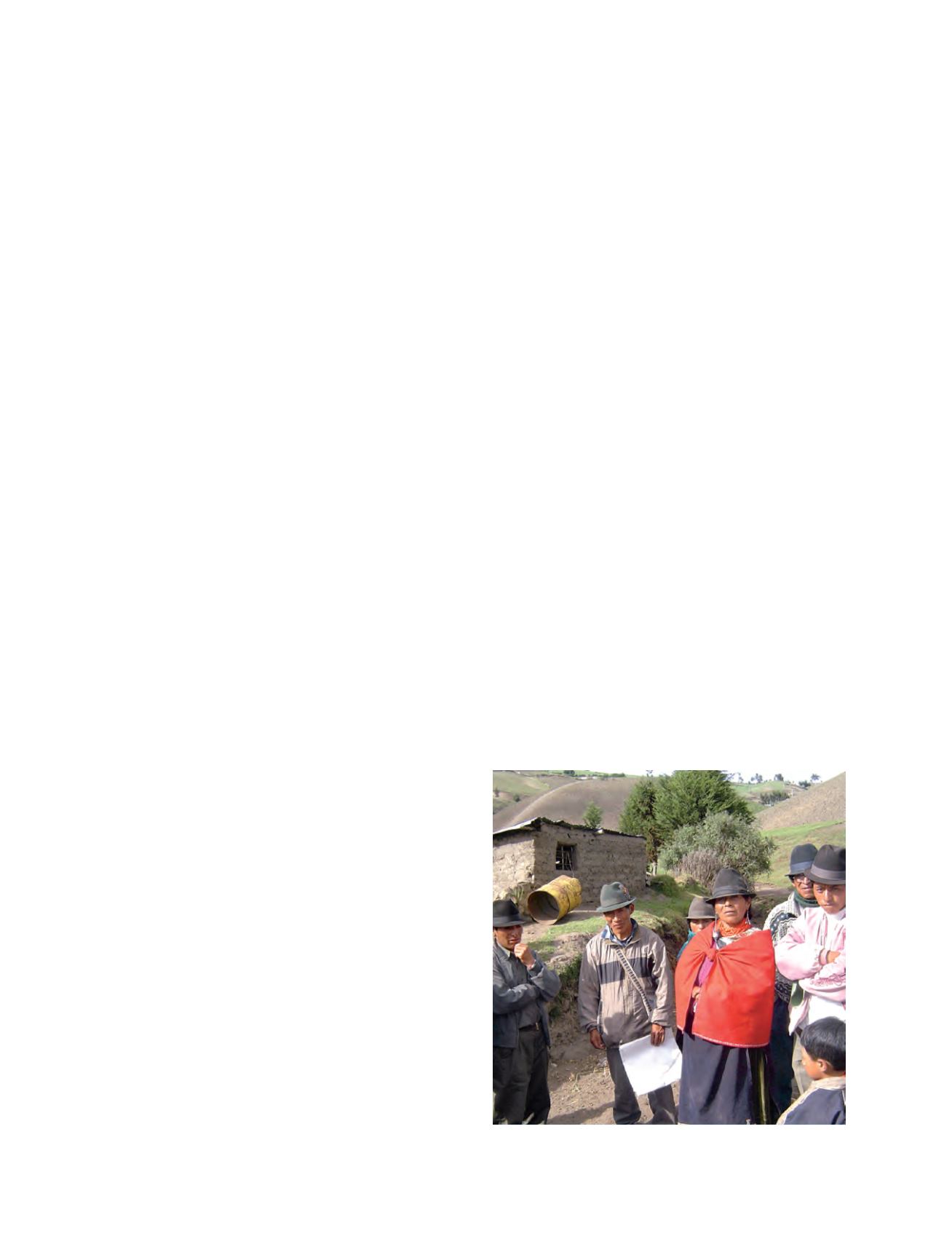
Community members in Ecuador in CERDM training
Photo: Carolyn Rose-Avila