


 65 / 156

[
] 65
I
N THE PAST
two decades, significant advances have been
achieved in tropical climate forecasting. A key development has
been the ability demonstrated in the mid-1980s to forecast El
Niño Southern Oscillation (ENSO) – the anomalous warming of
the equatorial Pacific Ocean – with lead times of as much as six
months to one year. The value of this breakthrough cannot be
underestimated: if forecasted with sufficient lead-time, El Niño-
related forecasts can theoretically provide societies with
opportunities to undertake steps that would enable them to address
potential impacts, which in many Southeast Asian countries include
drought, forest fires, and outbreak of infectious diseases.
Different countries and different sectors are in varying stages of
harnessing the present capability of climate science to reduce
risks in sectors which are susceptible to climate fluctuations, most
notably agriculture and water resources. Arguably, a major task
facing countries continues to be the development of an end-to-
end climate information generation and application system that
is aimed at climate risk reduction. Such a system encompasses a
continuous cycle of forecast generation, dissemination, applica-
tion, and evaluation of results.
In the past eight years, the Asian Disaster Preparedness Center
(ADPC) has worked to facilitate the development of an end-to-end
climate information generation and application system in
Indonesia, particularly to mitigate climate risks in agriculture.
Under the aegis of the USAID’s Office of Foreign Disaster
Assistance (OFDA)-supported Climate Forecast Applications
(CFA) programme (2003-2008) and its predecessor the Extreme
Climate Events (ECE) programme (1998-2003), efforts have been
made to strengthen the capacity of national and local institutions
in Indonesia and the Philippines to build such a system. There
follows an account of the Indonesian component of the
programme and the impacts it has made so far.
Lessons learnt from the 1997-1998 El Niño
The mere availability of climate forecast will not necessarily trans-
late into measures that would enable societies to adapt to the
potential impacts of the forecasted climate event. This is one of
the key lessons learnt from the massive 1997-1998 El Niño.
An El Niño forecast was made available as early as six months
before the onset of the event. Indonesia’s national meteorologi-
cal service – the Meteorological and Geophysical Agency (BMG)
– incorporated such information into its dry season forecast,
which was released in March 1997. But despite the availability
of this information, the 1997-1998 El Niño spawned widespread
social and economic damages in Indonesia because adequate
mitigation measures were not put in place. Large-scale forest fires
generated a regional smoke and haze emergency, and El Niño-
induced drought resulted in a production shortfall of 3 million
metric tons of paddy. As a consequence, rice imports reached 5
million metric tons.
This experience drives home the point that several conditions
must be present for climate information to translate effectively
into precautionary actions. First, information would be of little
use without well-functioning information delivery systems. While
the information was released by BMG six months before the onset
of the El Niño event, there was no institutional mechanism to
translate the global El Niño index into local impacts. Second, the
1997-1998 El Niño demonstrates that climate information – be
it a seasonal climate forecast or an analysis of past rainfall patterns
– is not sufficient for issuing early warning until it is translated
in terms of impacts on the variables that are of interest to deci-
sion makers. For example, reservoir managers need to know how
an El Niño event would affect stream flow and evaporation. On
the other hand, farmers need to know how El Niño could poten-
Managing climate risks through climate
information applications:
the Indonesian experience
A.R. Subbiah, Lolita Bildan, and Kareff Rafisura, Asian Disaster Preparedness Center
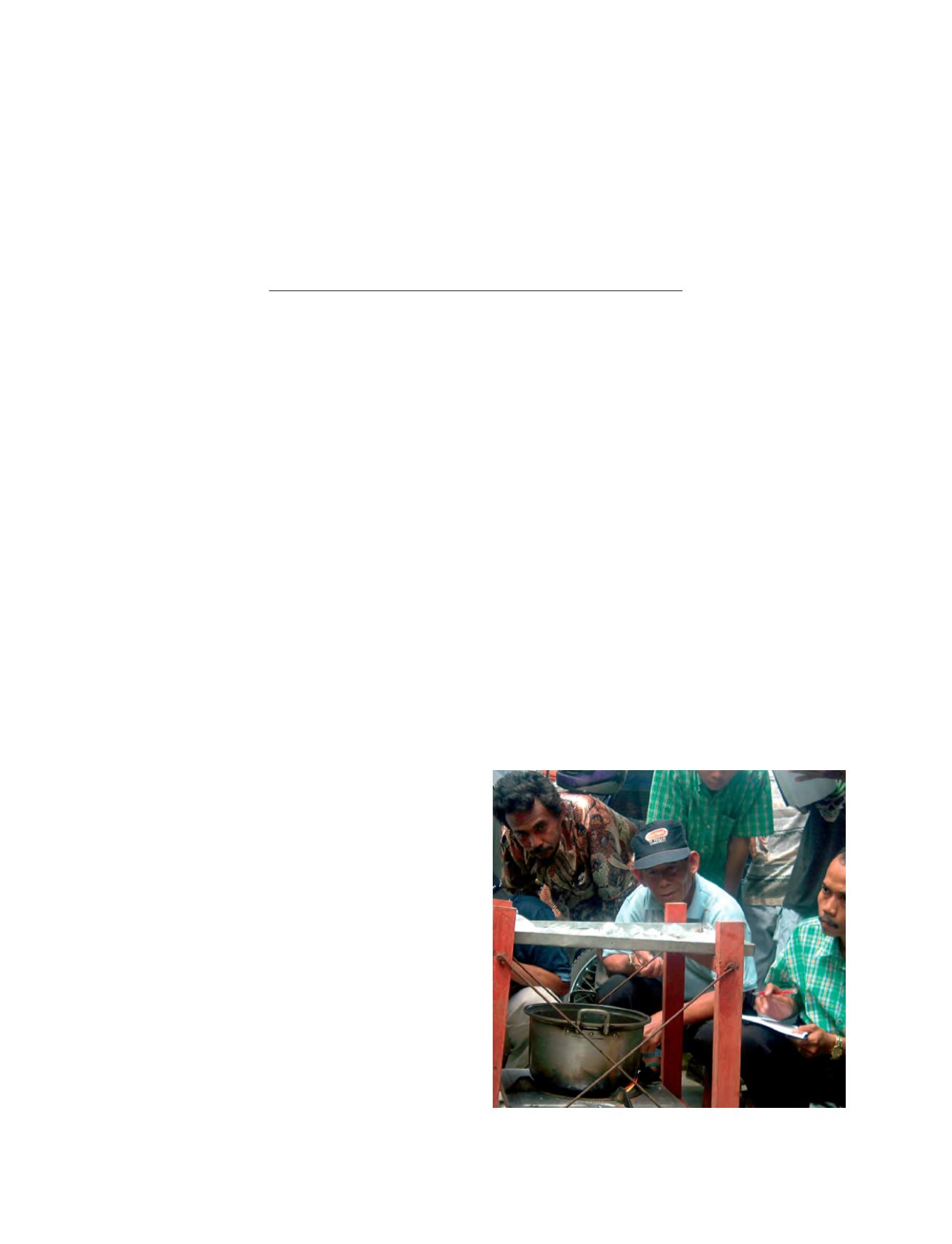
Farmers participating in the Indramayu CFS study on the process of
rainfall formation
Photo: Kareff Rafisura