


 67 / 156

[
] 67
high enough to survive flooding, whose probability of striking
Indramayu is more than 50 per cent in January and February.
CFS also made impacts in terms of how farmers set up their
cropping calendars. Farmers in the sub-district of Losarang revised
their cropping calendars – i.e. the sequence of planting rice,
fallow, and planting other crops – in 2004-2005 and obtained
higher yields compared to previous years.
Because of these positive impacts, local and national invest-
ments have been mobilized to replicate the CFS in other
locations. The Indramayu district government decided to sustain
CFS beyond the pilot phase and has allocated IDR100 million to
replicate CFS in 4-5 sub-districts every year. As of December
2005, 1,000 farmers had participated in CFS. In addition, the
Directorate of Plant Protection (DITLIN) within the Ministry of
Agriculture (MOA) has adopted the CFS as part of its nation-
wide agricultural development programme.
Institutional and policy changes at the national level, together
with the level of investments mobilized for producing spatially
downscaled climate forecasts, indicate that CFA activities will be
sustained beyond the pilot phase.
Realizing the utility of producing downscaled forecasts, BMG
has been producing localized forecast for 30 more districts as of
2006, and more districts are in the pipeline. This project started
in 2004 when BMG developed localized forecasts for ten districts.
For this undertaking, BMG, with parliamentary support, invested
between IDR3 billion and IDR4 billion in 2006 – a 300 per cent
increase from the 2005 budget level. Institutional mechanisms
at the district level involving BMG and district officials have also
been established to interpret and make use of climate information
to manage climate risks in water resources and agriculture sectors.
Policy changes have also occurred, signalling a paradigm shift
from crisis management to risk management. From 2001 to
November 2005, addressing climate problems was within the
purview of the Pest Analysis and Disasters division within DITLIN.
But with the realization that the climate problem is huge and
should be given more attention, a new division named the
Climate Analysis and Mitigation division was formed in November
2005. Operationally, this institutional development means that
the bureaucratic unit responsible for climate risk management
has been elevated in the bureaucracy and as such, it has been
vested with more budget and authority.
Although climate information is not the only information
needed to improve the performance of climate-sensitive sectors,
it is a potent tool that enables decision makers to manage risks
in different sectors. Just three years into implementing the CFA
programme, the basic prerequisites for sustaining an end-to-end
climate information generation and application system have
already emerged. These prerequisites include changing percep-
tions and practices for managing climate-related risks through
the CFS; mobilization of investments for risk management; and
institutional development.
The programme stakeholders in Indonesia went ahead of sched-
ule and replicated the CFA programme in several locations and in
sectors not initially targeted by the pilot phase. The challenge now
is to understand and respond to the new capacity building demands
brought by the expansion of climate forecast applications.
1
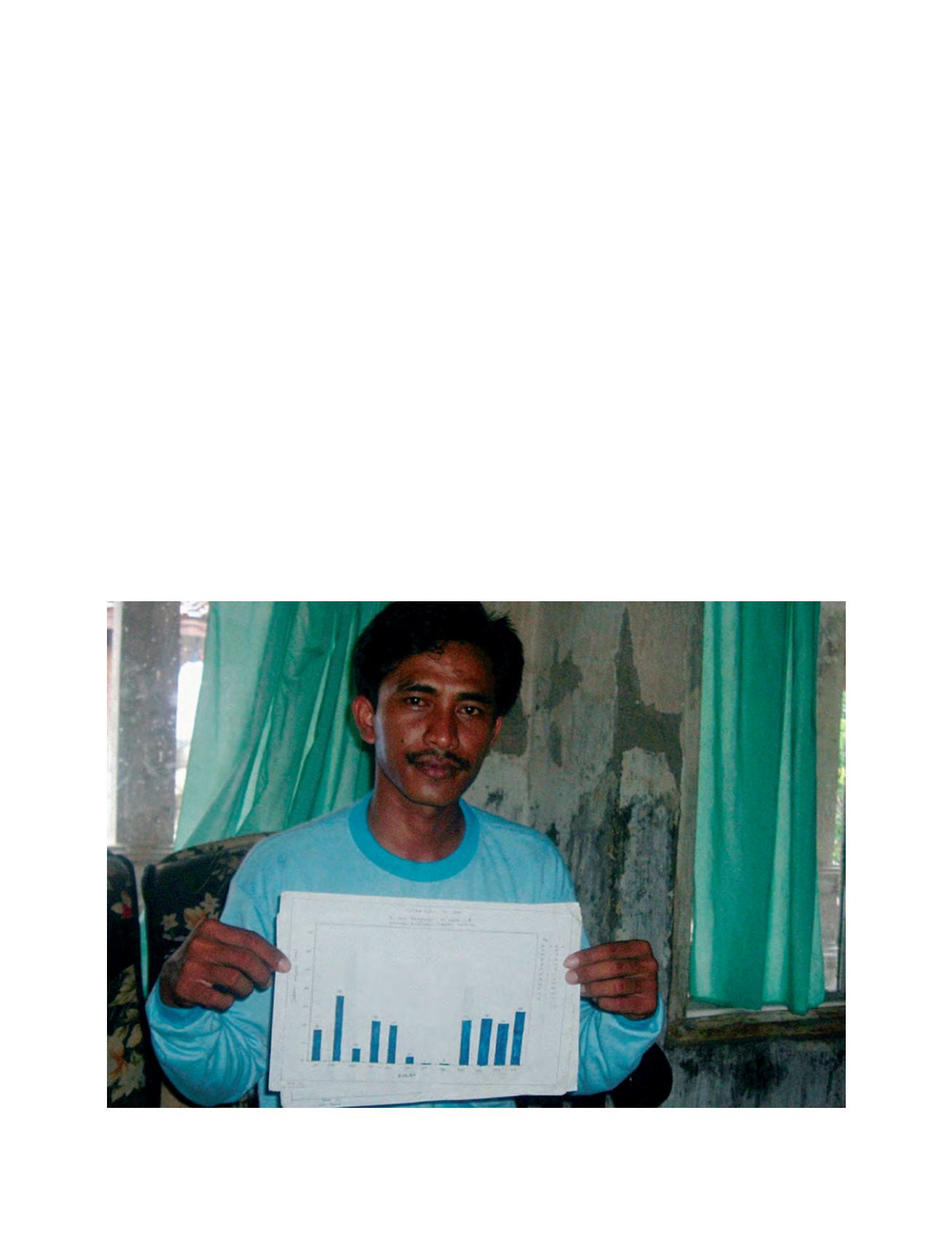
A farmer leader in Kandanghaur sub-district shows a rainfall graph, which he created from his own rainfall observations using improvised rain gauges.
He has been monitoring daily rainfall levels since he attended CFS in 2003
Photo: Kareff Rafisura