


 72 / 156

death and interruption of schooling. Overall results from the study
on these key household practices revealed the most notable
measures to avoid negative flood effects were:
• Sealing lower door entrances with mud (100 per cent)
• Clearing/digging of trenches (83.7 per cent)
• Piling mud around homesteads (45.3 per cent)
• Raising the floor of houses (28.4 per cent)
• Planting trees/sisal around homes and farms (22 per cent)
• Storing medicine (26.1 per cent)
• Building terraces (10 per cent)
• Evacuating to higher ground (29.2 per cent).
Measures taken immediately after the floods included raising what
can be destroyed by flood waters, drilling holes through the wall
to allow flood waters to flow through, removing flood waters from
the house using containers, cooking on top of tables and other
raised surfaces, and de-silting of trenches. It is only during extreme
flooding that people evacuated. After the floods subsided, soil was
poured on the floor and leaves spread on top to cover damp floors.
The two major efforts made to avoid and/or reduce flood-related
diseases included buying mosquito nets and treating or boiling
drinking water.
The survey data revealed that half (50.2 per cent) of the respon-
dents who experienced flooding received support from multiple
sources. Government disaster programmes accounted for 85.2 per
cent of the support received, while 28.1 per cent received help from
non-governmental organizations and 6.7 per cent were assisted by
relatives, friends and private donations from well-wishers.
Government initiatives at the district are coordinated by the
District Disaster Management Committee (DDMC), which has
incorporated all key government departments: agriculture, roads,
health, and water. The flood control unit under the Ministry of
Water and Natural Resources is currently overseeing the construc-
tion of a dyke along River Nyando. So far, 3.5 km has been
constructed on either side. The DDMC is represented at the loca-
tion and sub-location levels. These committees, together with the
chiefs and sub chiefs, organize, implement and oversee the Food
for Work programme introduced by the Government to engage the
community in managing floods. The community members dig and
clear trenches in exchange for food.
The Red Cross, VIRED, CREPP, World Vision and ADRA have
been the major non-governmental contributors during flood disas-
ters. Flood information is mainly obtained by volunteers on the
ground, who carry out assessments on the extent of damage. This
information is used to plan the type and amount of support needed.
Red Cross, World Vision and ADRA mainly provide temporary
shelter and distribute food, blankets, water purifying tablets and
mosquito nets. VIRED International has a food-for-work flood initia-
tive that engages the local community in digging proper drainage
systems, de-silting existing trenches and digging dams. CREPP
encourages tree planting by distributing seedlings to schools and
village youths. It has also introduced a micro-enterprise develop-
ment programme that targets women’s groups involved in farming
activities and small business enterprises, giving loans of up to
KES60,000 (USD845) per group. CREPP has a water and sanita-
tion programme, which involves the sinking of boreholes. It is also
involved in training disaster management committees at the commu-
nity level on how to handle and distribute food for work. In addition,
it is encouraging the local community to use mobile toilets.
As a result of the past flood disasters in Nyando, the Government
has allocated more funds toward mitigating floods in the area and
the World Bank has pledged USD80 million to be disbursed over a
seven-year period to mitigate flood related disasters in Western
Kenya. Treatment of malaria is now free in government hospitals
and dispensaries, and now pregnant women and mothers with chil-
dren under 5 years of age can buy mosquito nets at a subsidized
rate of KES50 (USD0.7) each, down from an average KES500
(USD7). There has also been more community involvement through
the formation of disaster committees at the community level. There
is now more community involvement in digging and clearing of
trenches through the food-for-work programme, which has resulted
in a reduction of negative flood effects in the past two years. The chi-
square test demonstrated a significant difference of 0.000 of support
received between the high risk and low risk areas; this is a positive
indication of equitable distribution of support in the study area.
Conclusions and recommendations
There is still a lot of emphasis placed on structural mitigation
measures, and very little on non-structural measures that could
contribute to reduced vulnerability in dealing with future floods.
The majority of the respondents still believe that the area will be
risk free once the dyke has been constructed. This perception has
led to the local community undermining its own coping capabili-
ties and beginning to rely more on external aid.
There is therefore need for community sensitization on non-
structural mitigation measures that require less reliance on external
support. This would encourage more community initiatives and a
creation of more sustainable programmes.
[
] 72
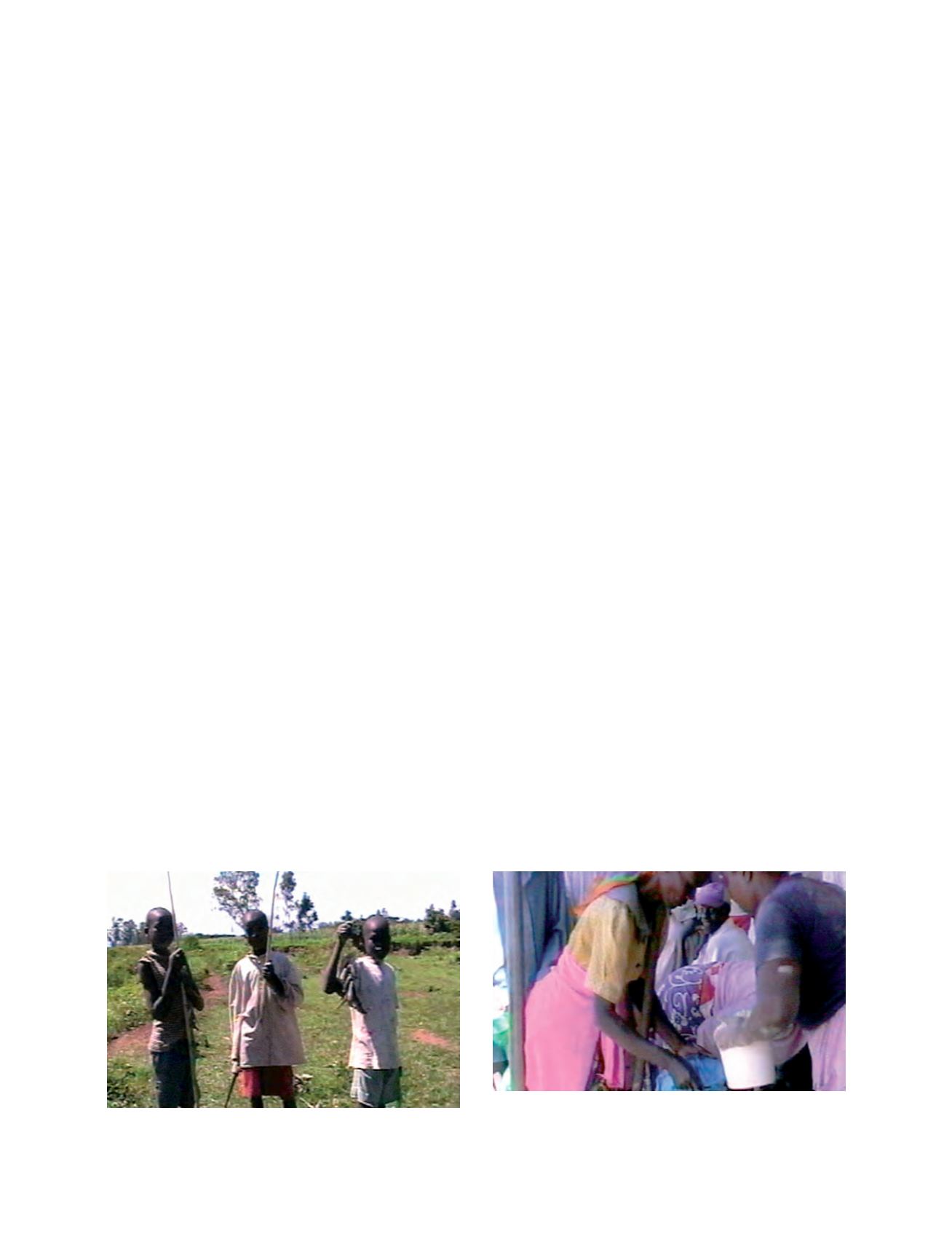
Children of Kogwedhi village in Nyando district carrying their fishing
rods and displaying fish caught from flood waters
Photo: Hellen Nyakundi
A woman in Ayweyo sub location, Nyando district, receiving her share of
maize after completing a day’s work (clearing trenches) in a food-for-
work initiative
Photo: Hellen Nyakundi