


 74 / 156

Resettlement is likely to stress both the resettled and host
communities – there is already intense competition for resources,
and this will intensify under the altered ecological conditions as
a result of the dam’s operation. Resettlement will also stress social
support networks which are constrained by the geographical
distance over which they are able to stretch. Thus, those indi-
viduals who are resettled may be moved away from their existing
sources of social support.
Effective resettlement schemes are known to be difficult to
achieve and there is a significant possibility that those displaced
by the project will find themselves worse off after resettlement
than they were before. As Scudder (2001) observes: “Within the
major dam building countries, I am aware of none, including the
United States, China and India, that can document that they have
been able even to restore the incomes of a majority of resettlers.”
8
Dam operation
The operation of the dam will also impact the 200,000 or so
people living downstream of the dam.
9
Currently this group is
not considered as directly affected by the dam and thus will not
receive any compensation.
The operation of the dam stands to significantly alter the exist-
ing flow-regime of the river. Currently the dam is being designed
to meet peak power demand in Gauteng, South Africa. This will
require the generation of twice-daily mini-floods which would
destroy the vegetable gardens currently located on the bed of the
degraded river channel. This would at worst destroy the funda-
mental dry-season livelihood strategy of those living downstream
of the dam, and at best have dramatic impacts on food (in)secu-
rity in the area. As well as the generation of mini-floods, the
reservoir will also impair the river’s ‘natural’ flooding regime,
which will have negative impacts on both commercial and artisan
fishing downstream. Further, flood risk will be exacerbated as
people’s flood memory is lost as a result of a more regulated river
flow – this will make the inevitable very large floods more cata-
strophic than they would have otherwise been.
10
The inundation of the reservoir also predisposes the area to the
generation of seismic activity via reservoir-triggered earthquakes
(RTE) and reservoir-induced sesimicity (RIS).
11
The lack of record-
ing of the general plate kinematics in the area,
12
and the
conservative manner in which the maximum credible earthquake
(MCE) has been estimated for the Estima Fault has generated
concern that the maximum design earthquake (MDE) for the
project could have been severely underestimated.
13
Research has shown quite clearly that sophisticated, local-level
risk-management systems have evolved in the bairro to cope with
the altered ecological conditions as a result of Cahorra Bassa.
They continue to evolve under the conditions of a changing
climate, and include social mechanisms which allow for the evolu-
tion of risk management strategies and which maintain social
order and regulate vital microeconomic systems. In addition, they
include traditional values which ensure that vulnerable groups
and individuals are able to access resources and social capital in
times of stress.
The Mphanda Nkuwa dam is likely to bring some benefit to
Mozambique in the form of foreign revenue, which could allevi-
ate balance-of-payments issues, and generate room for further
growth in large industry. The construction and subsequent oper-
ation of the Mphanda Nkuwa dam will at the same time act to
undermine many of the aforementioned local-level risk manage-
ment strategies. Such impacts will be felt as a result of:
• Rapid and dramatic alterations to the river’s ecology
• Stress on existing mechanisms for ensuring social control
• Erosion of traditional values through the rapid imposition of
modernizing influences.
As such, the benefits and risks associated with the construction
and operation of the dam are not evenly distributed, effectively
debunking cost-benefit arguments that fail to account for the
distribution of such costs and benefits.
Need for an effective medium
Much effort has been spent on mainstreaming disaster risk into
the developmental discourse. Despite this, applied research clearly
indicates that even in light of recommendations from such
reputable institutions as the WCD, risk as a holistic concept
continues to be excluded from the development-in-practice taking
place on the African continent. The risk fraternity continues to
seek out examples of best practice in implementing local risk
management activities, and while this is very useful, the need for
effective advocacy to implement applied community risk assess-
ment to planned large-scale developmental processes has in this
case remained largely untouched or ineffective.
Applied research has significant value on the African continent,
and schemes such as those provided by GGF and ProVention’s
Applied Grants Programme must be supported. However, risk
discourse is failing to engage sufficiently to halt large planned
developmental projects that could significantly undermine the
existing livelihood and risk management strategies being
employed at the local level.
In light of NEPAD’s approach to mega-projects and China’s
growing influence on the continent (with its express stance of
non-interference), issues of effective advocacy desperately need
addressing. As such, the growing numbers of people involved in
the field of risk management need to find an effective medium
and forum in which they can lend their voices to the develop-
mental dialogue. Without such action, even the best local-level
risk management practices are reduced to merely sticking plasters
across the gaping wounds of ‘development’.
[
] 74
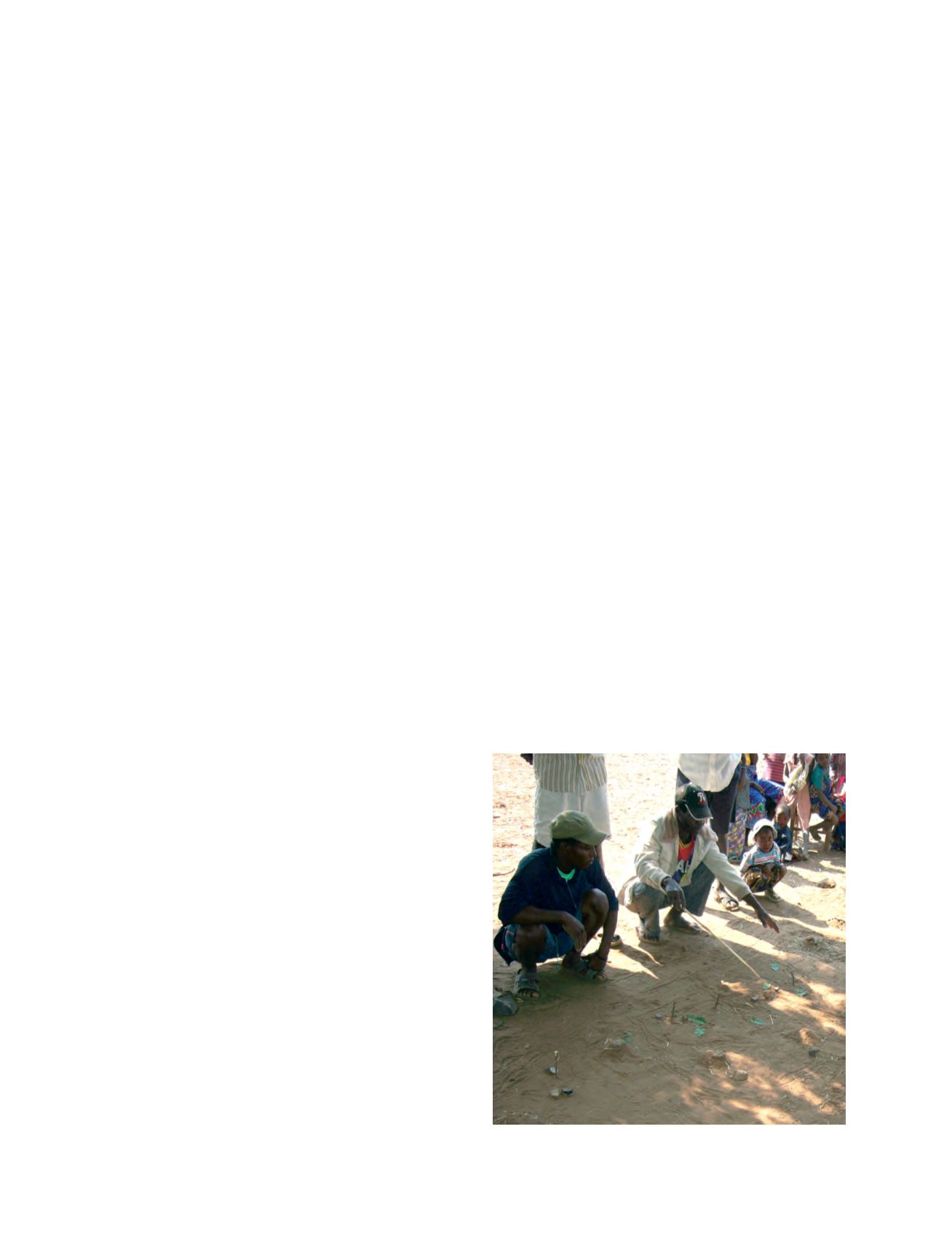
A community mapping exercise
Photo: James Morrissey, 2005