


 80 / 156

DRM cooperation agreement between the governments of South
Africa and Sweden in June 2005.
The agreement saw Sweden allowing South Africa the use of its
proven advanced DRM systems and processes, and the relevant train-
ing in their application. Key areas for future cooperation were
identified as information systems technology, education and training.
Subsequent to the agreement, the South African Government
and Saab GrIDS (based in Centurion, Gauteng) signed a contract
for the implementation of a national DRM system for South Africa.
The Swedish systems and processes are now being tailored and
introduced in the Eastern Cape, in close consultation with the
relevant local municipalities, and the personnel who will be apply-
ing them.
A total implementation strategy and a provincial framework have
been successfully developed and are now in place. Installation of
technical systems and provision of the appropriate technical and
bridging training have commenced. Once this is completed, atten-
tion will be focused on how to use the technology and
newly-acquired expertise to create risk reduction strategies and
contingency plans that comply with DRM requirements.
The pilot project will culminate in February 2007 in a complex,
integrated disaster management exercise, the planning directive
for which is already completed.
The Department of Provincial and Local Government (DPLG),
charged with converting the country’s Disaster Management Act
and Framework into reality, has arrived at the following conclusions:
• DRM must include a decentralized management and control
system, to directly involve the main support services such as
essential services, fire brigade, police, ambulance, water
affairs and public works
• Management and control centres need to be established on
national, provincial and municipal spheres
• Disaster management officials in municipal and provincial
spheres must be educated and trained to conduct basic risk
assessments for geographical areas for which they are respon-
sible. This includes hazard identification, vulnerability assess-
ment and risk definition
• Reliable communication links between all spheres of govern-
ment need to be established
• Risk reduction and contingency plans can then be developed
on realistic risk profiles.
Saab GrIDS and its specialist consultants in DRM were required
to ensure that the knowledge transfer and intellectual empower-
ment of South Africa was an integral component of the pilot
project in the Eastern Cape.
An integrated disaster management information system has
been developed and is nearing completion. A government-to-
government agreement between South Africa and Sweden was
entered into on 28 June 2005, addressing collaboration between
the two countries in the field of disaster management and
providing software tools, valued at ZAR28 million, free of charge.
These tools will be customized to suit South African conditions
and the source code will reside in South Africa. The agreement
also allows for the utilization of the tools through all organs of
state.
Challenges ahead
Across South African society, government bodies have gone
through a rigorous process of legislative reform, and are now into
the implementation phase. Reorientation, seamless engagement,
and a different style of collaboration are now required.
National systems for disaster management involve the active
participation of a wide range of stakeholders including govern-
ment, civil society, the private sector, media, the scientific
community, development sectors and the community, to name
a few. All these entities, at various levels, need to be actively
involved in the process as each has a unique role to play.
Because, in South Africa, disaster risk management is every-
one’s business.
[
] 80
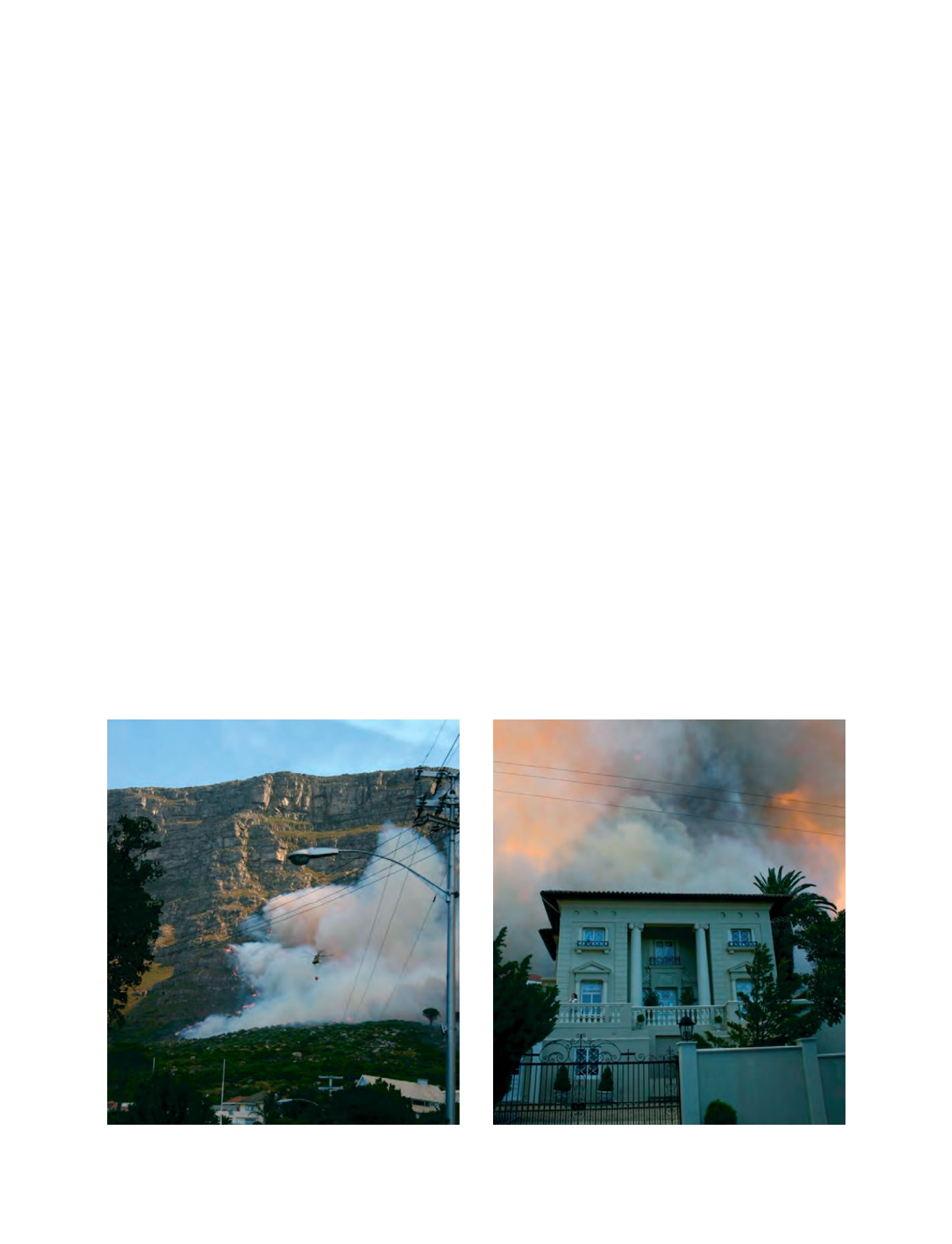
Runaway fires remain a serious concern
Photo: Johan Minnie, DMISA, 2006
Aerial fire fighting has been used to successfully combat mountain fires
Photo: Johan Minnie, DMISA, 2006