


 85 / 156

[
] 85
W
HILE TEACHING A
disaster risk communications class at
the Asian Disaster Preparedness Center in Thailand, a
group of public and private mitigation projects managers
from around the world shared stories of the challenges they faced
in their high risk communities. Repeatedly, they described cultural
roadblocks, successful and unsuccessful attempts to encourage the
implementation of innovative risk reduction approaches, and the
need for personalized, innovative approaches to communicate
natural hazard risks and promote unfamiliar mitigation techniques.
The class of experienced professionals told a universal story of how
high-risk communities differ dramatically in cultural values, atti-
tudes towards change, and the ability to listen, understand,
personalize and implement risk reduction messages.
Since the Indian Ocean earthquake and tsunami and Hurricane
Katrina’s devastation of New Orleans and surrounding communi-
ties, risk communicators and mitigation project managers have
begun to more clearly realize the critical roles played by culture,
psychology, spiritual traditions and individualized communication
approaches in the implementation of disaster reduction practices.
The two disasters have underscored the need to build a cultural
context for communities at risk and customize outreach campaigns
and risk communication messages rather than depending on a
prescribed ‘one size fits all’ approach. For the United States, the
devastation of New Orleans and the extensive loss of life among
the hardest to reach populations demonstrated this overlooked
need in one of the nation’s greatest natural disasters.
The need to embrace effective cross-cultural communication
increases as the informed debate on the role of risk reduction in
community development and socio-economic sustainability creates
new discourse, institutional practices and policies. Just as feminist
scholars are now more readily being listened to as they address key
concerns pertinent to the role of gender in risk reduction and disas-
ter recovery, so equal consideration should be given to addressing
a sustainable policy targeted at effective, cross-cultural communi-
cation practices combating discrimination and social exclusion.
A global communication challenge
Internationally, limited resources are directed towards public aware-
ness efforts and outreach campaigns in each stage of emergency
management – be it preparedness and mitigation, response, short-
term recovery, or in the long-term rebuilding of infrastructure,
economy and a return to quality of life. Yet risk communication
techniques significantly influence the success rate for implemen-
tation of disaster reduction practices and decision-making processes
in pre-disaster and post-disaster environments.
Men, women and children in Galle, Aceh, New Orleans and
other, more recently disaster-impacted areas such as Pakistan, now
struggle to understand and accept hazard mitigation strategies being
introduced in the rebuilding process. Impacted residents, business
owners and officials are being asked to utilize alternative building
construction techniques, relocate homes and change lifestyles; to
live in a different relationship to the land and the sea; and to imple-
ment controversial land use solutions. Communication strategists
assisting in implementing these risk reduction practices now have
an opportunity to increase the chance of success by embracing the
use of traditional and non-traditional techniques that penetrate the
psyche of the impacted community and build upon their psychol-
ogy, behaviours, beliefs and decision-making practices.
In New Orleans, the struggle for coherent, culturally appropriate
shared communication continues. In Sri Lanka, long-time warring
political factions, militant extremes, multiple spiritual traditions,
languages and traditions highlight the need for communication
outreach that reflects the divergent communities while at the same
time rebuilds a nation.
Cross-cultural communication theory
Over recent years I have used theoretical frameworks from the field
of cross-cultural communications to help craft risk communication
messages in Southeast Asia and the US. Two approaches in partic-
ular have been useful. K. Hagerman’s Iceberg of Communication
demonstrates how the tip of an iceberg – that which one sees above
the waterline – is what we readily see in another person, such as
ethnicity, clothing and music. Below the waterline, out of sight, are
Crafting cross-cultural risk
communication strategies
Suzanne L. Frew, Cross-cultural Risk Communications Consultant, The Frew Group
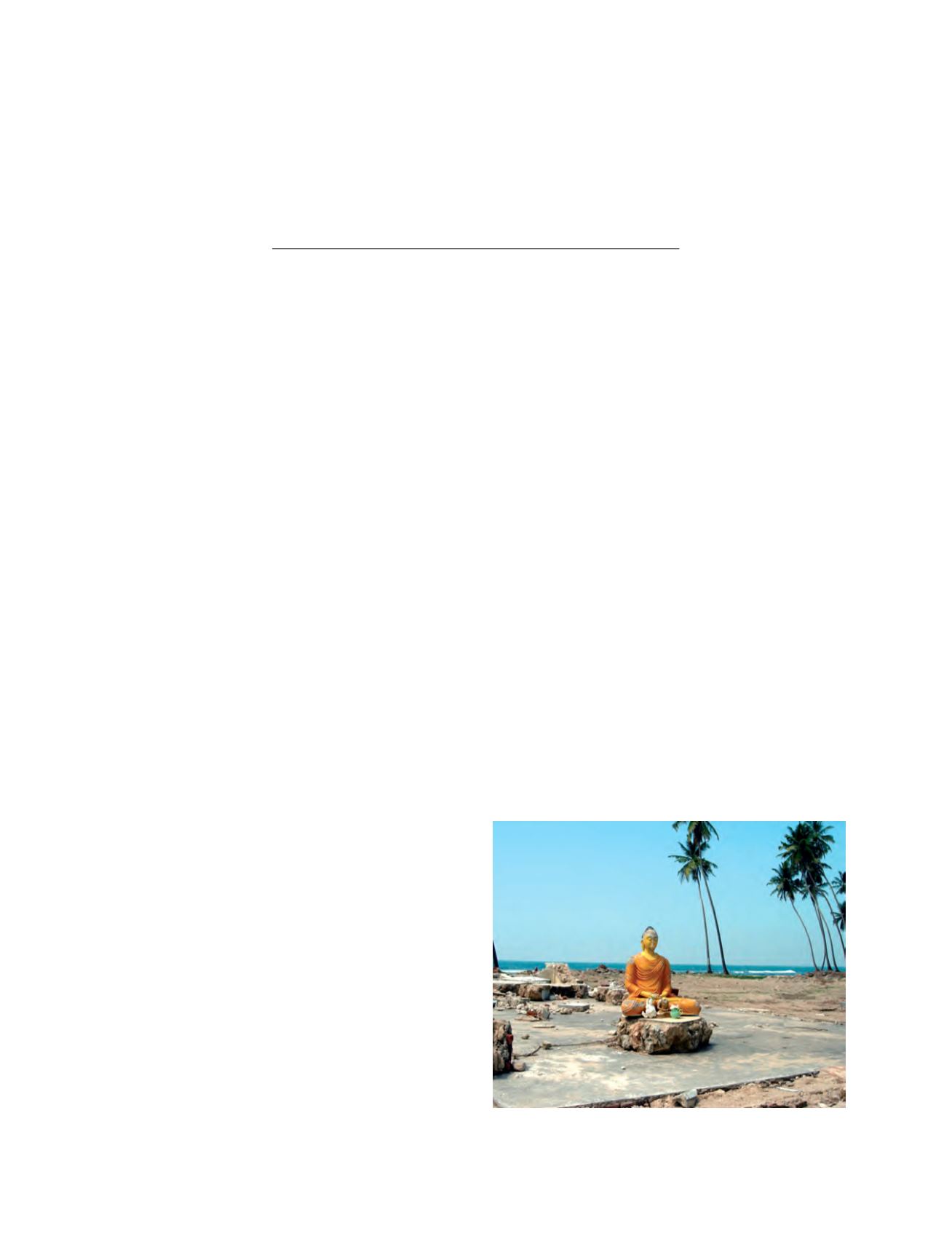
A makeshift home altar after the Indian Ocean tsunami reflects the
critical role of spiritual traditions to disaster recovery
Photo: Suzanne L. Frew, 2004